Key facts
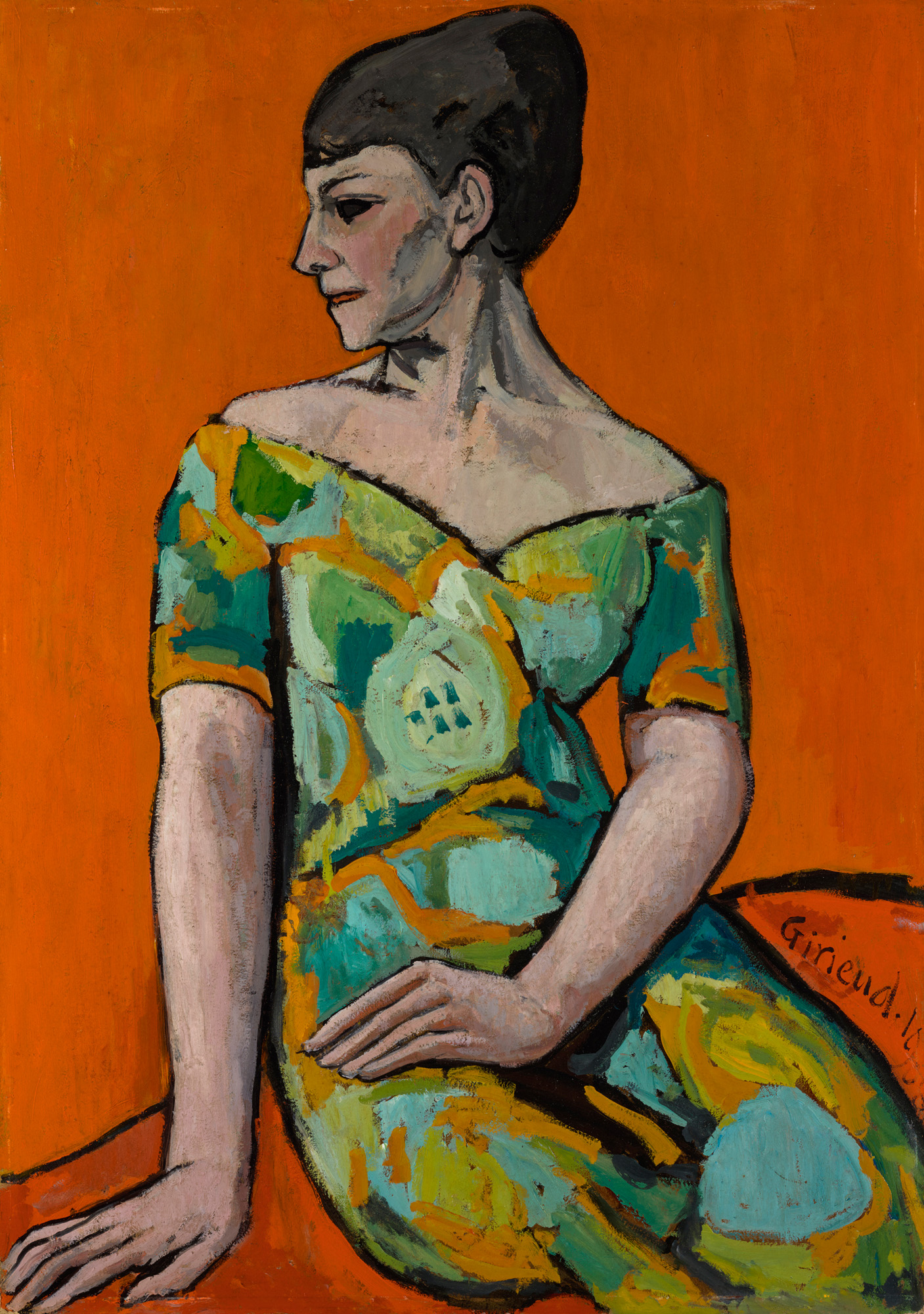
Portrait of the Painter Emilie Charmy was painted by Pierre Girieud in 1908, in oil on cardboard. The work shows painter Emilie Charmy in profile, against a monochrome orange ground characteristic of early twentieth-century Fauvist experimentation. Girieud, a lesser-known figure of the Parisian avant-garde, exhibited at the 1905 Salon d’Automne before drawing closer to Kandinsky and the Neue Künstlervereinigung München (NKVM), a circle that would prefigure German Expressionism. The painting is now held at the Städtische Galerie im Lenbachhaus in Munich, on permanent loan from the Gabriele Münter and Johannes Eichner Foundation. It bears witness both to French Fauvism and to the Franco-German artistic exchanges that preceded the First World War.
I first saw this painting at the exhibition “Berthe Weill, Art Dealer of the Avant-Garde” at the Musée de l’Orangerie in autumn 2025. It stood out among the surrounding works; one could hardly walk past it unnoticed. Its vivid colours, the flat monochrome orange background, the almost abstract treatment of the sitter’s sharp features, the head turned in profile: everything about it commands attention. It is a striking work, all the more so, to my mind, given Girieud’s ties to the NKVM, the Munich avant-garde circle animated in particular by Kandinsky. History has barely remembered Girieud’s name, yet this painting offers a way back into a little-known facet of that early twentieth-century avant-garde.
Look first at the black line that separates the profile from the orange ground. A bold stroke cuts Emilie Charmy’s face out of the flat colour behind her. The nose, the mouth, the ear: everything appears outlined, carved as if with a knife. Around her, the dress bursts into green, turquoise and yellow, chaotic and vivid, almost unruly against so contained a face. The skin, by contrast, stays grey and cool, as though washed by the surrounding orange light. One hand rests, fingers long and folded. The only moment of stillness in an otherwise tense composition.
What lies beneath the surface of this Portrait of the Painter Emilie Charmy
Beneath the vivid surface, Girieud sets up a tension between two pictorial languages. The face, outlined in black, remains graphic, close to pure drawing. The dress, by contrast, dissolves into broad patches, with little concern for exact pattern. Painted in oil on a piece of cardboard measuring 101.5 x 72 cm, the support itself is quick, almost workmanlike. Yet the paint remains thick, responsive to the pressure of the brush. The orange ground, uniform throughout, flattens any sense of depth. There is no setting, no interior: only a colour that pushes the body forward. This economy of means recalls Fauvist experimentation of 1905-1907. Yet it retains a stiffness, almost a coolness, foreign to Matisse or Derain. Girieud paints here less a setting than a confrontation between a figure and its colour. The signature, in cursive script in the lower right corner, anchors the canvas in the artist’s studio.
Pierre Girieud and his times
Pierre Girieud (1876-1948) moves through Fauvism without ever settling into it fully. Self-taught, and based in Montmartre from 1900, he exhibits at the 1905 Salon d’Automne. He later befriends Kandinsky and joins the Neue Künstlervereinigung München (NKVM). This Munich circle would, a few years on, give rise to Der Blaue Reiter. His name remains largely forgotten today, overshadowed by peers who went on to fame. Emilie Charmy meets a comparable fate. She had exhibited at the Salon des Indépendants as early as 1904, a year before Girieud. Discovered by the dealer Berthe Weill in 1905, she was praised by critics in her own time. Then long neglected by art history. This portrait brings together two parallel trajectories within the early twentieth-century avant-garde.
Museum update
The Kunstbau, the Lenbachhaus’s annexe exhibition space beneath Königsplatz, remains closed throughout 2026 for energy-efficiency renovations. The Lenbachhaus itself, where this portrait is held on permanent loan from the Gabriele Münter and Johannes Eichner Foundation, remains open to the public as usual.
Source: Lenbachhaus, lenbachhaus.de/besuchen/allgemeine-informationen
A question for you
Girieud built a bridge between French Fauvism and the emerging German Expressionist movement. How many other such go-betweens has art history simply erased?
About this work
- Portrait of the Painter Emilie Charmy
- Pierre Girieud
- 1908
- Oil on cardboard
- 101.5 x 72 cm
- Städtische Galerie im Lenbachhaus und Kunstbau, Munich, on permanent loan from the Gabriele Münter and Johannes Eichner Foundation
- https://www.lenbachhaus.de/en/digital/collection-online/detail/bildnis-der-malerin-emilie-charmy-30029717