Delft, 1654. Carel Fabritius immortalises a goldfinch chained to its feeding box. The bird is looking at you. And you cannot take your eyes off it.
A striking presence against a flood of light
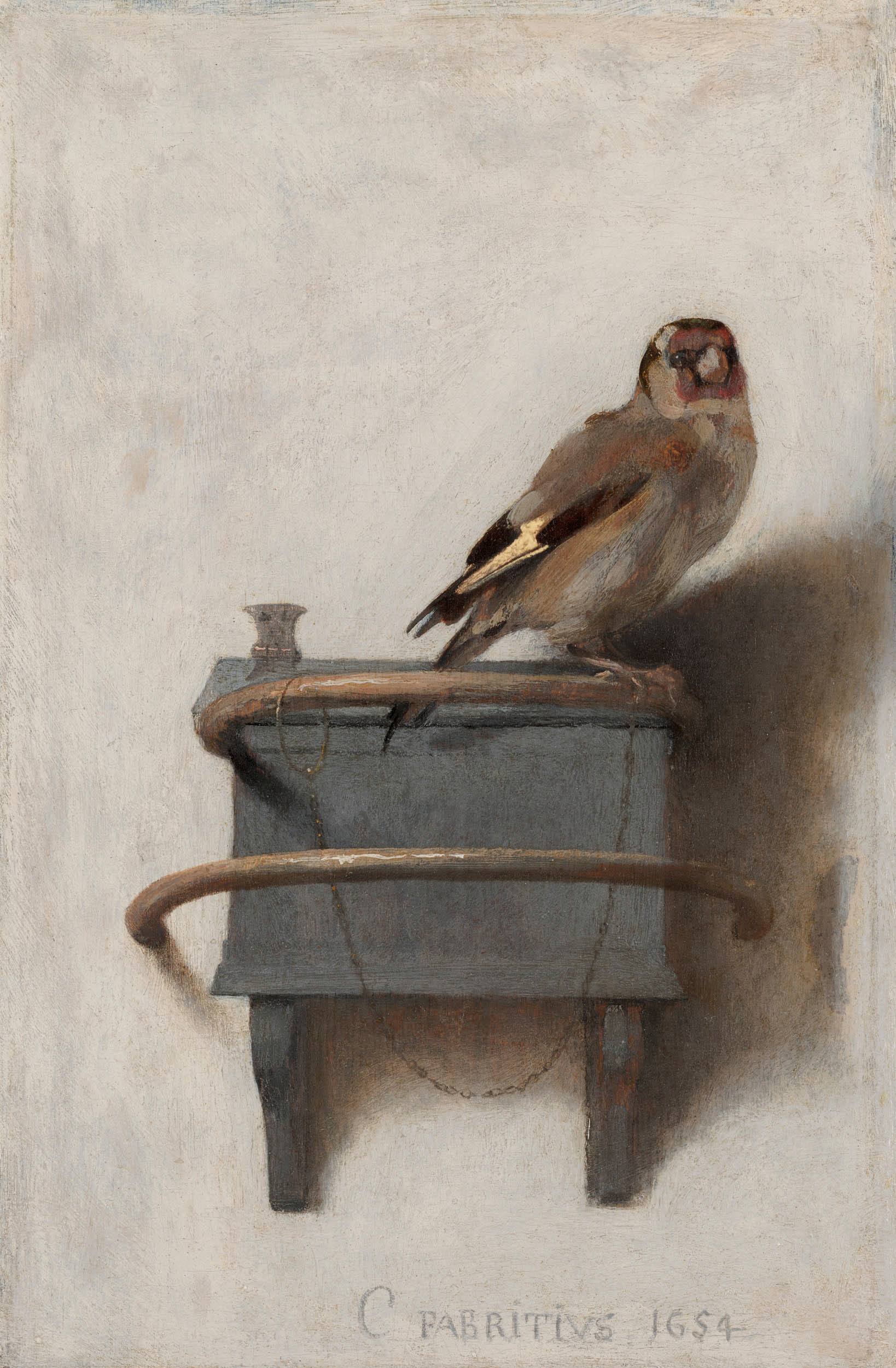
Against a whitewashed wall, a Carduelis carduelis perches with quiet dignity. Notice the flash of brilliant yellow on the black wing: a single brushstroke, and it is alive. Fabritius works in thick impasto, building layers of varying depth. The individual strokes remain visible. The red of the head, slightly faded by time, must once have blazed. A small chain tethers the bird to its grey-blue feeding box. This modest panel radiates a remarkable intensity.
A trompe-l’œil with many secrets
In the 17th century, goldfinches were prized pets. Their Dutch nickname, puttertje, comes from their knack for drawing water with a tiny bucket. Fabritius painted his bird on a panel cut from a much larger support, a detail that has long puzzled art historians. Was it a trompe-l’œil cage door? A shutter concealing a niche? A protective cover for another work? The slightly downward viewpoint suggests the painting was meant to be seen from below. At the Delft school, illusion was a serious discipline.
Fabritius, the brilliant missing link
A pupil of Rembrandt in Amsterdam around 1641, Carel Fabritius (1622–1654) broke free from his master to develop a lighter, more luminous style. In Delft, he foreshadowed the eye of Vermeer. His surviving œuvre numbers barely a dozen paintings: in 1654, the very year of The Goldfinch, he perished in the explosion of a gunpowder store that devastated the city.
A question for you
💭 Trompe-l’œil, cage door, or protective shutter: if this painting were in fact an everyday object, does that change the way you see it?
About this work
- The Goldfinch
- Carel Fabritius
- 1654
- Oil on panel
- 33.5 × 22.8 cm
- Mauritshuis, The Hague
- https://www.mauritshuis.nl/en/our-collection/artworks/605-the-goldfinch
A Survivor of the Delft Explosion
The Goldfinch is one of approximately twelve paintings that constitute Carel Fabritius’s (1622-1654) entire known body of work, and perhaps the most compelling of them all. The panel depicts a European goldfinch (Carduelis carduelis) chained by its leg to a grey-blue feeder fixed against a whitewashed wall. In the seventeenth-century Dutch Republic, goldfinches were prized pets, trained to draw water from a miniature bucket using a tiny chain, domestic ornaments that graced bourgeois interiors alongside parrots and starlings. Fabritius painted this goldfinch in the same year he died, at thirty-two, in the Delft gunpowder magazine explosion of October 12, 1654, the Delftse Donderslag, or “Delft Thunderclap”, a catastrophe that destroyed a quarter of the city and took with it almost the entirety of his painted output. That this small panel survived is something close to a miracle.
Rembrandt’s Technique in the Service of New Light
Trained in Rembrandt’s Amsterdam studio around 1641-1643, Fabritius developed in Delft an aesthetic radically different from his master’s: where Rembrandt works in shadows and deep browns, Fabritius explores clear light, whites, and pale blues. In The Goldfinch, the technical procedure is legible: the vivid yellow plumage is achieved by laying a yellow layer over a black underlayer and scratching the wet paint with the brush handle to reveal the dark beneath in places, a discreet virtuosity that creates a chromatic vibration no photograph can fully convey. The paint is applied in varying thicknesses that give body to the feathers and near-transparency to the wall. The slightly downward viewpoint suggests the panel was meant to be seen from below, lending credence to the hypothesis that it originally functioned as a trompe-l’oeil cage door or cupboard cover. In Delft, Fabritius is thought to have known the young Vermeer; the luminous, light-filled palette of white and blue that would define Vermeer’s mature work may owe something to this older colleague who died before his own career reached its full height.