Paris, 1889. Maurice Denis is 19 years old. In the ferment of nascent Symbolism, this devout young Catholic takes up his brush and lays down on panel a mystical vision of breathtaking audacity.
An Incandescent Cross
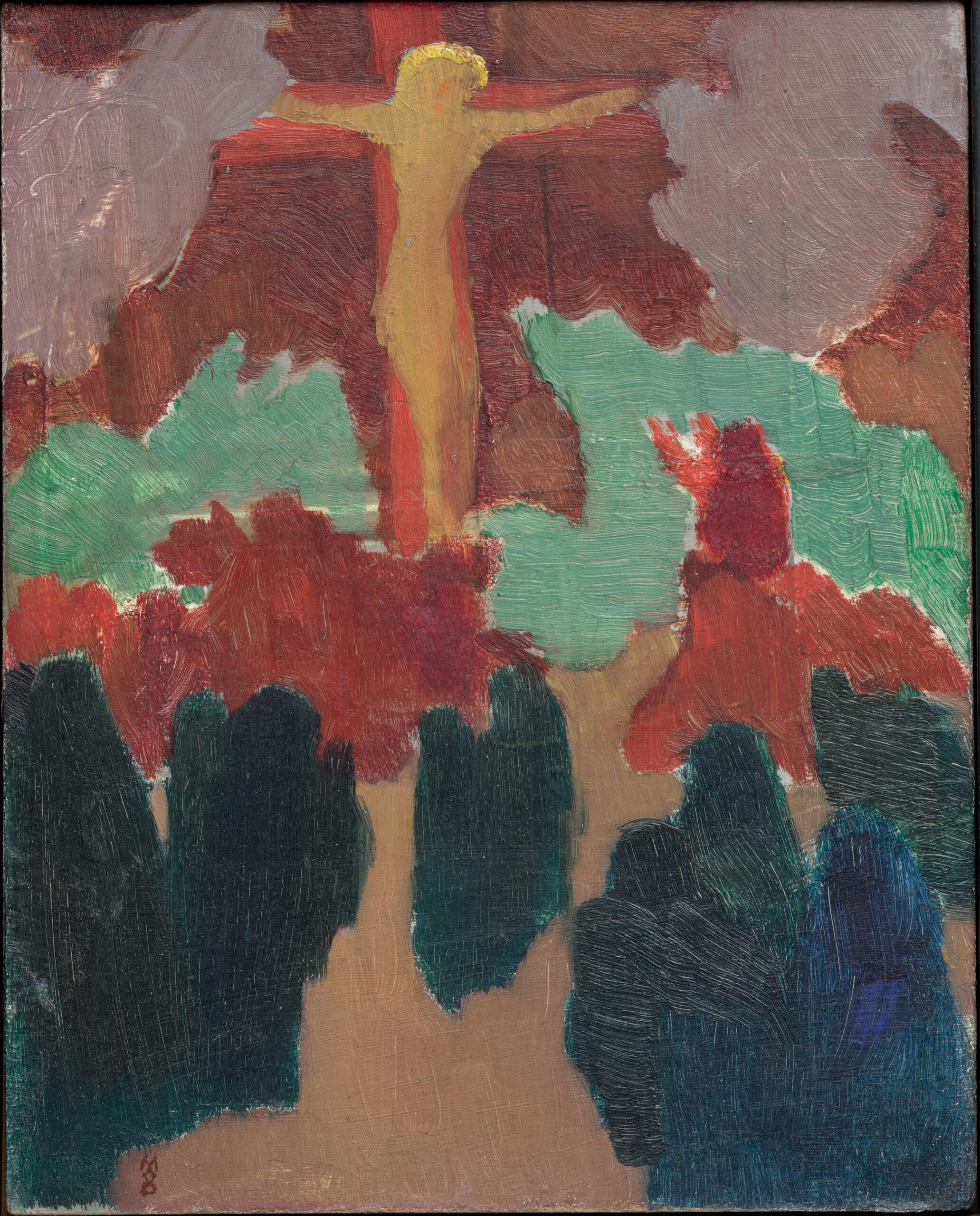
Look at this Christ. His orange body burns at the centre of the painting like a flame. The blood-red cross rises above a crowd of dark silhouettes, massed at the bottom, reduced to black, hunched shapes, nearly abstract. The sky explodes. Purple, red-brown, streaked with emerald green: Maurice Denis sweeps the panel with thick, restless, heavily loaded strokes. Pink angels surge through the clouds. The vivid yellow halo of Christ blazes outward. Here, painting does not describe, it strikes.
An Icon for the Modern World
In 1889, academic religious painting still dominated the Salons. Maurice Denis rejected that frozen inheritance. Influenced by Gauguin and Japanese woodblock prints, he would articulate as early as 1890 his celebrated formula: a painting is a flat surface covered with colours assembled in a certain order. This orange Christ is an early proof of that idea. Symbolic colour, simplified form, direct emotion: Denis invents here a new visual language, poised between spiritual fervour and the avant-garde. He sought what he called imperishable icons, images capable of touching the soul without resorting to realistic illusion.
The Painter of the Nabis
Maurice Denis (1870–1943) co-founded the Nabis group alongside Sérusier, Bonnard and Vuillard. Painter, theorist and decorator, he devoted his life’s work to reconciling modern art with Christian spirituality. This small panel already announces his entire trajectory.
A Question for You
💭 From the Italian Primitives to the Expressionists, every era has painted its own Christ. Which speaks to you more: the tortured body of Grünewald, or this orange flame by Denis?
About this work
- The Orange Christ
- Maurice Denis
- 1889
- Oil on panel
- 23.8 × 18.9 cm
- Cleveland Museum of Art
- https://www.clevelandart.org/art/2020.107
Color as an Act of Faith: Denis and Religious Symbolism
The Orange Christ is a work that Maurice Denis (Granville, 1870 – Saint-Germain-en-Laye, 1943) painted at nineteen, in the first flush of the discoveries that would shape his artistic vision. Christ is depicted in burning orange tones at the center of the composition, like a living flame, above a dark mass of simplified silhouettes. A blood-red cross rises in a sky of purple and rust-brown streaked with emerald green; pink angels emerge from the clouds, and an intense yellow halo radiates from the central figure. This canvas directly anticipates one of the most celebrated formulations in the history of modern art: Denis would later declare that before being a warhorse, a nude woman, or any anecdote, a painting is “essentially a flat surface covered with colors assembled in a certain order.”
Denis, the Nabis, and the Lesson of Gauguin
In 1889, the very year this panel was painted, Maurice Denis was drawn into the circle that would constitute itself as the Nabis group around the indirect teaching of Paul Gauguin, whose Synthetist painting, founded on flat areas of pure color and the rejection of traditional perspective, had been revealed to Sérusier at Pont-Aven. The Orange Christ bears the immediate mark of these discoveries: non-naturalistic colors, simplified silhouettes, the arabesque of the cross and the halo all contribute to an image that does not attempt to represent but to suggest, to evoke the spiritual dimension rather than to narrate it. The influence of Japanese prints, their flat areas, their bold outlines, their compositional daring, is also legible in the way Denis organizes his picture surface.
The Cleveland Museum of Art
The Cleveland Museum of Art acquired this panel in 2020, giving it a place in one of the great American encyclopedic collections where its historical importance can be fully appreciated. As one of the earliest and most concentrated expressions of the aesthetic position that Denis would spend the rest of his long career elaborating, the reconciliation of avant-garde formal means with a sincerely held Catholic faith, this small panel carries an outsized significance in the history of modern religious art.