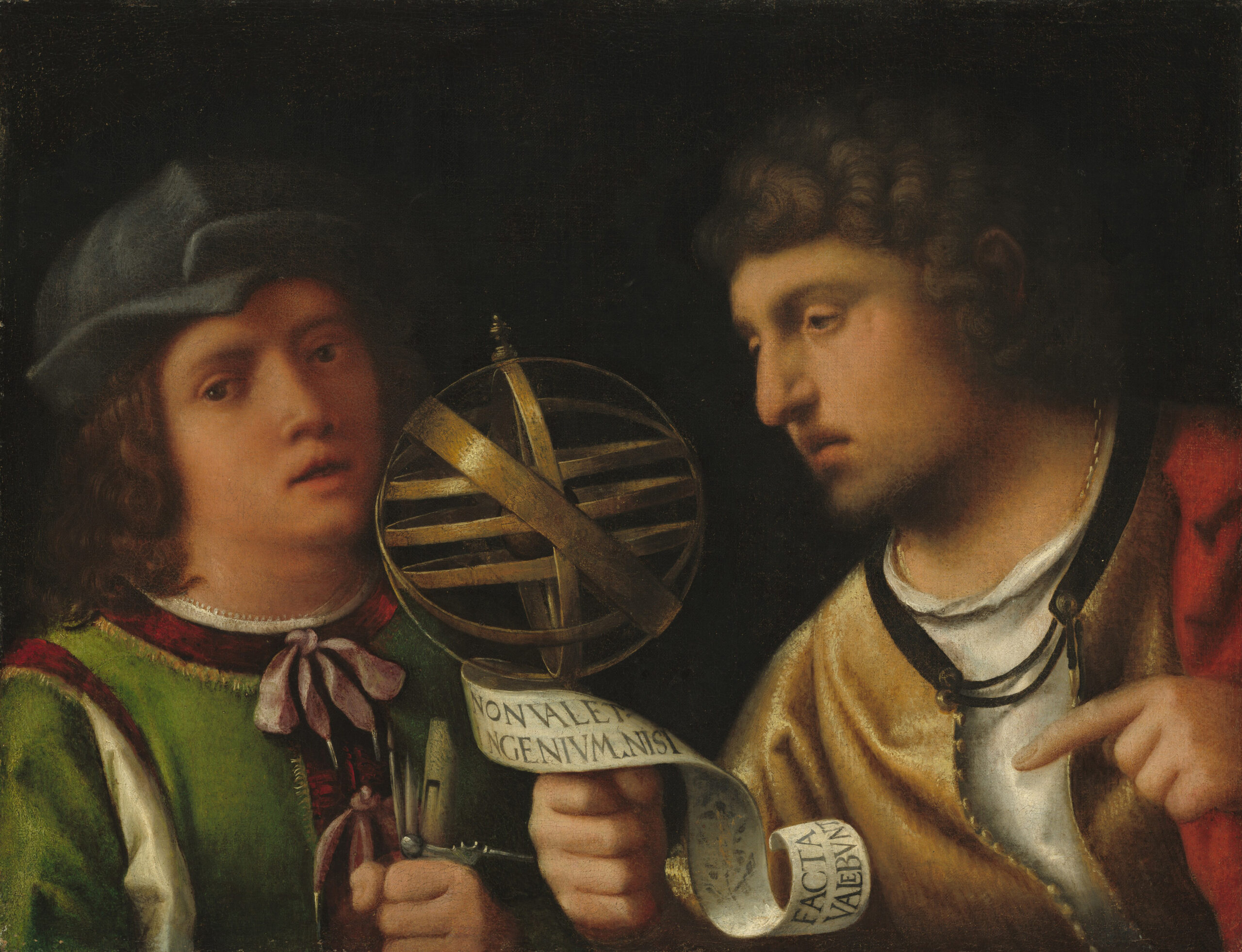
Venice, c. 1510. A tutor holds an armillary sphere and teaches. A scroll wound around the instrument bears a Latin motto: “Non valet ingenium, nisi facta valebunt.” Talent is worth nothing without deeds. Everything is said.
A lesson suspended in light
On the left, Giovanni Borgherini. His dark curls spill beneath a steel-blue beret. His emerald green tunic trimmed with ruby red cuts sharply against the darkness. His lips slightly parted, his dark eyes fix on the viewer. In his left hand: a brush, a quill, a compass, a flute. The liberal arts, condensed. On the right, his tutor leans toward him, seen in profile. His golden ochre tunic catches the light with quiet warmth. The brass armillary sphere gleams between the two figures. The composition creates a magnetic tension between master and pupil.
Humanist education in Renaissance Venice
Giorgione embodies the pedagogical ideal of the Italian Renaissance. The armillary sphere, an astronomical instrument, symbolizes knowledge of the cosmos. The objects held by young Borgherini represent the disciplines of the liberal arts. In the early 16th century, Venice was a vibrant intellectual hub. Patrician families commissioned educational portraits to assert their status and humanist values. The Latin inscription rings out like a lifelong creed: intelligence must prove itself through action.
Giorgione, master of Venetian sfumato
Giorgione (c. 1477–1510) revolutionized Venetian painting. He invented a poetic atmosphere grounded in luminous gradations and psychological mystery.
A question for you
💭 Compare this gaze directed at the viewer with portraits by Titian or Raphael: is it the same way of inhabiting the canvas?
About this work
- Giovanni Borgherini and His Tutor
- attributed to Giorgione
- c. 1510
- oil on canvas
- 47 × 60.7 cm
- National Gallery of Art, Washington
- https://www.nga.gov/artworks/54757-giovanni-borgherini-and-his-tutor