Venice, c. 1743. The sun rises over the Grand Canal. Bernardo Bellotto sets up his easel and captures the city in all its morning splendour.
Light as Revealer
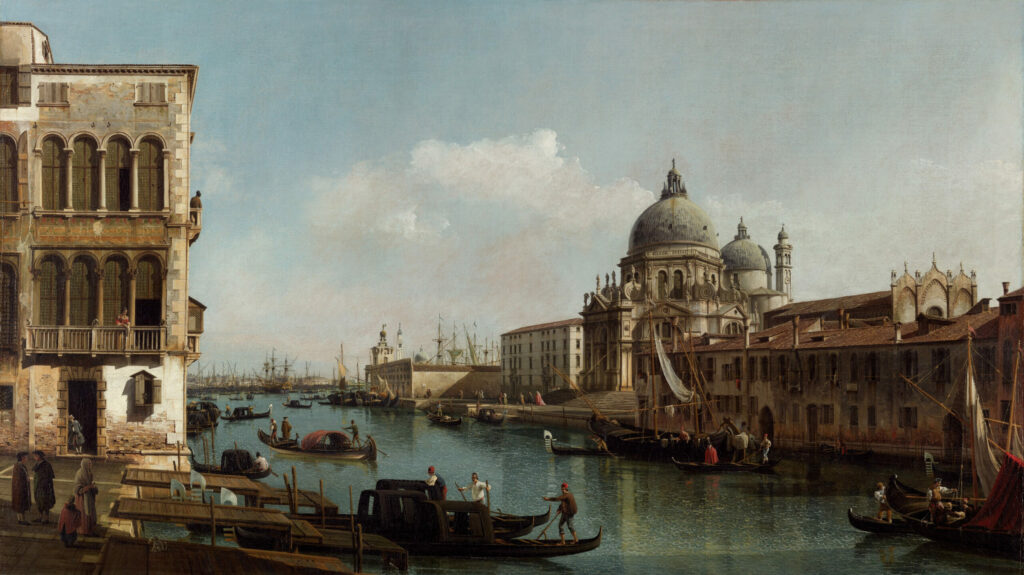
The raking light from the east strikes the Palazzo Pisani-Gritti, revealing every arched window, every worn stone. To the left, a small Venetian devotional box hangs on the wall, discreet, intimate. Look at the canal: its grey-green waters reflect the Baroque dome of Santa Maria della Salute. The Dogana and its gleaming copper globe shimmer at the centre. Gondolas glide and cut through the water. Bellotto paints in oil on canvas with near-photographic precision, playing on contrasts of light and shadow to sculpt space.
A Veduta for Grand Tour Travellers
Why does this painting exist? To appeal to European aristocrats on their initiatory journey through Italy. The Grand Tour was by then an institution, and Venice its unmissable highlight. These vedute, topographical urban views, served as prestigious souvenirs. Bellotto and his uncle Canaletto fed this flourishing market. To acquire such a canvas was to assert one’s cultural refinement. The Venetian society depicted here, merchants, gondoliers, onlookers, is no mere backdrop. This is Venice alive: commercial, devout, on the eve of the Serenissima’s decline.
Bernardo Bellotto
Bernardo Bellotto (1721–1780), nephew and pupil of Canaletto, had mastered the veduta by his twenties with unrivalled architectural rigour. His cool, almost geometric eye sets him apart from his uncle. This painting illustrates his talent at its peak.
Think about it
💭 If you could step into a gondola and cross this canal frozen in paint, toward which shore would you head?
About this work
- View of the Grand Canal: Santa Maria della Salute and the Dogana from Campo Santa Maria Zobenigo
- Bernardo Bellotto
- c. 1743
- Oil on canvas
- 139.1 × 236.9 cm
- J. Paul Getty Museum, Los Angeles
- https://www.getty.edu/art/collection/object/103RJP
Bellotto and the Veduta: Topography and Light
View of the Grand Canal: Santa Maria della Salute and the Dogana from Campo Santa Maria Zobenigo is one of the largest vedute painted by Bernardo Bellotto (Venice, 1721 – Warsaw, 1780) at the precise moment when the young artist was asserting himself in the shadow of his uncle and master Canaletto. The veduta, the urban topographic view with documentary aspirations, was an essentially Venetian genre that flourished in the eighteenth century, driven by demand from Grand Tour travellers who wanted accurate images of the cities they had visited. Bellotto brings to the genre a more systematic geometric rigour than Canaletto: where his uncle prioritises atmospheric effect and luminous vibration, Bellotto insists on architectural articulation, every cornice, every arched window, every quoin is rendered with a precision that pulls the painting toward architecture and topographic printmaking.
The Salute, the Dogana, and the Symbol of Venice
The viewpoint chosen, Campo Santa Maria Zobenigo on the left bank of the Grand Canal, offers one of Venice’s most emblematic prospects: opposite stands the Baroque facade of Santa Maria della Salute (begun by Baldassare Longhena in 1631, consecrated in 1687), and to its right the point of the Dogana da Mar with its golden weathervane of Fortune balanced on a bronze sphere. This architectural pair has been the visual symbol of Venice as seen from the Grand Canal since the seventeenth century. Bellotto illuminates it with a raking morning light that sculpts volumes and casts long shadows across facades, giving the scene atmospheric density while preserving the architectural legibility that is his trademark.
From Venice to the Courts of Europe
Painted in 1743, this canvas dates from a pivotal moment: Bellotto left Venice in 1747 for a peripatetic career that took him to Turin, Dresden (where Augustus III, Elector of Saxony, made him court painter), Vienna, Munich, and finally Warsaw, where he spent the last nineteen years of his life in the service of King Stanislas Augustus Poniatowski. The Warsaw vedute he produced in the 1770s, of such extraordinary topographic precision that they served as reference documents for the reconstruction of the Polish capital after the Second World War, are the logical continuation of the documentary rigour already legible in this early Venetian view. The painting is now at the Getty Museum in Los Angeles.