Saint-Rémy-de-Provence, May 1889. Vincent van Gogh passes through the gates of the Saint-Paul-de-Mausole asylum. He is not fleeing. He chooses. And from the very first week, he steps into the garden, sets up his easel, and paints.
A forest of blue velvet
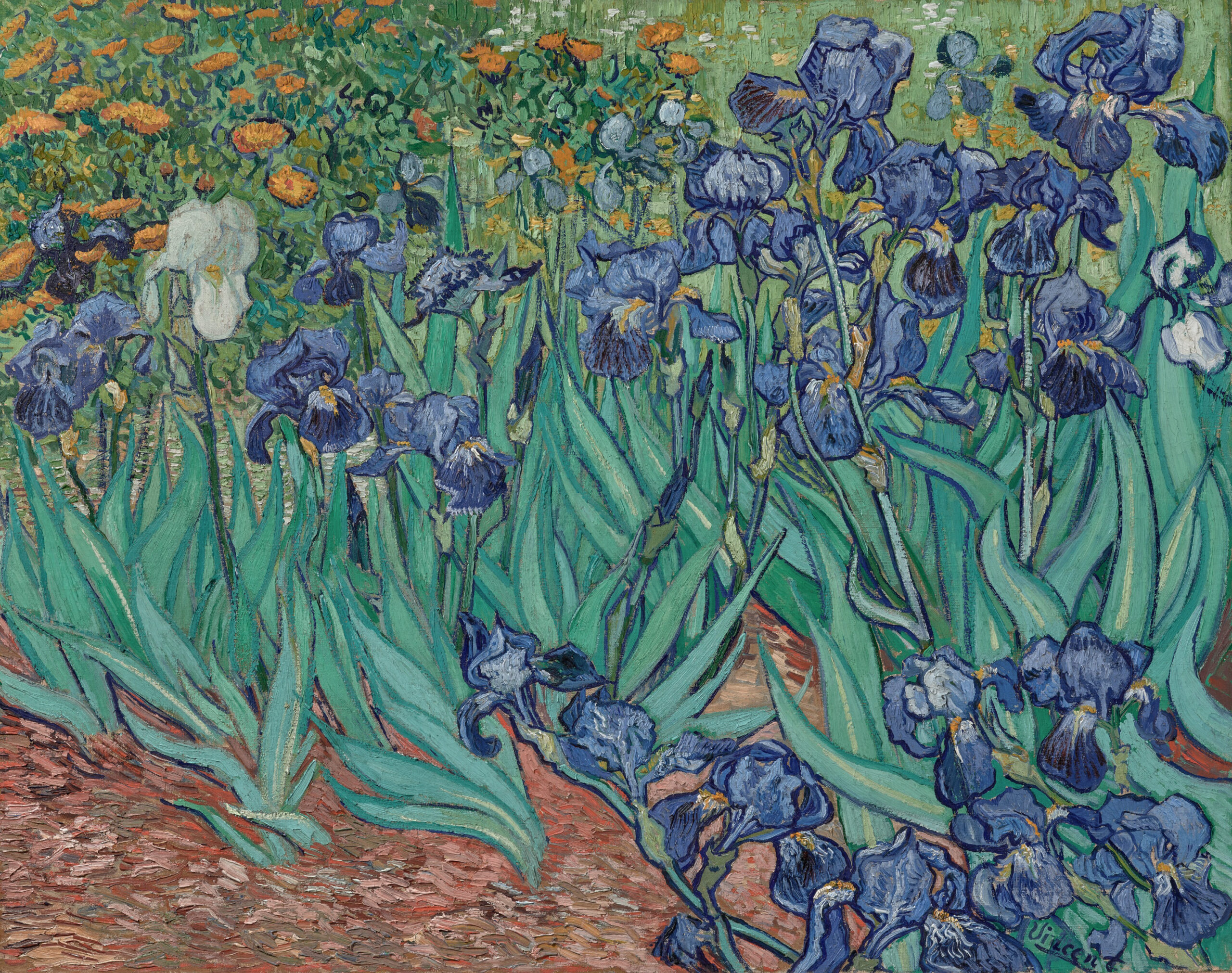
Irises take over the canvas. They spill over, push upward, curve and bend. Van Gogh outlines them in undulating lines, almost alive. Every flower is unique — none resembles its neighbour. The blue-violet petals vibrate against the intense greens of the stems. At ground level, a pink and ochre earth anchors the composition. In the upper left, a single white iris stands apart, solitary. The brushwork is thick, nervous, sculpted directly onto the canvas. No preparatory drawing. Van Gogh observes, seizes, translates.
A study that became a masterpiece
Van Gogh himself regards this canvas as a simple study. Yet his brother Theo submits it to the Salon des Indépendants as early as September 1889. The reaction is immediate: it draws the eye from across the room. The cropped composition, the flat planes of bold colour, the decorative forms — all betray the influence of the Japanese prints Van Gogh collects with such passion. The critic Octave Mirbeau, the painting’s first owner, would write that Van Gogh had understood the exquisite nature of flowers with rare insight. At the height of Post-Impressionism, this oil on canvas asserts itself as a foundational work.
Vincent van Gogh
Vincent van Gogh (1853–1890) was Dutch, self-taught, and impossible to classify. In ten years of work, he produced more than 900 paintings. His style — pure colour, expressive brushstroke — transformed Western art and paved the way for Expressionism.
Think about it
💭 Mirbeau bought Irises in 1891, a year after Van Gogh’s death, for 300 francs. Today, the painting would be worth tens of millions. What drives a person to recognise a genius the world has not yet seen?
About this work
- Irises
- Vincent van Gogh
- 1889
- Oil on canvas
- 74.3 × 94.3 cm
- The J. Paul Getty Museum, Los Angeles
- https://www.getty.edu/art/collection/object/103JNH