England, winter 1620–1621. A young Flemish painter slips into the skin of an aristocrat. He poses, studies himself, decides what posterity will remember of him.
A gaze that holds, hands that speak
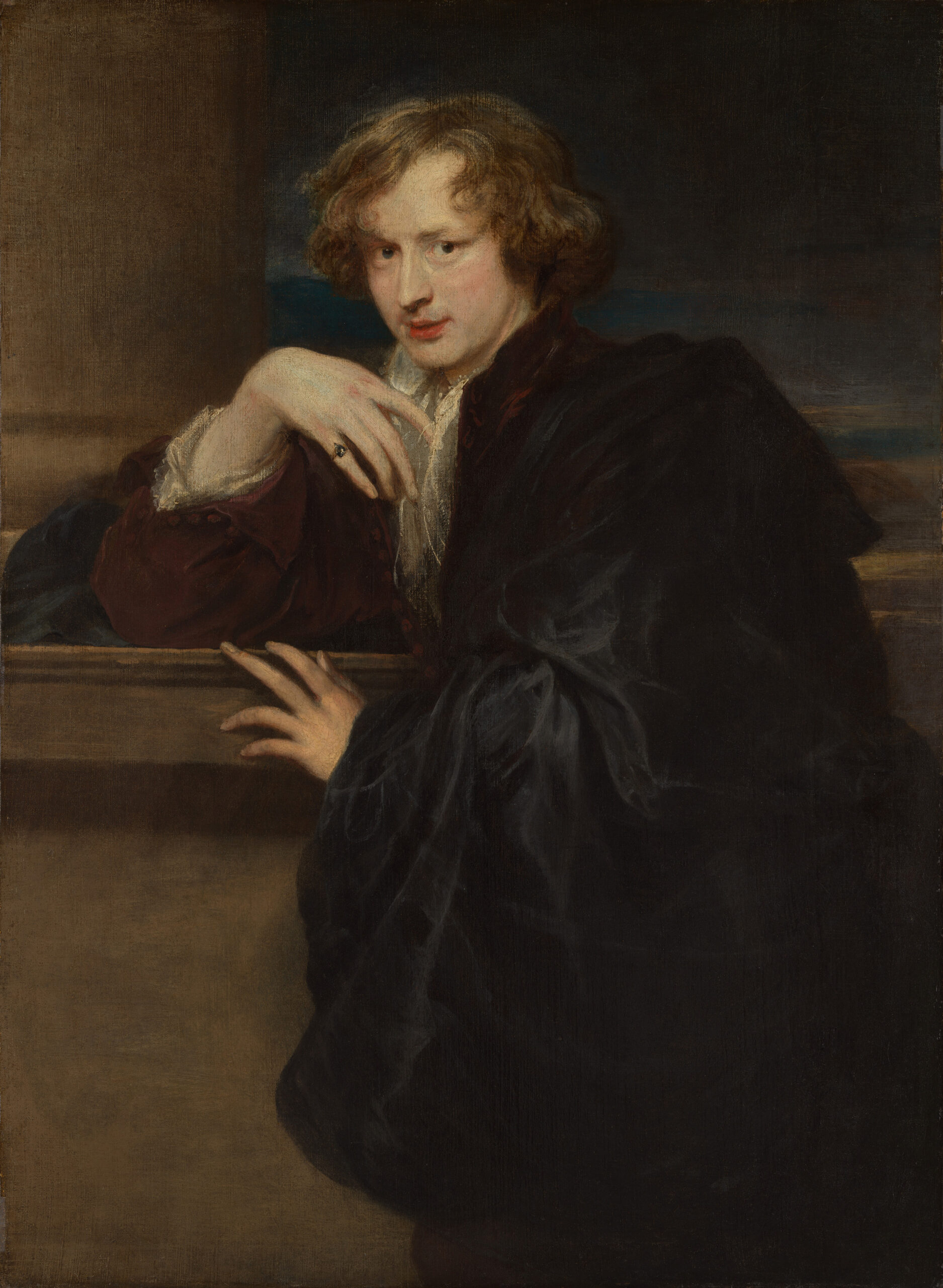
The right hand rests, nonchalant, on a stone ledge. The other rises toward his chin with studied elegance. No palette, no brush. Van Dyck frees himself from the painter’s attributes. He chooses burgundy velvet, a dark cloak with pearlescent sheen, a white ruffled shirt. Light caresses his face with softness. The background dissolves into an atmospheric blue-grey. The touch is fluid, sumptuous. The gaze, slightly averted, meets the viewer with quiet self-assurance.
A self-portrait as social manifesto
A painter who refuses to be “merely” a painter. In 1620, Van Dyck is visiting the English court. It is a revelation. Flemish artists move alongside the nobility, negotiating their social standing. Van Dyck watches, absorbs, and internalizes these codes. This self-portrait is a declaration: he presents himself as a gentleman, not a craftsman. This posture anticipates his entire career. Before long, his refined manners and luxurious dress will inspire as much admiration as envy among his Italian peers.
Anthony van Dyck
Born in Antwerp and trained in Rubens’s studio, Van Dyck (1599–1641) rapidly became one of the most sought-after portraitists in Europe. His Baroque style combines subtle psychological insight with technical virtuosity. He redefined the art of the official portrait for an entire century.
A question for you
💭 By erasing palette and brushes, Van Dyck breaks with a well-established tradition. Dürer, Titian, Gentileschi all asserted their craft before the mirror. He chooses the aristocrat. What does this choice tell us about the place of the artist in 17th-century society?
About this work
- Self-Portrait
- Anthony van Dyck
- c. 1620–1621
- Oil on canvas
- 119.7 × 87.9 cm
- The Metropolitan Museum of Art (MET), New York
- https://www.metmuseum.org/art/collection/search/436258
A Social Manifesto Painted at Twenty-One
Self-Portrait is one of the most ambitious self-portraits a young painter has ever executed. Anthony van Dyck (1599-1641) was not yet twenty-two when he painted it, most likely during his first stay in England in 1620 at the court of King James I. He chose to represent himself without any of the traditional attributes of the painter, neither palette, brushes, nor mahlstick, dressed in burgundy velvet and a dark cloak with pearlescent reflections, his right hand resting nonchalantly on a stone ledge, the other near his chin in the pose of a thinking gentleman. This choice is a declaration: Van Dyck intends to be seen as a courtier, a cultivated mind, not as a craftsman, however gifted. The slightly angled gaze that meets the viewer’s with quiet confidence completes the construction of this gentleman-artist persona.
From Rubens’s Studio to the Courts of Kings
Van Dyck’s trajectory up to this self-portrait was already exceptional. Entering Rubens’s Antwerp studio around 1617-1618, he became its chief assistant at nineteen, at the time when Rubens himself described him as “the best of my pupils.” His formation with the Antwerp master immersed him in the world of great aristocratic commissions and taught him that the court painter is not a servant but an interlocutor. After this first English stay, Van Dyck departed for Italy in late 1621, where he spent six years, notably in Genoa, where patrician families commissioned from him monumental portraits that defined his mature style, before returning permanently to England in 1632, where Charles I knighted him and granted him an annual salary of £200 as “principalle Paynter in ordinary to their majesties.”
Vaporous Brushwork as Aristocratic Signature
What strikes in this self-portrait is the mastery of a soft, atmospheric light, grey blues that dissolve contours, ivory and burgundy tones that vibrate gently, very different from the dramatic chiaroscuro of Peter Paul Rubens or Caravaggio. Van Dyck develops here a vaporous, almost diaphanous touch that would be his signature throughout his career and would influence Gainsborough, Reynolds, and Lawrence in the tradition of English portraiture. This elegance of handling is inseparable from the social elegance he claims: to paint this way is to be this way.