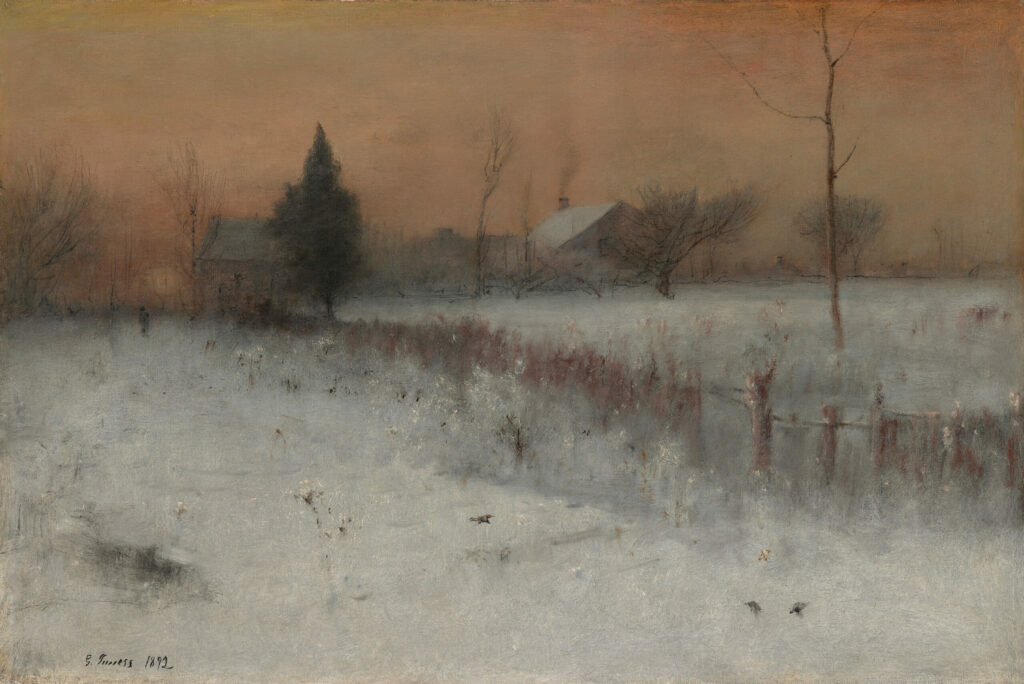
Montclair, New Jersey, winter 1892. George Inness rarely goes out. He observes. From his property, he contemplates the snow erasing the contours of the world. He decides to paint not what he sees, but what he feels.
A Fading Light
The sky burns with a muted orange. The snow in the foreground absorbs every last trace of light. Tufts of russet grass pierce the white. A wooden fence dissolves into the cold mist. On the horizon, two houses are barely discernible. Inness works in thin, layered glazes. Contours dissolve. The touch is vaporous, almost immaterial. Look: no detail holds the eye for long. Everything slides toward silence.
The Painter of the American Twilight
In the 1880s and 1890s, Tonalism emerged in the United States. This movement rejected anecdote in favour of pure atmosphere. Inness was its central figure. In Montclair, he returned again and again to the same motifs: his house, his trees, his winters. His son would write of this canvas that one is seized by a feeling of grandeur and majesty, and by a deep conviction of truth and nature. A work without artifice, born of a profound intimacy with the natural world.
George Inness
George Inness (1825–1894) began his career in the grand tradition of the Hudson River School, with its sweeping American panoramas. Then Barbizon transformed him. He abandoned spectacle for intimacy. Deeply marked by Swedenborgian philosophy — which sees in nature a reflection of the divine — he developed a unique pictorial language: forms that recede, lights that vibrate, a matter that is almost immaterial.
Think about it
💭 American Tonalism and European Impressionism emerged almost simultaneously: two ways of dissolving reality. Which speaks to you more deeply?
About this work
- The Home at Montclair
- George Inness
- 1892
- Oil on canvas
- 76.5 × 114.3 cm
- Clark Art Institute, Williamstown (ref. 1955.10)
- https://www.clarkart.edu/ArtPiece/Detail/Home-at-Montclair