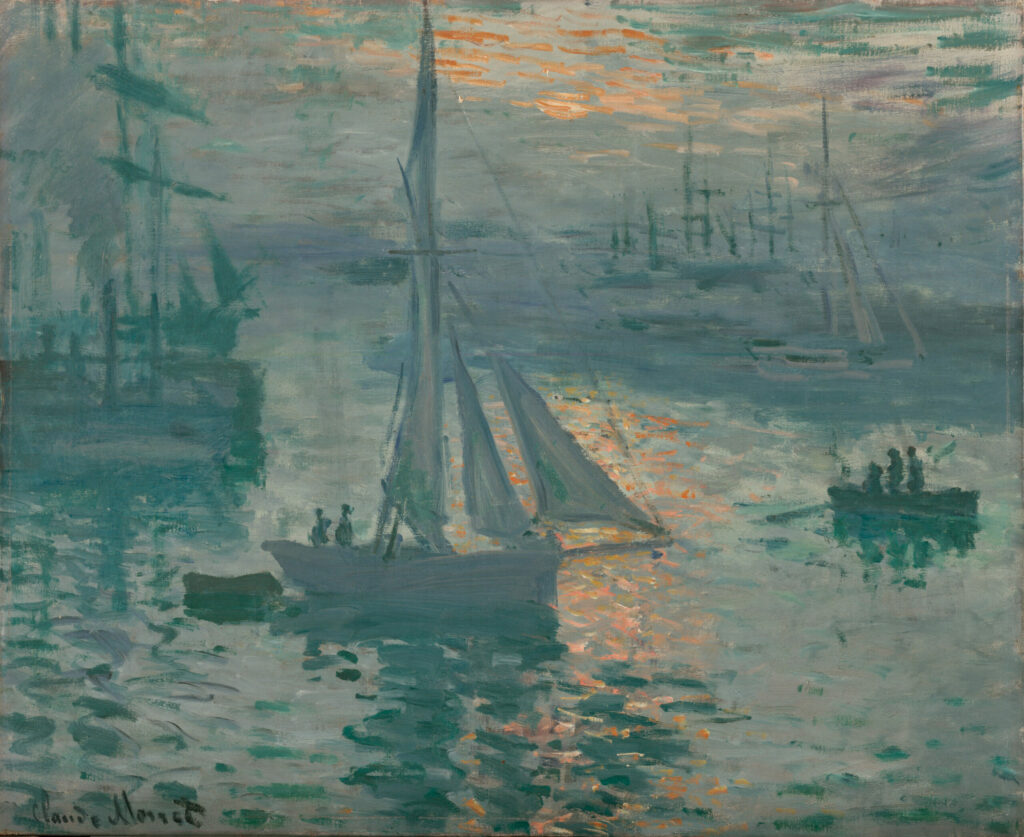
Le Havre, spring 1873. Claude Monet sets up his easel facing the still-sleeping industrial port. The sun breaks through the horizon. The artist must capture this fleeting moment when light transforms everything.
A Symphony of Light on Water
An orange light sets ablaze the sky and water of the Norman port. Monet lays down rapid, almost brutal strokes. The sun reflects in a luminous trail that dances on the waves. Iridescent blue-greens mingle with orange flashes. To the left, ships spew their smoke into the humid air. Their silhouettes dissolve in the morning mist. The brushstrokes remain visible, spontaneous. The oil paint is applied in nervous touches. Monet does not seek detail. He wants pure impression, the instant seized before it escapes.
The Dawn of a New France
France is healing its wounds after the Franco-Prussian War. This sunrise could symbolize the rebirth of a wounded country. Monet paints outdoors, a method still controversial at the time. This canvas dialogues with his famous Impression, Sunrise at the Marmottan Museum, painted the same year. The two works establish the Impressionist movement. Monet revolutionizes painting by abandoning academic rules. He prefers immediate sensation to meticulous rendering. The Getty Museum preserves here a precious testimony to this major artistic rupture.
Claude Monet, Pioneer of Impressionism
Claude Monet (1840-1926) revolutionizes 19th-century art. He devotes his life to studying variations of light on a single motif. His series of cathedrals, haystacks, and water lilies testify to this. This Le Havre seascape already announces all his future obsessions.
Think about it
💭 And you, can you see, beyond the mist, this new day breaking?
About This Work
- Sunrise (Marine)
- Claude Monet
- 1872-1873
- Oil on canvas
- 50.2 × 61 cm (19 3/4 × 24 in.)
- The J. Paul Getty Museum, Los Angeles
- https://www.getty.edu/art/collection/object/103QT7