In this delicate composition, Paul Sérusier transports us to a bucolic landscape bathed in vaporous light.
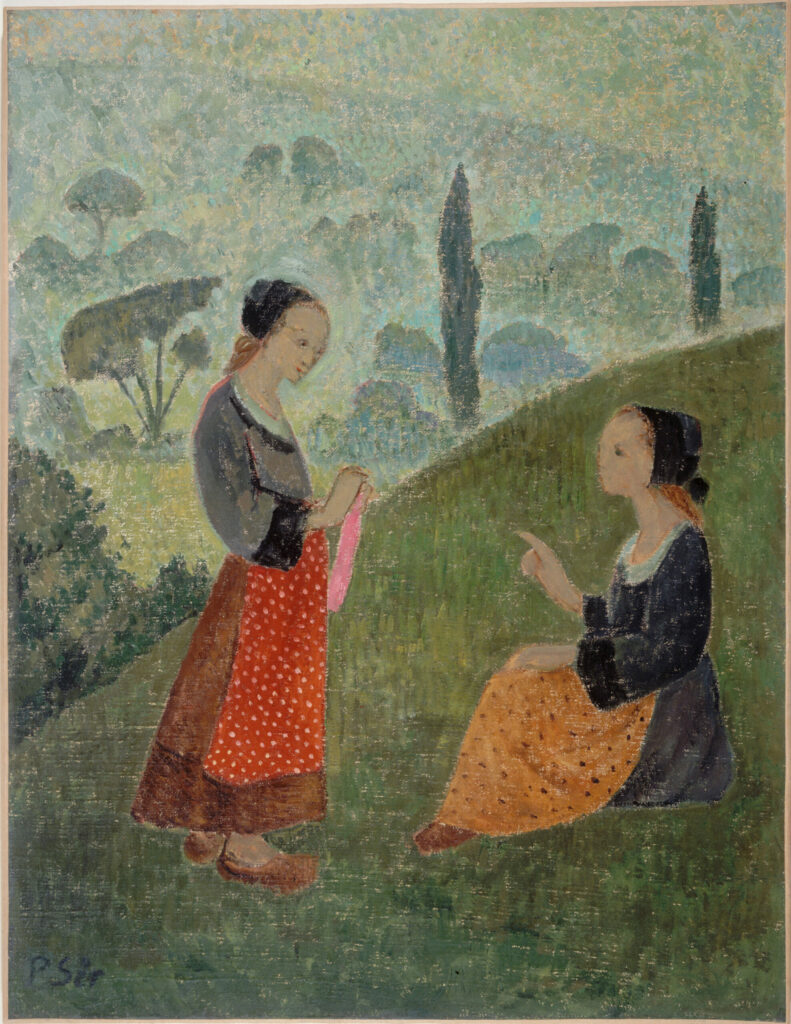
Two young Breton women converse on a verdant hillside, embodying the simplicity and harmony of rural life. One stands, handling a pink cloth, while the other sits engaged in conversation, her ochre skirt contrasting with the omnipresent green. The slender silhouettes of cypress trees and the gentle undulation of hills create an almost dreamlike background, enveloped in characteristic bluish mist. The muted palette, punctuated by vivid accents such as the dotted red of the skirt and warm orange, reveals the influence of Synthetism. Here Sérusier transcends mere representation to achieve a poetic, almost mystical vision of the Brittany he so cherished.
Further Information
- Morning Mists by Paul Sérusier, between 1907 and 1909
- 65.3 × 50.5 cm
- Paris Musées, Petit Palais, Museum of Fine Arts of the City of Paris
- https://www.parismuseescollections.paris.fr/fr/petit-palais/oeuvres/brumes-du-matin
Paul Sérusier (1864-1927), an emblematic figure of the Nabi movement, was transformed by his 1888 encounter with Gauguin, who encouraged him to paint his famous “Talisman.” The work presented here, created between 1907 and 1909, corresponds to his Breton period, when he regularly stayed in Châteauneuf-du-Faou.
Fascinated by local spirituality and traditions, Sérusier developed an aesthetic combining simplified forms and symbolic colors. His art, nourished by theosophy and esotericism, sought to reveal the hidden essence of nature beyond appearances. This painting perfectly exemplifies his quest for transcendental painting, where each visual element carries profound spiritual significance.
The Talisman and the Founding of the Nabis
To understand Morning Mists, one must go back to autumn 1888. Sérusier was in Pont-Aven, Brittany, where he received from Paul Gauguin a decisive lesson: on the lid of a cigar box, Gauguin had him paint the Aven at the Bois d’Amour using pure, unmixed colours, not seeking to imitate nature but to transpose it into an autonomous plastic language. This small painting, The Talisman, became, on his return to Paris, the manifesto of a group of young painters gathered around him: the Nabis (from the Hebrew word for “prophets”), including Maurice Denis, Pierre Bonnard, Édouard Vuillard, and Félix Vallotton. Twenty years later, Morning Mists still bears the trace of that revelation: the two Breton figures in the landscape of Châteauneuf-du-Faou, the dominant green tempered by touches of red and ochre, the simplified form of hills dissolving into mist — all are the heritage of a painting that seeks essence rather than appearance.
Châteauneuf-du-Faou: A Breton Anchor
Sérusier settled permanently in Châteauneuf-du-Faou in Finistère from the 1890s onward. This Breton village, to which he returned each summer, became the primary setting of his late painting. Breton women in traditional dress, the damp bocage landscapes, the morning mists over the hills, motifs he returned to and deepened over the years, with the conviction that Brittany, with its distinctive light and intact Celtic culture, was a western equivalent of what Gauguin had sought in the South Seas. Morning Mists illustrates this programme: nature is not copied but distilled, the figures are not portraits but types, and colour is chosen for its expressive value rather than its descriptive fidelity.