Giverny, winter 1891. Claude Monet steps out into the cold morning. He sets up his easel facing the haystacks he had left outside all winter. The light changes, he paints. Again and again, twenty-five times the same scene.
The Symphony of Winter Mornings
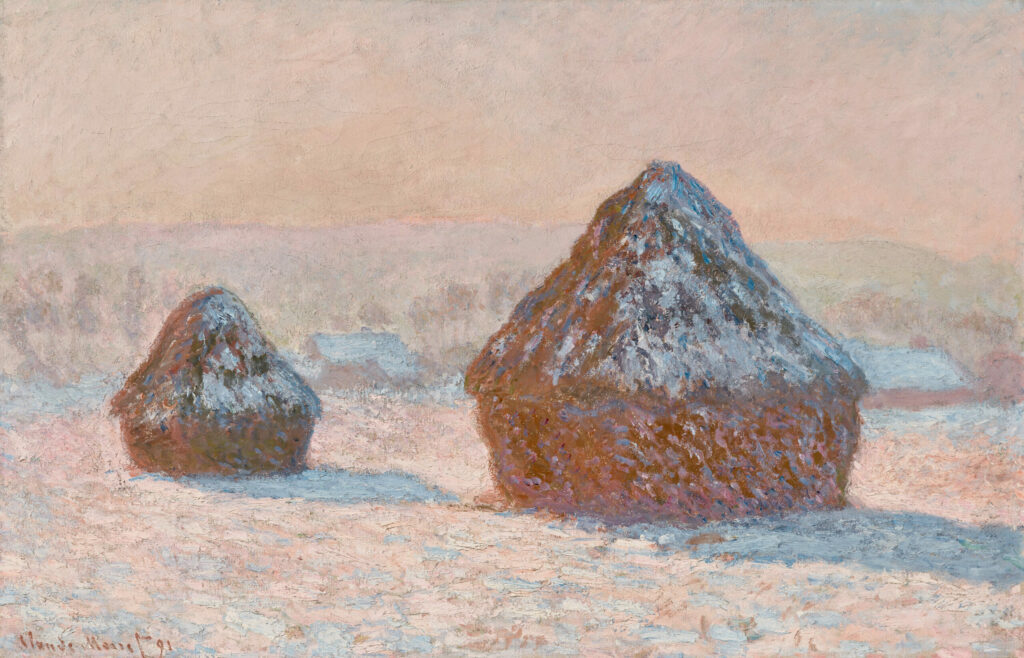
Observe these two haystacks rising from the snow. One dominates in the foreground, massive and imposing. The other, smaller, stands back. Monet uses a discontinuous, raised brushstroke. Each stroke captures a fragment of light. The delicate pink of the winter sky reflects on the immaculate snow. The blue shadows of the haystacks answer the subtle blues that illuminate the snowy landscape. In the distance, house roofs emerge, blurred up close but clear overall. This oil on canvas constructs a solid geometry. The forms never dissolve into shapeless patches.
The Birth of Serial Painting
This work belongs to Impressionism’s first series. Monet chooses a single motif and explores it through all its atmospheric variations. For him, landscape does not exist in itself. It lives through the light and air that constantly transform it. Begun outdoors, each canvas is reworked in the studio. There Monet creates those chromatic harmonies that unify the composition. The Haystacks mark a turning point in modern art. They prove that a banal subject becomes extraordinary through the artist’s gaze.
Claude Monet, Painter of Light
Claude Monet (1840-1926), master of French Impressionism, devoted his life to painting light. From the Gare Saint-Lazare to the Water Lilies, he tirelessly explored atmospheric variations. With the Haystacks, he reached a new artistic maturity.
A Question for You
💭 Does the endless repetition of the same motif bring us closer to truth, or does it distance us from it?
About this Work
- Wheatstacks, Snow Effect, Morning (Meules, Effet de Neige, Le Matin)
- Claude Monet
- 1891
- Oil on canvas
- 64.8 × 100.3 cm
- The J. Paul Getty Museum, Los Angeles
- https://www.getty.edu/art/collection/object/103RK8