Louveciennes, Autumn 1870. A few steps from his home, Camille Pissarro steps out onto the path. The air is crisp. The light hesitates. He sets up his easel and begins to paint.
A scene vibrant with ordinary life
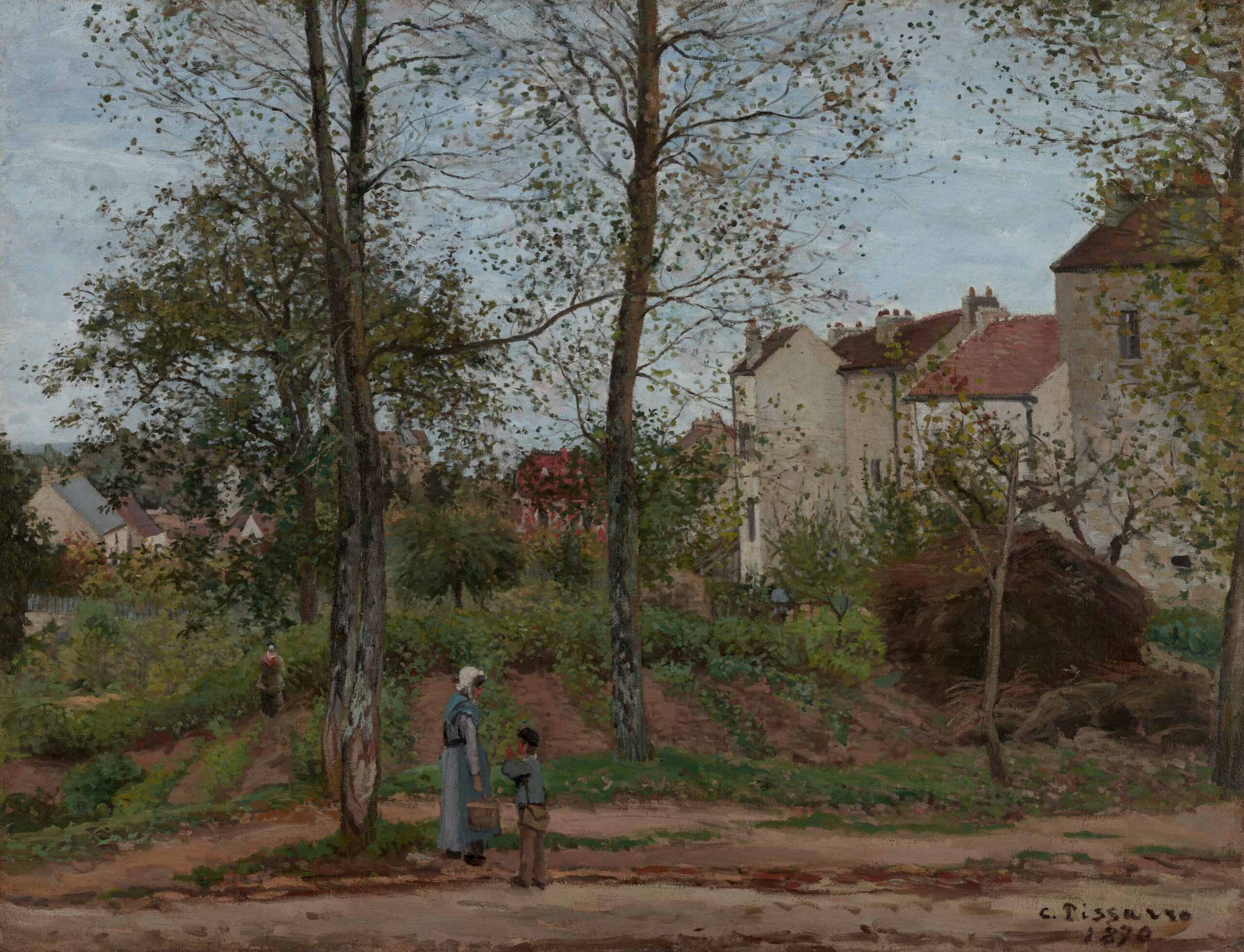
In the foreground, a woman pauses, bucket in hand. She speaks to a young boy, satchel slung over his shoulder. Behind them, the trees are shedding their leaves. The grey sky settles gently over the red rooftops. Look closely at the brushwork: each stroke follows its own logic. Pissarro turns the canvas into a field of living textures.
Impressionism born in the open air
In 1870, Pissarro painted alongside Monet and Renoir in the countryside around Paris. Together, they forged a revolutionary method: breaking up the pictorial surface with free, spontaneous strokes to capture light in motion. This oil on canvas is a masterful demonstration. Impressionism had not yet been named — yet it was already there, pulsing in every brushstroke. That same year, the Franco-Prussian War broke out. Pissarro would soon flee to England. This autumnal landscape is also a quiet farewell to Louveciennes.
Camille Pissarro
Born in Saint-Thomas in the Danish West Indies, Pissarro (1830–1903) arrived in Paris at the age of twenty with a single conviction: to paint real life, unvarnished. He studied under Corot, crossed paths with Courbet, and went on to become the only painter to have participated in all eight Impressionist exhibitions. A generous mentor, he guided Cézanne toward structure and Gauguin toward colour. His strength lay in bridging the earthy rigour of Millet with the fragmented light of the Impressionists. At Louveciennes, that synthesis found one of its most accomplished expressions.
A question for you
💭 In 1870, Impressionism had no name yet. Can you already sense its spirit in this canvas?
About this work
- Landscape at Louveciennes (Autumn)
- Camille Pissarro
- 1870
- Oil on canvas
- 88.9 × 116.2 cm
- The J. Paul Getty Museum, Los Angeles
- https://www.getty.edu/art/collection/object/103RF5