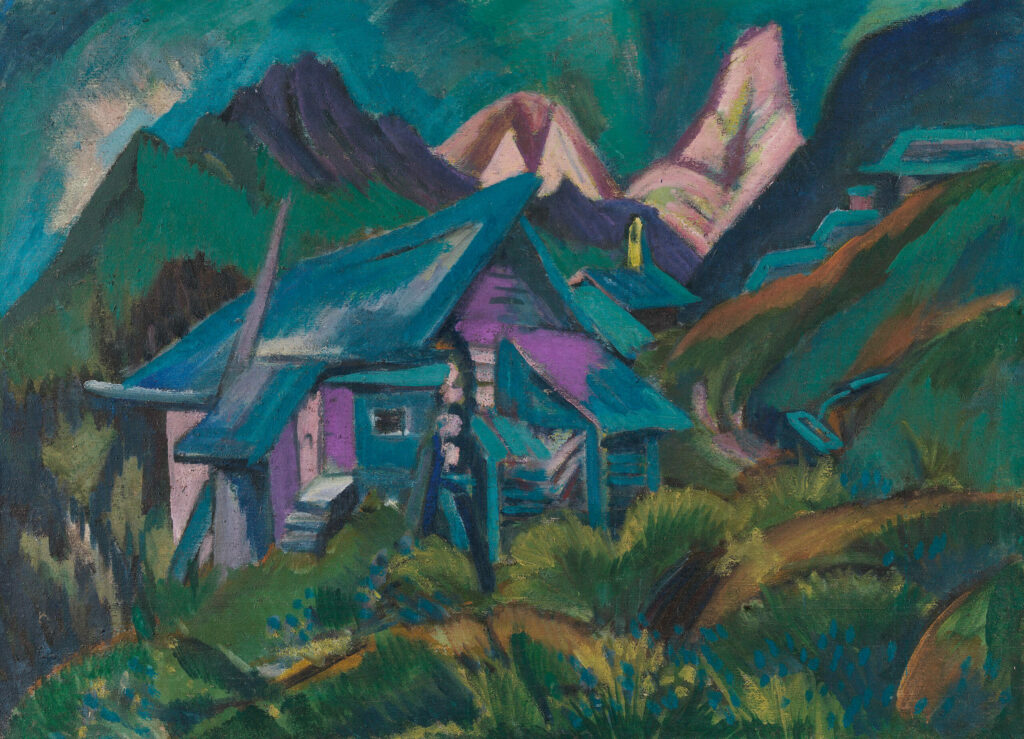
Davos, 1919. Kirchner settles in the Swiss Alps to escape war-torn Germany. Facing the Tinzenhorn, a dizzying 3,173-meter peak, he repaints the world in new colors. Chalets turn violet, the sky shifts to electric turquoise, mountains undulate like waves.
An Explosion of Pure Color
Alpine refuges blaze with color. Kirchner applies oil paint in broad strokes. The turquoise roof of the central chalet echoes the hues of the sky. Mountains rise in angular masses. The Tinzenhorn dominates the composition. No classical perspective: everything tilts, twists, vibrates. Grasses in the foreground burst forth in yellow-green strokes. This chromatic violence transforms an ordinary landscape into a cosmic vision.
The Creative Exile of an Expressionist
Traumatized by his military service in 1915, Kirchner flees to Switzerland. In Davos, he finds a form of peace. The Alps become both his refuge and his subject. Far from Expressionist Berlin and Die Brücke, the movement he co-founded, he develops a more synthetic style. Kirchner projects his quest for primitive harmony, his need to rebuild a world after horror. The Swiss mountains offer the artist a space for pictorial regeneration.
Kirchner
Ernst Ludwig Kirchner (1880-1938) ranks among the pioneers of German Expressionism. After revolutionizing the Berlin art scene, he devoted his final years to alpine landscapes. His angular, colorist style reaches a unique maturity here. The Pinakothek der Moderne houses this major work from his Swiss period.
Think about it
💭 Do Kirchner’s unreal colors seem closer to a dream or a nightmare?
About This Work
- Alpine Chalets and Tinzenhorn
- Ernst Ludwig Kirchner
- 1919-1920
- Oil on canvas
- 88.5 x 120.5 cm
- Pinakothek der Moderne Munich, Bavarian State Painting Collections, Modern Art Collection