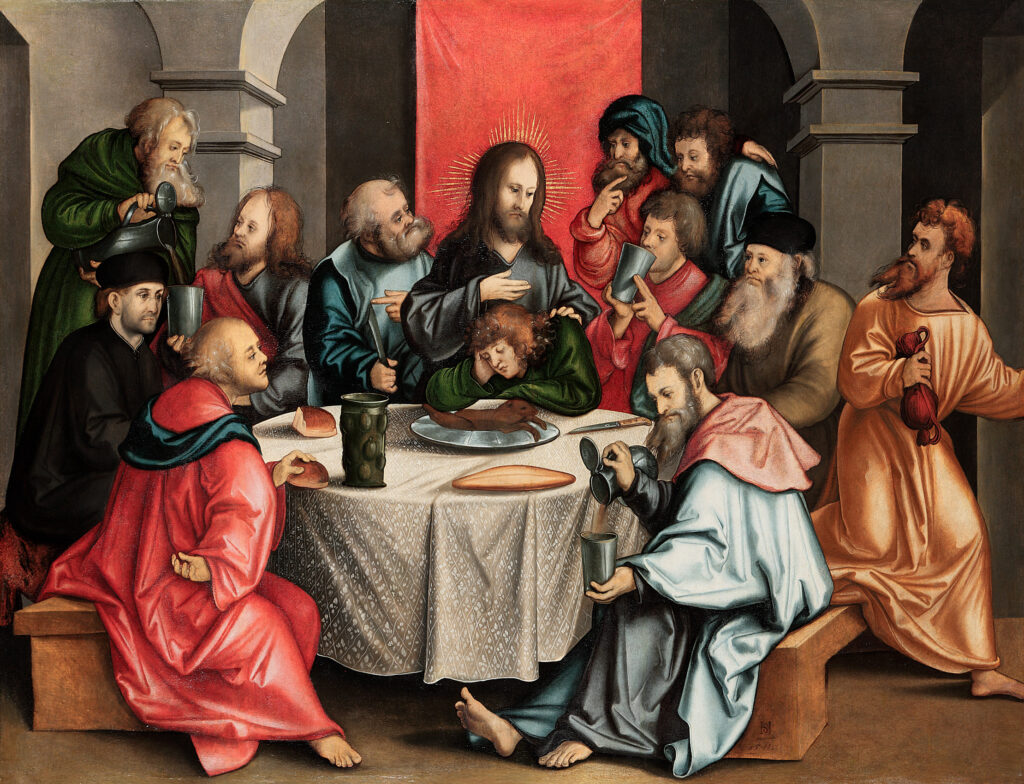
Augsburg, 1511. Hans Schäufelin paints a meal that will change the world. Around a round table, thirteen men share bread and wine for the last time.
A Table Laden with Meaning
Observe the circular composition. Christ enthroned at the center, haloed in golden rays against a scarlet drape. His presence radiates. John, the beloved disciple, has fallen asleep against his chest. A gesture of surrender, of total trust. Around them, the apostles drink from pewter goblets, break bread. The ample drapery — vermillion red, deep green, icy blue — captures the light with striking modelling. Every face expresses a distinct emotion. On the right, a silhouette moves away. Judas flees, his purse of thirty pieces of silver clutched against him. The traitor has already left the scene.
Schäufelin, a Student of Dürer in Augsburg
Schäufelin created this panel during his stay in Augsburg, a city then at the heart of European commerce. Trained in Albrecht Dürer’s workshop in Nuremberg, he mastered woodcut engraving and panel painting. His style bears the imprint of the nascent German Renaissance. The dense composition, the realism of expressions, the sculptural treatment of drapery recall the master’s teaching. But Schäufelin asserts his own voice here. The choice of a round table breaks with the tradition of the Last Supper as a horizontal frieze. It tightens the space, creates an intimacy around the sacred.
Hans Schäufelin
Hans Schäufelin (circa 1480-1540) is a significant figure of Renaissance painting and engraving. After his apprenticeship under Dürer, he settled in Nördlingen where he produced altarpieces and illustrations. His work combines Northern rigor with narrative sensibility.
Think about it
💭 How does Schäufelin manage to create narrative tension within an apparently serene scene?
About This Work
- The Last Supper
- Hans Schäufelin
- 1511
- Beech wood
- 81.5 × 109.5 cm
- Gemäldegalerie, Staatliche Museen zu Berlin
- https://recherche.smb.museum/detail/869062/das-abendmahl