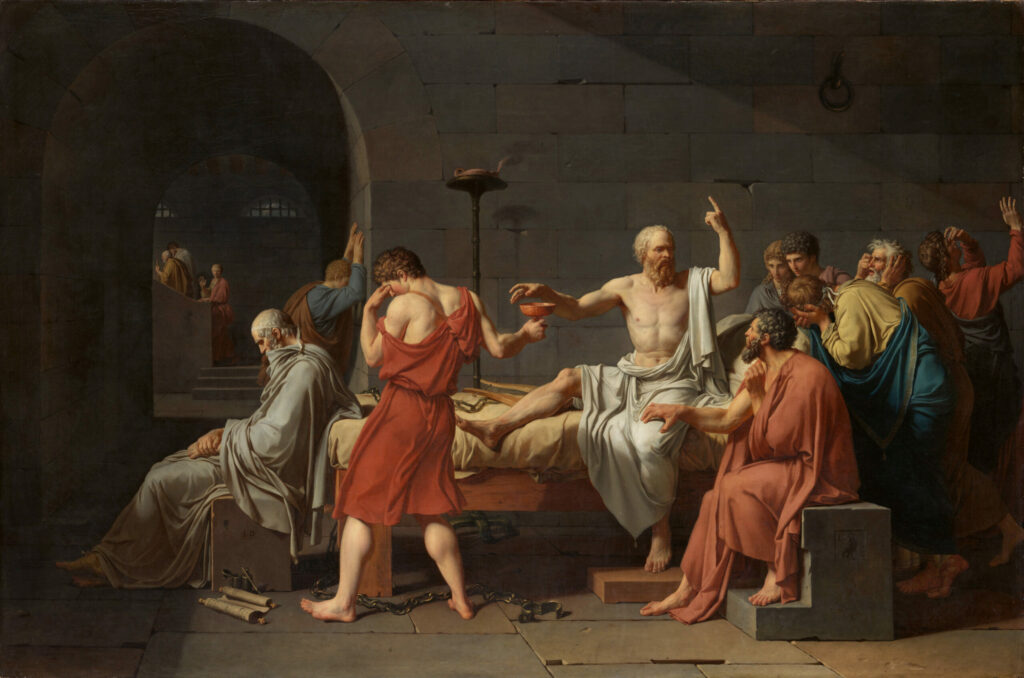
A Philosophical Drama. In this masterpiece, David immerses us in the final moments of Socrates’ life with dramatic intensity. He captures the ultimate moment when the philosopher, about to drink the hemlock, continues teaching with serenity, embodying the triumph of reason over the fear of death.
The composition organizes space around the figure of the sage, whose finger raised toward the heavens symbolizes his conviction in the immortality of the soul. The contrast between Socrates’ almost superhuman tranquility and the distress of his disciples creates profound emotional tension. The draperies, the architectural rigor of the prison setting, and the austere palette dominated by reds and ochres demonstrate a masterful command of neoclassical visual language. David transforms this tragic moment into a universal meditation on human dignity in the face of injustice and death.
Essential Information
- The Death of Socrates, by Jacques-Louis David, 1787
- Dimensions: 129.5 x 196.2 cm
- Location: The Metropolitan Museum of Art, Fifth Avenue, New York, Gallery 634
- https://www.metmuseum.org/art/collection/search/436105
Jacques-Louis David (1748-1825) was the quintessential revolutionary painter, both through his political engagement and the artistic renewal he embodied. A central figure in French Neoclassicism, he broke with Rococo to return to the moral and aesthetic values of antiquity. His career led him from the salons of the Ancien Régime to revolutionary circles, then to Napoleon’s service before his final exile in Brussels.
Partly trained in Rome, where he absorbed the lessons of classical masters, David developed a style of rigorous perfection in service of a conception of art as a vehicle for moral and civic edification. His influence was immense across several generations of European artists, and this “Death of Socrates,” completed in 1787, constitutes one of the most accomplished expressions of his genius and his vision of art in service of the highest human values.
A Neoclassical Programme on the Eve of Revolution
The Death of Socrates was painted two years before the French Revolution, at a moment when the question of civic sacrifice and obedience to law at the cost of individual life was not merely philosophical but urgently political. Jacques-Louis David (Paris, 1748 – Brussels, 1825) treats the subject with a narrative and formal rigour that exceeds any private commission and becomes an aesthetic and moral manifesto. Socrates, condemned to death by the Athenian tribunal for impiety and corrupting the youth, refuses to flee when escape is offered, drinks the hemlock without faltering, and dies discoursing on the immortality of the soul to his grief-stricken disciples. David represents the precise instant the cup is extended: Socrates raises a finger toward heaven, asserting his conviction in the afterlife, while his hand gropes toward the poison with a serenity that violently contrasts with the despair of the men around him. The composition functions as a Stoic rhetoric: Socrates at the centre, vertically erect on his couch like an antique statue, radiates cold light over the lateral figures plunged in shadow and grief.
Success Across Europe and the Metropolitan Museum
At the Salon of 1787, The Death of Socrates was received as an event. The painter Johann Heinrich Wilhelm Tischbein wrote to Goethe that it was “one of the greatest ideas that has ever been painted.” Immediately engraved and circulated throughout Europe, the work combined formal rigour, philosophical serenity, and veiled political charge at the exact intersection of the Neoclassical programme theorised by Winckelmann and the pre-Revolutionary tensions of Louis XVI’s France. Four years later, David would be the official painter of the Revolution itself, and the same Stoic virtues he attributes to Socrates, courage, sacrifice, fidelity to principle, would become the core of Republican iconography. The painting entered the Metropolitan Museum of Art in 1931 and is displayed in Gallery 634 as the centrepiece of the museum’s eighteenth-century European painting holdings.