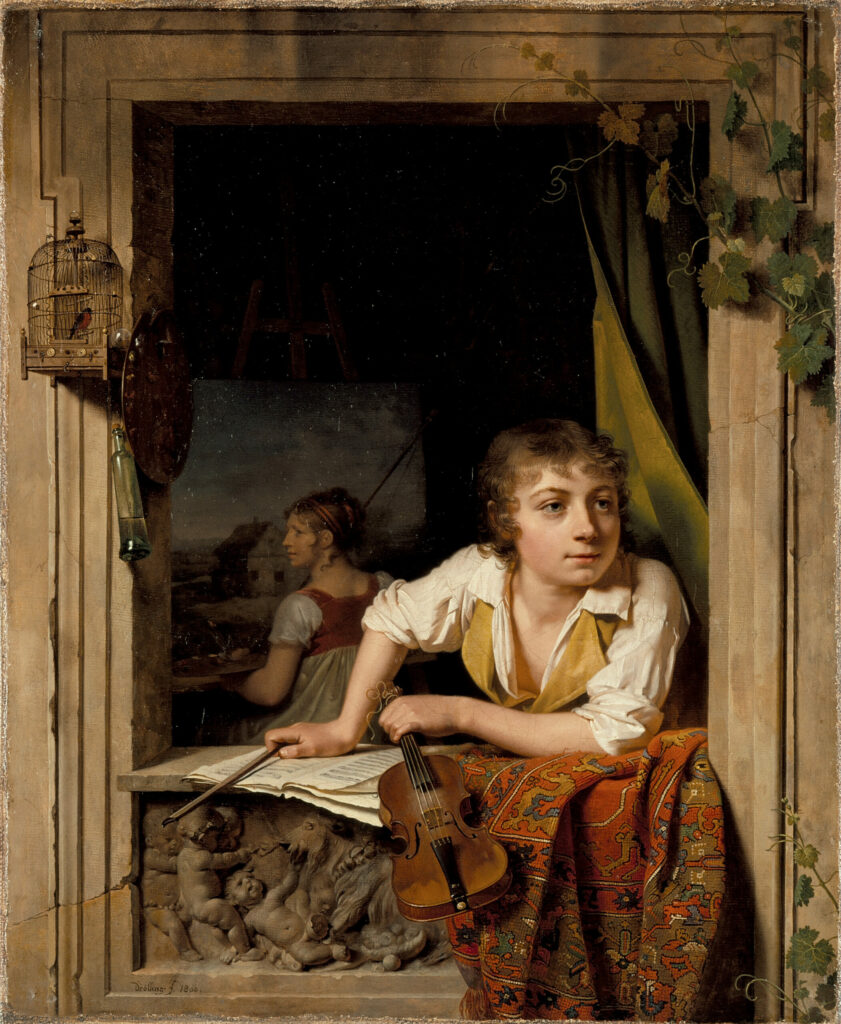
Paris, 1800. In the intimacy of his studio, Martin Drölling casts a father’s gaze upon his son Michel-Martin. The young man holds a violin, surrounded by sheet music and sculptures. This familiar scene becomes a manifesto: art is not divided, it unites.
A Dialogue Between the Arts
The young man leans against a trompe-l’œil window. Behind him, a young woman paints in shadow. In the foreground, a sculpted bas-relief depicts chubby putti. Drölling orchestrates this composition with Neoclassical precision. Light caresses the musician’s face, slides over the varnished wood of the violin, illuminates the pages of the score. Warm colors dominate. The brushwork is smooth, the details meticulous. We can distinguish the instrument’s strings, the patterns of the Oriental fabric, even the suspended birdcage.
The Ideal of an Extended Age of Enlightenment
This oil on canvas embodies the vision of an era that saw in complete artistic education the fulfillment of humanity. In 1800, Drölling championed a humanism where music, painting, and sculpture form an indivisible whole. This portrait of his own son becomes a declaration: the liberal arts elevate the soul.
Martin Drölling: Painter of the Intimate
Of German origin, settled in Paris, Drölling (1752-1817) excelled in genre scenes and portraits. He perpetuated with his sons a tradition of family workshop. His precise style, his taste for domestic details, and his warm palette make him a sensitive witness to everyday Parisian life at the turn of the century.
Think about it
💭 By placing painting, music, and sculpture within the same frame, Drölling illustrates the ideal of the paragone dear to the Renaissance: in your view, which art expresses itself most powerfully in this painting?
About This Work
- Painting and Music (Portrait of the Artist’s Son)
- Martin Drölling
- 1800
- Oil on canvas
- 45.72 × 37.47 cm (18 × 14 3/4 in)
- Los Angeles County Museum of Art (LACMA)
- https://collections.lacma.org/node/246381
A Tribute to the Liberal Arts in an Intimate Format
Painting and Music (Portrait of the Artist’s Son) operates on two levels. It is first a family portrait: the young man with the violin is Michel-Martin Drölling, the painter’s son, who would himself become an artist and win the Prix de Rome in 1810. But it is also an intellectual programme: the arrangement of musical instruments, scores, sculptures, and painting materials makes this portrait an allegory of the liberal arts. The concept of the paragone, the rivalry or comparison between the arts, a debate inherited from the Italian Renaissance, structures the scene: painting, music, and sculpture are represented simultaneously, in an equivalence that asserts their equal dignity. Martin Drölling, born in Alsace and trained in Paris, belongs to the Neoclassical academic tradition of the late 18th century, while maintaining in this painting a warmth and intimacy that temper the genre’s rigour.
Drölling’s Alsatian Roots and Parisian Career
Martin Drölling was born in 1752 in Oberhergheim in Alsace and established himself in Paris, where he built a solid academic career. He was particularly admired for his interiors and bourgeois genre scenes, a domain in which he excelled through precision of detail and gentleness of light. Painting and Music reflects this capacity to combine thematic ambition with direct observation: the suspended birdcage, the Oriental fabric, the violin strings are rendered with a meticulousness that anchors the scene in domestic reality even as it aspires to the universal. Drölling died in Paris in 1817, leaving behind a son who would carry on his work.