Paris, c. 1908. Henri Rousseau, known as le Douanier, sets up his easel before one of the most majestic avenues in the Parc de Saint-Cloud. He paints what he sees and what he dreams.
An Enchanted Perspective
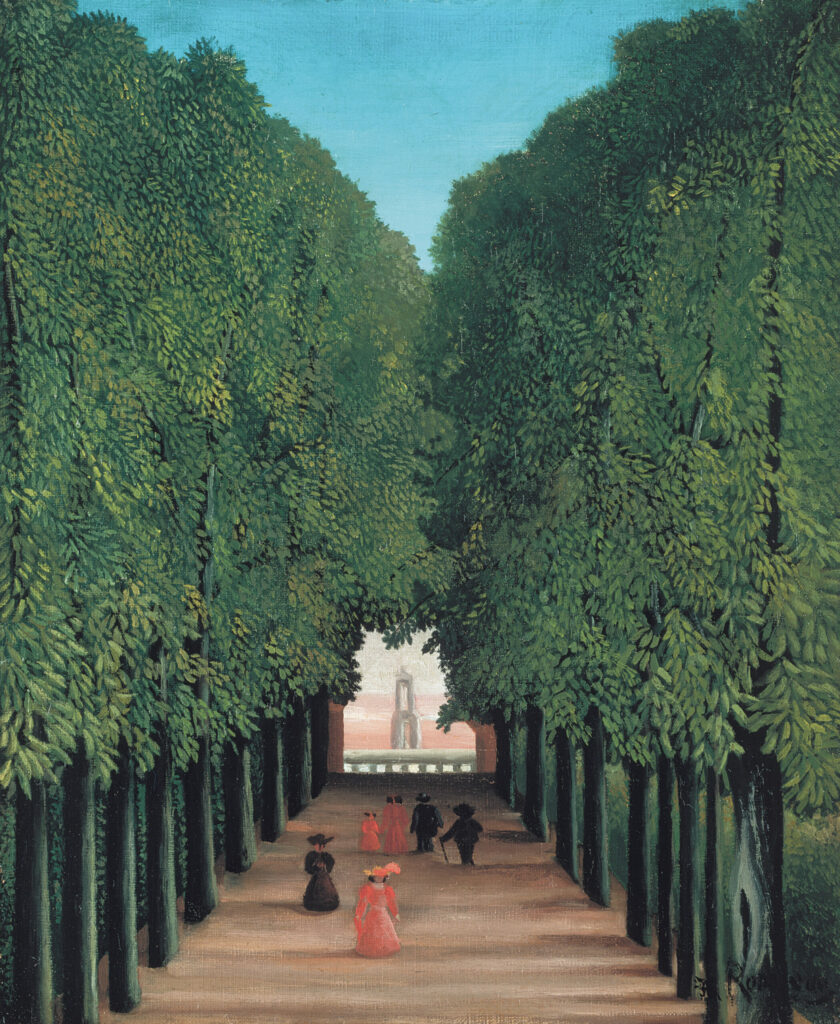
Two rows of towering trees frame an earthen path. Their dense foliage meets overhead to form a leafy vault. In the distance, a bright opening hints at a fountain. Two women in the foreground appear caught in an eternal stroll. Look closely: each leaf receives the same attention as the figures or the distant architecture. Rousseau establishes no hierarchy. Everything coexists with equal clarity. This frontality, these shifted proportions between giant trees and tiny figures, create a singular effect. Reality gently tilts toward dream.
The Customs Officer Who Dreamed While Painting
At the age of 41, Henri Rousseau left his post as a toll collector for the city of Paris to devote himself entirely to painting. Self-taught, he began exhibiting at the Salon des Indépendants as early as 1886. Critics mocked him, ridiculing his incongruous perspectives and naive proportions. Yet Picasso, Apollinaire, and Delaunay were among the first to recognise his genius. This painting perfectly illustrates his manner: the subject is commonplace, but the treatment transforms the everyday into a dreamlike vision. Through this fusion of dream and reality, Rousseau paved the way for Surrealism, becoming, without ever seeking it, one of the pioneers of naïve art and a major source of inspiration for the twentieth-century avant-garde.
Henri Rousseau, known as le Douanier (1844–1910), is an unclassifiable figure in modern painting. His work, long dismissed, is today held in the world’s greatest museums.
Think about it
💭 Which avenue would you rather lose yourself in, the one of reality, or the one of dreams?
About this work
- The Avenue in Saint-Cloud Park
- Henri Rousseau
- c. 1908
- Oil on canvas
- 46.2 × 37.6 cm
- Städel Museum, Frankfurt am Main
- https://sammlung.staedelmuseum.de/en/work/the-avenue-in-saint-cloud-park
The Customs Officer in the Park: A Parisian Geography
The Avenue in Saint-Cloud Park (c. 1908) is as much a painting of a promenade as it is a painting of nature. The Parc de Saint-Cloud, which overlooks Paris from the heights of the left bank of the Seine to the west of the capital, has been a public space accessible to Parisians since the 19th century. Rousseau, who spent his entire life in Paris, walked the city’s parks and gardens, the Tuileries, the Luxembourg, Vincennes, the Bois de Boulogne, to observe and sketch motifs that he then transposed in the studio. This avenue of tall trees seen in descending perspective, framing an earth path that opens onto a luminous fountain, corresponds to the park’s actual geography. But in Rousseau’s hands, perspective no longer obeys the rules of classical geometry: the trees are massive, the silhouettes of the two women strolling are miniaturised, and everything is bathed in an even, slightly unreal light. The Städel Museum in Frankfurt holds this oil on canvas (46.2 × 37.6 cm).
The Self-Taught Painter and His Defenders
Henri Rousseau (1844-1910) left his post as a Paris toll collector, the source of his nickname “le Douanier”, around 1885 to devote himself to painting. He had received no academic training and began exhibiting at the Salon des Indépendants from 1886. Institutional critics mocked his “incongruous” perspectives and unusual proportions. But from the late 1890s onward, the Parisian avant-garde saw something different in his work: Picasso organised a celebrated banquet in his honour in 1908, and Apollinaire wrote enthusiastically about his paintings. What these young artists recognised in Rousseau was a coherent and personal pictorial vision, indifferent to academic conventions, what the 20th century would later call naive painting, even if Rousseau himself aspired to be a “realist” painter.