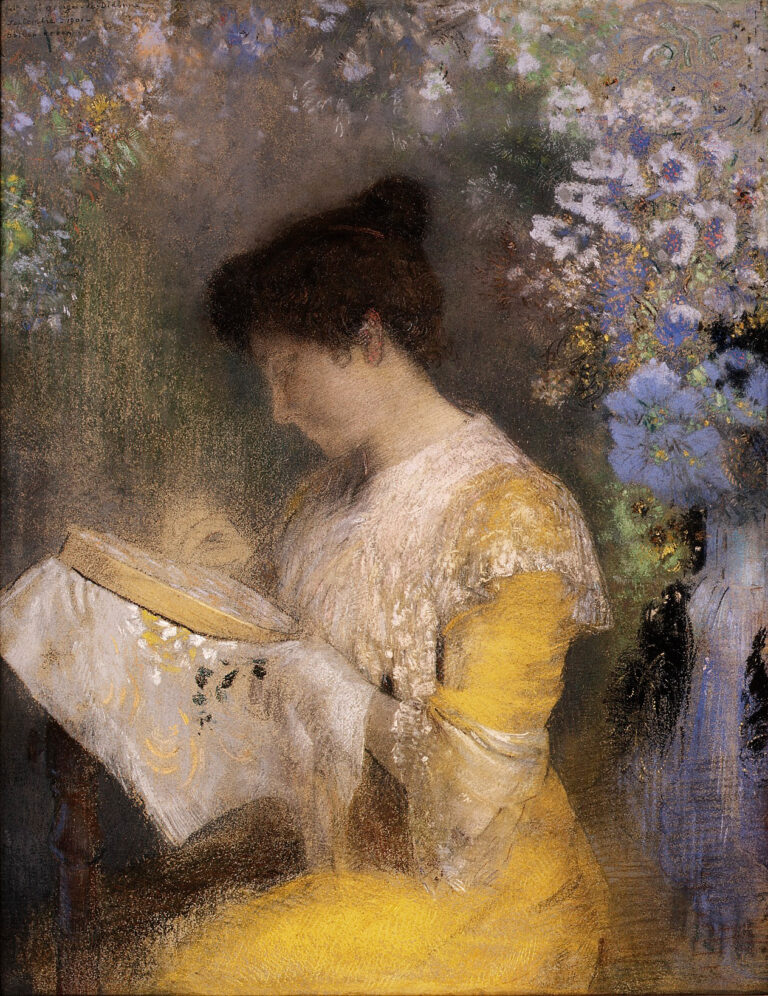
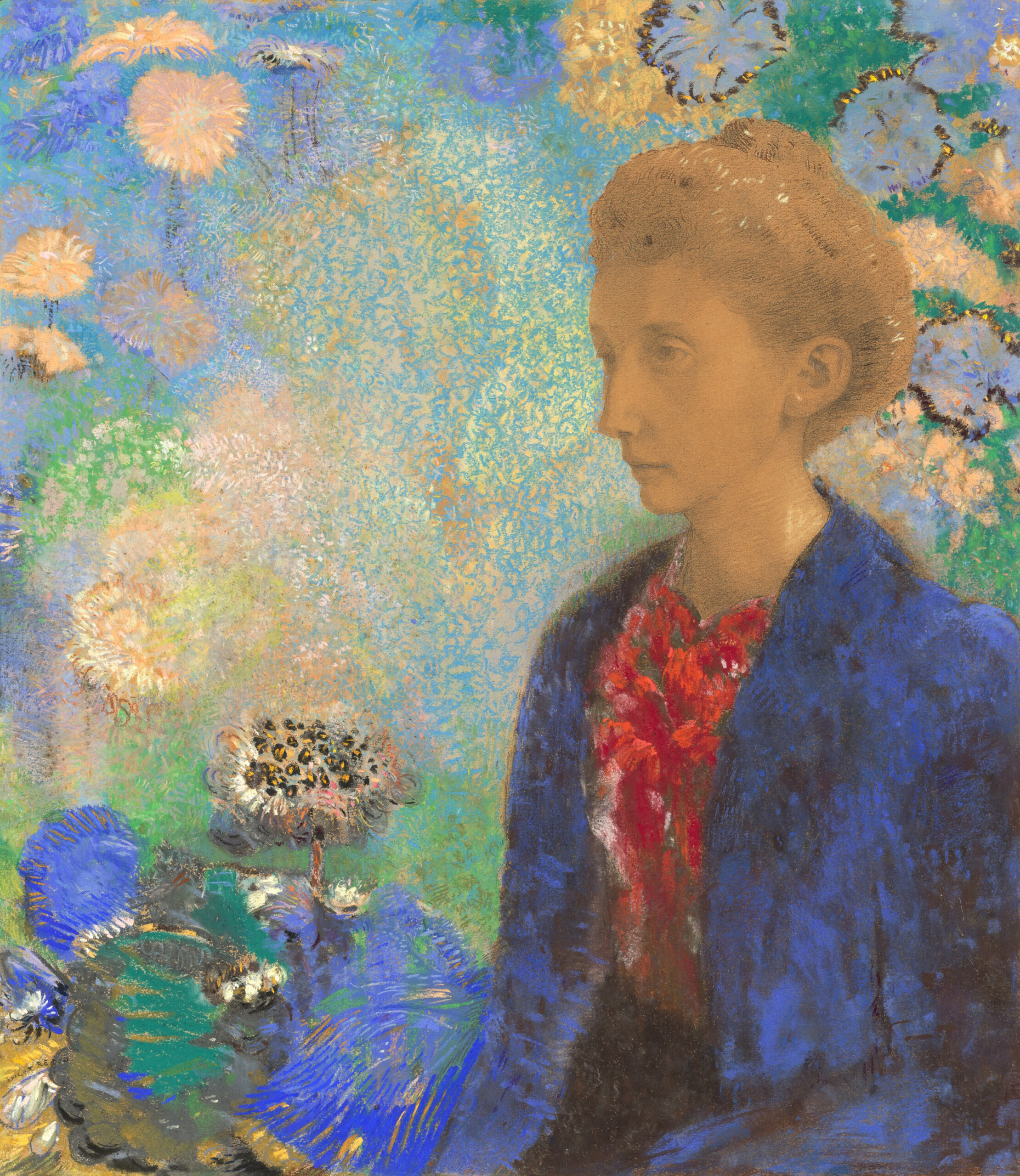
What an extraordinary atmosphere this pastel conjures. Here we find everything that makes Redon so compelling in his colour period: that singular ability to dissolve one hue into another, the blue of the Baroness’s jacket bleeding almost imperceptibly into the surrounding flowers, until one can no longer determine whether the woman inhabits the garden or the garden quietly claims her. Pastel is the ideal medium for this kind of alchemy, it refuses hard contours, it suggests, it resonates.
What strikes me most is the contrast between the floral exuberance and the gravity of the face: Redon renders the Baroness’s features in fine graphite, held back, withdrawn, with a silent interiority that sits in sharp tension with the chromatic explosion surrounding her. As though the real woman were gently resisting the Symbolist vision the painter projects onto her. It is this tension, between portrait and dream, between presence and erasure, that lifts this work well beyond a mere commissioned likeness.
This is not a portrait. Or rather: it is not only that. Look at the face. It is still, almost absent. Around it, everything erupts.
Beneath the surface
The light brown laid paper functions as skin. Redon does not cover it. He allows the support to breathe, drawing the face in graphite with an almost anxious restraint. Then comes the pastel: dense, near-carnal on the blue jacket, untethered in the flowers behind. Impossible chrysanthemums, nameless corollas, a blue that spills from the garment into the vegetation. The boundary between clothing and garden dissolves entirely. Redon completed this portrait around 1900, shortly after executing an ambitious cycle of decorative paintings for the château of Baron Robert de Domecy, his patron and friend. The Baroness sits for him. Yet this is no conventional commission: Redon projects an inner world onto her, or perhaps his own.
Redon and Symbolism
Odilon Redon (1840–1916) spent his first three decades in the strict blacks of charcoal and lithography. Then colour arrived, late and absolute. Symbolism gave him a framework: not to describe the visible world, but what it conceals. His pastels of the 1900s stand among the most singular works of the period. No other artist of the time navigated so deliberately the boundary between portraiture and vision.
Odilon Redon enters the Van Gogh Museum
In January 2026, Flowers in a Small Chinese Porcelain Cup (1884) was transferred to the State of the Netherlands and placed in the care of the Van Gogh Museum, Amsterdam. The earliest known still life by the artist, it was formerly part of the collection of Andries Bonger, a close associate of the Van Gogh family. The acquisition has been widely welcomed by scholars.
Source: vangoghmuseum.nl
Une question pour vous
💭 At a moment when Symbolism staked its claim on dream over reality, who was painting the truth: the Impressionist seizing the light outside, or Redon capturing the light within?
About this work
- Baronne de Domecy
- Odilon Redon
- c. 1900
- Pastel and graphite on light brown laid paper
- 61 × 42.4 cm
- The J. Paul Getty Museum, Los Angeles
- https://www.getty.edu/art/collection/object/1097R2