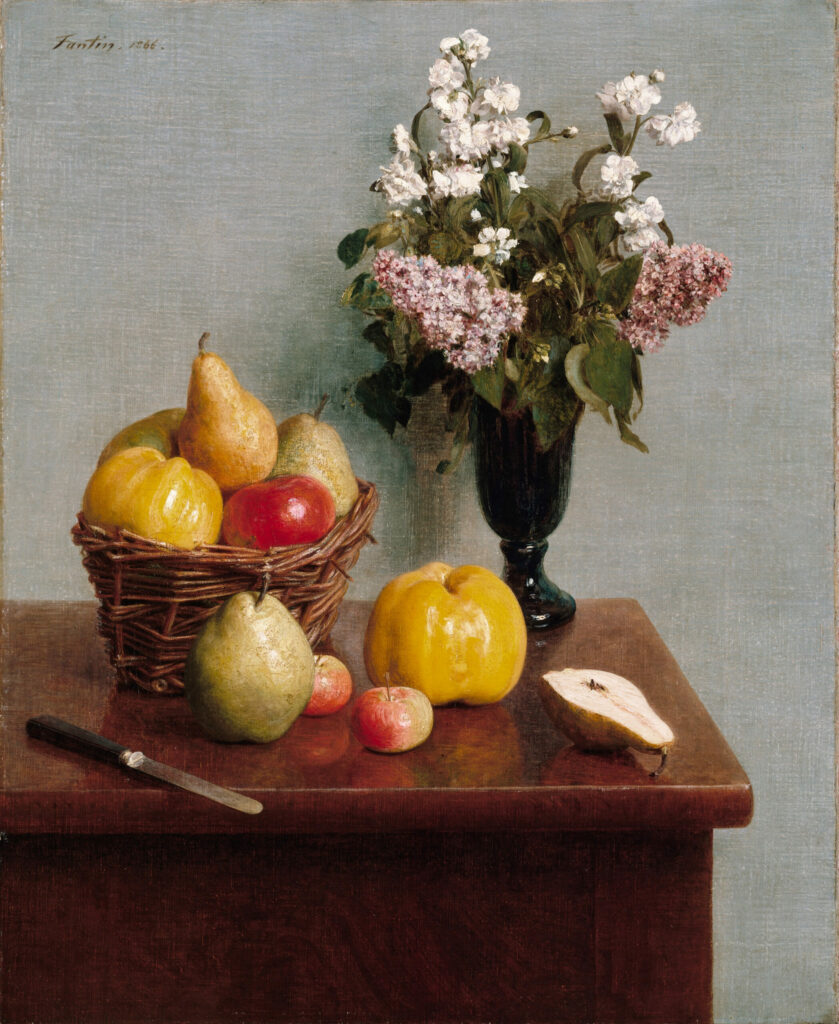
Paris, 1866. Henri Fantin-Latour carefully arranges golden pears, scarlet apples, and flowering branches. The painter composes a visual symphony for his London patron, Michael Spartali. On this brown table, each element finds its place in perfect balance.
A Living Still Life
Observe this woven wicker basket overflowing with luminous fruit. The golden-yellow pears catch the light, their matte skin contrasting with the gleaming apples. In the background, an elegant black vase holds a generous bouquet: pink and white lilacs, wallflowers with delicate petals. Each brushstroke builds the volume of the fruit, the rough texture of the basket, the velvety quality of the petals. The neutral tones of the background, that soothing blue-gray, enhance the brilliance of the subjects.
Chardin’s Heir
This work belongs to a series of four still lifes commissioned by Spartali, a Greek diplomat. Fantin-Latour worked on them from March to September 1866 and exhibited one at the Paris Salon. The painter follows in the lineage of the great masters: he admired Chardin for his elegant simplicity and Courbet for his uncompromising realism. In Second Empire France, still life was experiencing a revival. Fantin-Latour transformed this genre, considered minor, into ambitious and contemplative compositions.
Henri Fantin-Latour, the Artist of Intimacy
Henri Fantin-Latour (1836-1904) excelled in group portraits and still lifes. Trained in Paris, he developed a realistic and delicate style. This canvas marks his first major successes in the genre.
Think about it
💭 By choosing to elevate still life to the rank of a major work, wasn’t Fantin-Latour challenging the academic hierarchy of genres that still dominated nineteenth-century art?
About this Work
- Still Life with Flowers and Fruit
- Henri Fantin-Latour
- 1866
- Oil on canvas
- 73 × 60 cm
- The Metropolitan Museum of Art, New York
- https://www.metmuseum.org/art/collection/search/436293
A Commission from Michael Spartali
Still Life with Flowers and Fruit is not an isolated easel painting: it is one of four still lifes commissioned from Fantin-Latour in 1866 by Michael Spartali, a Greek businessman and diplomat based in London. Spartali, father of the Pre-Raphaelite painter Marie Spartali Stillman, was one of the first collectors to give systematic support to Fantin-Latour, at a time when the artist was still little recognised in France and was seeking commercial outlets in England. The four canvases were produced between March and September 1866, at an intense pace that reflects both Fantin-Latour’s working discipline and the economic urgency of the commission. This still life entered the Metropolitan Museum of Art in New York in 1980, purchased through an exchange gift from Mr. and Mrs. Richard J. Bernhard (accession number 1980.3).
Chardin and Courbet: Two References for an Art of Precision
Fantin-Latour situates himself within a dual tradition: the sobriety and economy of means of Chardin on one side, the material density of Courbet‘s Realism on the other. But his touch is softer, more silent than either of his two references. He is not trying to demonstrate, he is trying to see. The golden pears, scarlet apples, and flowers, pink and white lilac, wallflowers, are arranged with a naturalness that is nonetheless entirely calculated. Each composition is the product of meticulous organisation, designed so that the eye moves freely through the painting without ever being stopped by an overly emphatic accent. This restraint makes Fantin-Latour a quiet precursor of the modernist still life, distant from the expressive monumentality of Cézanne’s arrangements but grounded in the same aspiration to elevate a minor genre into a meditation on the visible world.