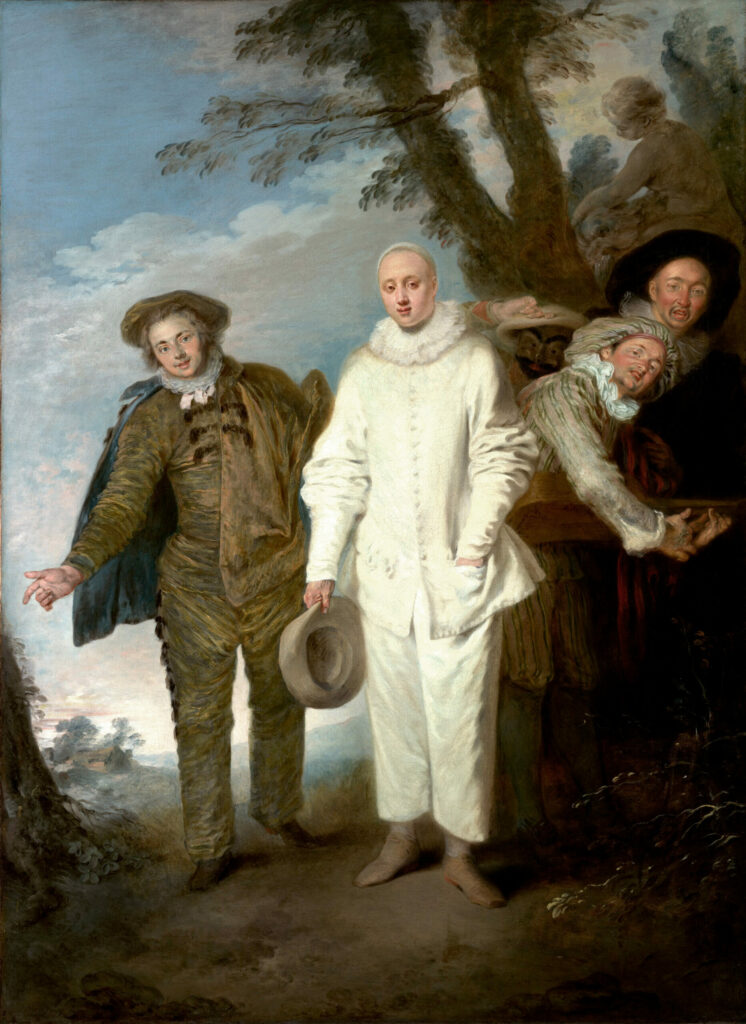
The show is over. The comedians are still here, in costume, in the failing light. One of them is no longer playing: at the center, Pierrot, dressed all in white, hat in hand, looks at us and says nothing. It is he, not the troupe, who is the true subject of the canvas. Watteau (1684-1721) invented a genre, the fête galante, those scenes of elegant pleasure shot through with a strange melancholy, as if the party were already ending. Here he does not paint the party. He paints what comes after.
What plays out behind the grace is his own dread. Watteau is a man of fragile health, introverted, fascinated all his life by the theater and above all by this one figure: Pierrot, the sad valet, the clown who draws no laughter, the one who stays at the edge and watches. By about 1720, the painter has little time left to live: tuberculosis will carry him off the following year, at thirty-six, at the end of a career barely fifteen years long. We do not know whether he already knew. His painting knows: with him, joy is always on the verge of flickering out.
So look at Pierrot. He stands straight, motionless, his face smooth and unreadable, his eyes fixed on nothing. An actor who refuses to act. The others carry on, gesturing, flirting, Brighella in green and gold bustling at the left. That is where the canvas reaches us: in that silent white amid the commotion, we recognize the moment when we stop holding our role, when we become, alone, ourselves again. At the center of his scene Watteau placed not the comedian, but the man beneath the costume.
It is the same vertigo that haunts his fêtes galantes, those gardens where elegant figures love and grow bored beneath a sky turning toward evening. Theater or park, the setting hardly matters: Watteau always paints the same thing, happiness just before it slips away.
A question for you
When Pierrot stops playing and looks at us, whom do we see: the character, or ourselves?
Find out more
- Title: The Italian Comedians (Les Comédiens italiens)
- Artist: Jean-Antoine Watteau
- Date: c. 1720
- Medium: Oil on canvas
- Dimensions: 128.9 x 93.3 cm (50 3/4 × 36 3/4 in.)
- Accession no.: 2012.5
- Long catalogued among Watteau’s followers, this large-format painting resurfaced at auction in 2011 before entering the Getty in 2012
- Collection: The J. Paul Getty Museum, Los Angeles (not currently on display)
- https://www.getty.edu/art/collection/object/109HKC