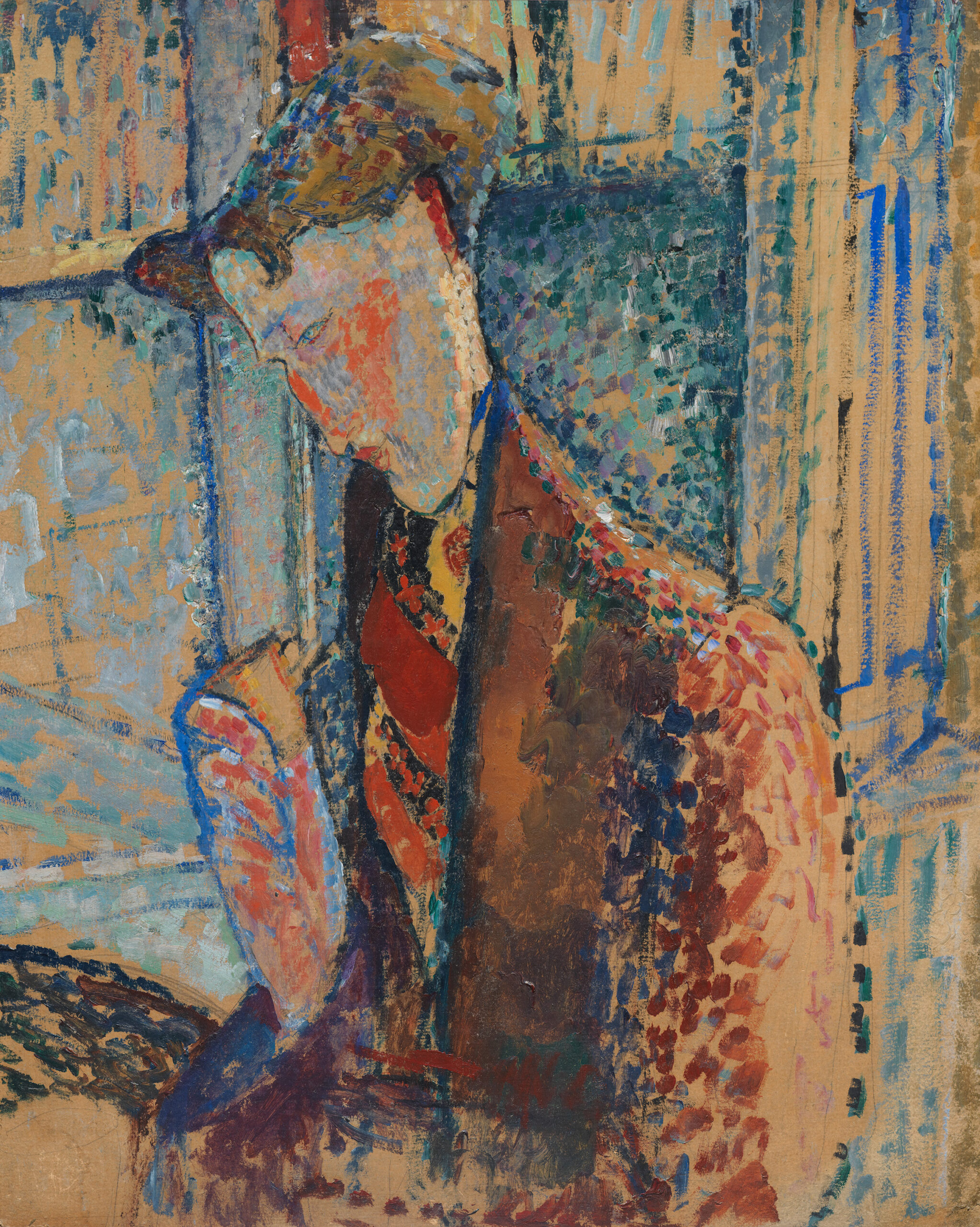
Paris, 1914. In a Montparnasse studio, Amedeo Modigliani observes his friend Frank Burty Haviland. He reaches for a sheet of cardboard, graphite, color. He is after something beyond a face: an inner presence.
A figure dissolved in color
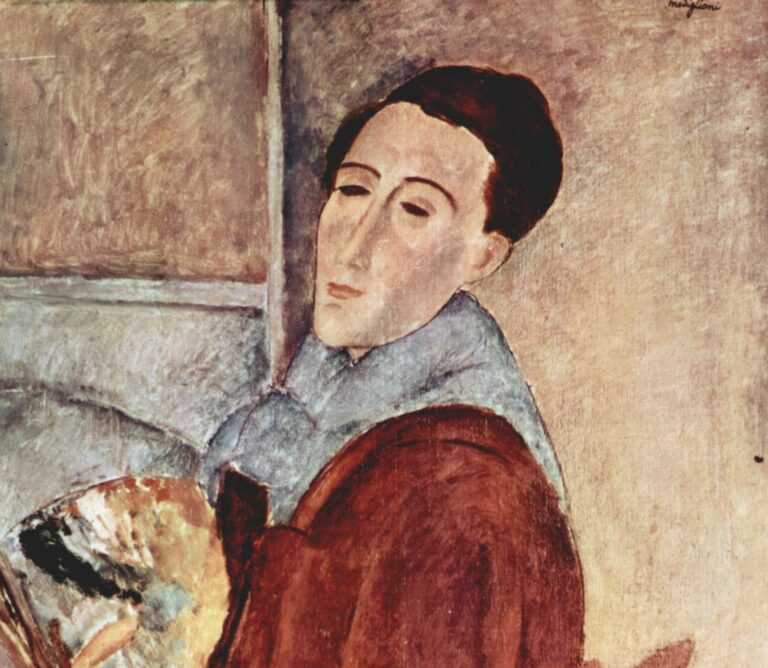
The silhouette leans forward, head tilted, gaze cast downward. No frontal face. No eye contact with the viewer. Modigliani builds his figure in dense, vibrant, almost pointillist touches. Burning oranges clash against muted blues. The raw cardboard breaks through in places, warm as ochre. The material breathes. This is a study: swift, organic, electric.
Montparnasse and friendship as creative fuel
Frank Burty Haviland was an American painter and collector based in Paris. He moved in the same circles as Modigliani, Picasso, and Max Jacob. In 1914, Modigliani was in a period of intense formal inquiry. He absorbed Cubism without surrendering to it. He explored portraiture as psychological space. This Reverie is not a commissioned portrait. It is an intimate study. The work documents a moment of free creation, unconstrained by any external demand. It anticipates the great elongated figures that would bring the painter his lasting fame.
Amedeo Modigliani
Amedeo Modigliani (1884–1920) was born in Livorno, Italy. He arrived in Paris in 1906. Painter, sculptor, and emblematic figure of the Parisian bohème, he developed an unmistakable style: oval faces, elongated necks, synthetic forms inherited from Cézanne and African art. This Reverie shows Modigliani in a state of tension, still searching.
A question for you
💭 Somewhere between Cézanne and African art, Modigliani was finding his way. Look at this study: can you already detect the characteristic elongation that would make him one of the most recognizable portraitists of the 20th century?
About this work
- Reverie (Study for the Portrait of Frank Burty Haviland)
- Amedeo Modigliani
- 1914
- Oil and graphite on cardboard
- 62.23 × 49.53 cm
- Los Angeles County Museum of Art (LACMA)
- https://collections.lacma.org/object/9246