Nice, 1918. Modigliani is exhausted. The Italian painter flees Paris and its excesses in search of the southern sun. He needs a model. A young housemaid agrees to sit.
A face outside of time
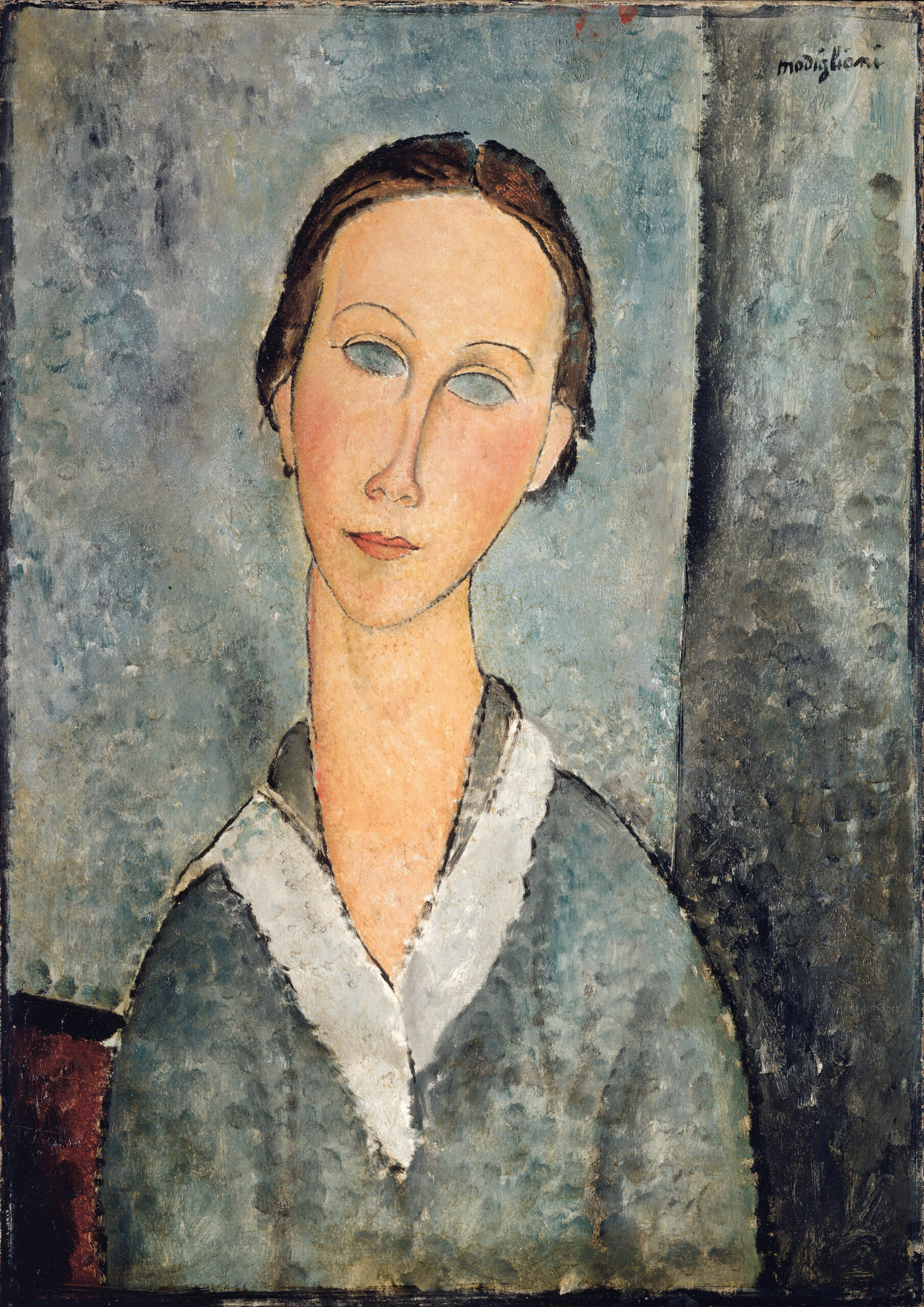
The neck stretches, long and graceful. The face elongates according to Modigliani’s own pictorial grammar. The eyes, grey-blue, are empty, two almond shapes of porcelain that look without seeing. The skin is warm, rosy ochre, laid in broad fluid planes. The blue-grey sailor suit enters into dialogue with the textured, almost shifting background. The brushwork is supple, the contours outlined in a delicate brown line. Nothing is incidental. Everything is essential. Childhood surfaces in the rounded cheeks, yet something grave inhabits this absent gaze.
The South as refuge, the anonymous as subject
From March 1918 to May 1919, Amedeo Modigliani stays in Nice to treat his tuberculosis. Far from Montparnasse, he turns his painting toward the strangers of everyday life: housemaids, shopgirls, local children. These anonymous models become his subjects of choice. The work belongs to the final period of his life, the most luminous, despite the illness. It also bears the imprint of the Parisian avant-gardes and of African art, which had radically transformed his vision of portraiture.
Modigliani, the magnificent solitary
Born in Livorno, Amedeo Modigliani (1884–1920) arrived in Paris in 1906. He developed an immediately recognisable style: elongated bodies, oval faces, enigmatic gazes. Influenced by Cézanne and African sculpture, he remains impossible to classify. He died at thirty-five, leaving behind a brief and devastating body of work.
A question for you
💭 This face has no name. A Nice housemaid, encountered by chance, elevated to the rank of pictorial subject. At a time when portraiture was a matter of commission and prestige, what does this choice tell us about Modigliani?
About this work
- Girl in a Sailor’s Blouse
- Amedeo Modigliani
- 1918
- Oil on canvas
- 65.4 × 46.4 cm
- The Metropolitan Museum of Art (MET), New York
- https://www.metmuseum.org/art/collection/search/489102
Nice, 1918: The Light of the South Against Tuberculosis
Girl in a Sailor’s Blouse is one of the works painted during Modigliani’s stay in the south of France from November 1918. Suffering from tuberculosis, he left Paris at the urging of friends and settled in the Nice area with his companion Jeanne Hébuterne. This stay, which lasted until 1919, is often described as the most luminous period of his work, despite the illness that was wearing him down. Far from the cafés of Montparnasse and his usual clientele, Modigliani turned his attention toward the ordinary inhabitants of the region: children, household workers, women of the people. The young girl in the blue-grey sailor’s blouse is one of these anonymous figures whom he raised to the dignity of portraiture with the same seriousness he would bring to a bourgeois commission. The elongated neck, the heavy-lidded face, the eyes with empty irises, the formal syntax that Modigliani had built through his Parisian years, is here applied to a popular subject with a grace that reconciles the strangeness of the style with the warmth of human presence.
A Unique Pictorial Language Between Cézanne and African Art
Modigliani gradually built a style recognizable above all others, the product of multiple influences absorbed and then transcended. The elongation of figures owes something to Cézanne and to the African sculpture Modigliani studied at the Trocadéro; the flatness of the background and the frontality of the portraits recall archaic statuary; the almond-shaped eyes, often without pupils, create the enigmatic distance that makes each portrait a figure poised between icon and testimony. Girl in a Sailor’s Blouse exemplifies this balance: the subject is particular, dated, rooted in a specific moment and place, but the plastic treatment confers upon it a timeless presence.