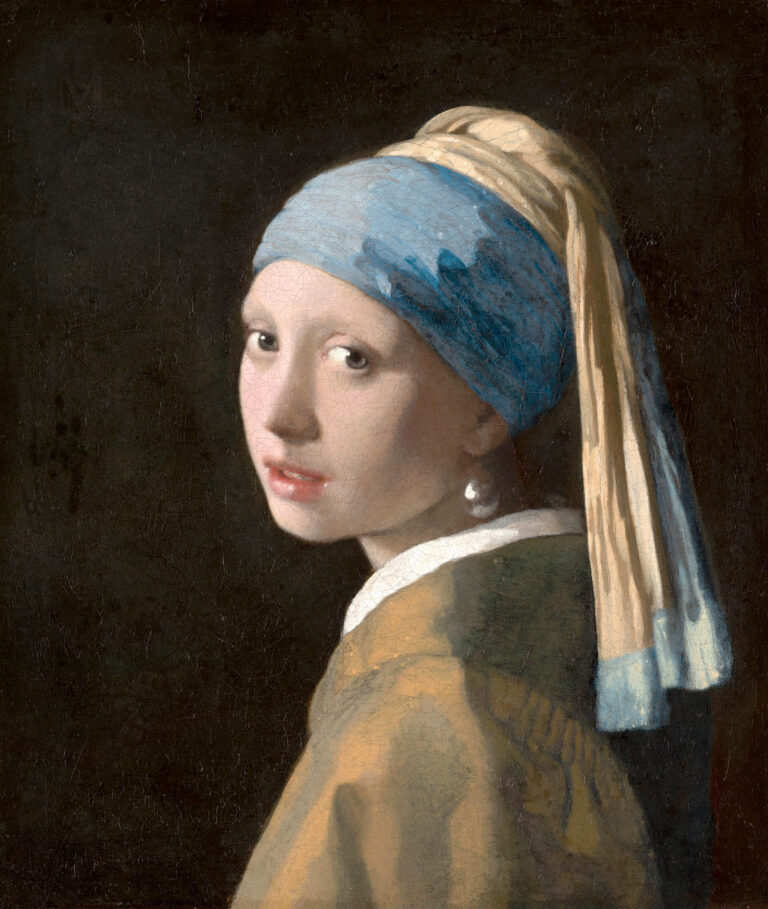
Vermeer stands, for me, among those rare artists who transcend their moment entirely. His work achieves a universality comparable to the greatest masterpieces of Western painting, much as Leonardo’s Mona Lisa has lodged itself in collective memory, so too has Girl with a Pearl Earring become part of a shared visual consciousness. Yet it is before The Geographer that I find myself most moved, in a way the more celebrated genre scenes do not always provoke: a raw, unspoken humanity.
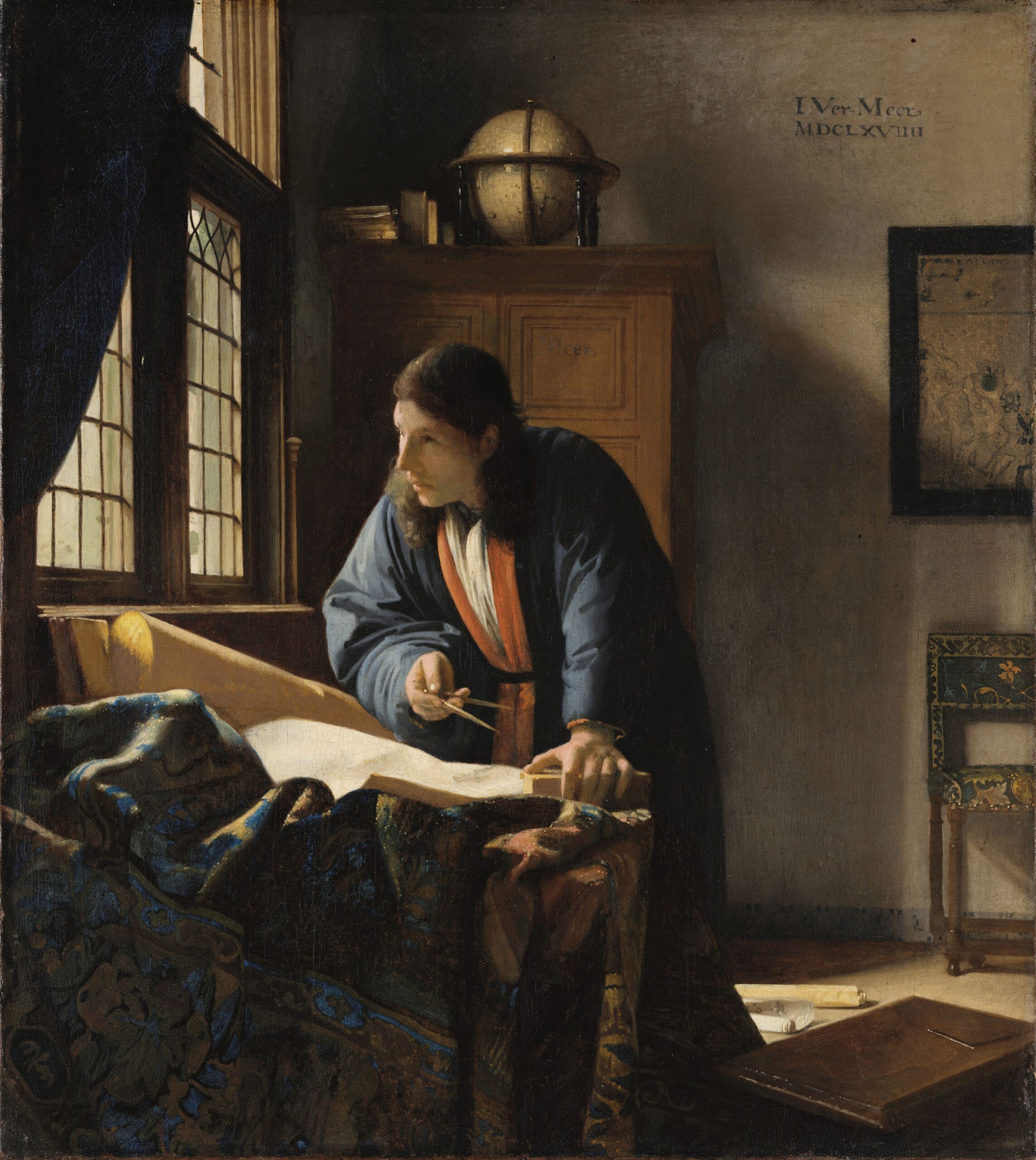
What strikes me here is the suspended quality of the figure, that precise instant in which the man pauses, dividers in hand, and lets his gaze drift toward the window. We do not see him working. We see him thinking. Vermeer achieves something rare: he makes knowledge felt. The globe on the cabinet and the charts spread across the table are not mere symbolic props, they become the silent companions of an interior life. That, to my mind, is the painting’s true distinction: not the erudition it depicts, but the fragile, concentrated humanity it holds.
You are looking at a hand. It holds a pair of dividers. It has just measured. It has stopped. That suspended gesture, poised between action and thought, may be the painting’s real subject.
What the canvas tells us
Light enters from the left. It falls across the unfurled chart, the fingers, the blue robe. Vermeer works in oil on canvas, as a master of Flemish chiaroscuro. He builds depth through successive glazes. The robe falls in heavy folds, almost audible. On the cabinet behind, a terrestrial globe catches the light on its gilded surface. To the right, a wall map charts the Indian Ocean. Look at the floor: scattered papers, an open box. This is not an ordered cabinet of curiosities. It is a workshop of thought in motion. Vermeer is not painting a scholar. He is painting the interior of a mind.
What the age tells us
The year is 1669. The Dutch Republic commands world maritime trade. Cartography is an instrument of state power. Maps are worth their weight in gold. To paint a geographer in this context is a deliberate choice. And yet Vermeer subverts the genre. He does not illustrate Dutch supremacy. He catches a hesitation, a pause. The man turns his eyes toward the window, away from the charts. Knowledge stops. Something else begins. What exactly, the painting declines to say.
Johannes Vermeer (1632–1675), foremost master of Dutch Golden Age painting, left barely thirty works. The Geographer is among the rare few to bear both his signature and a date. It is held in the permanent collection of the Städel Museum, Frankfurt am Main.
The Geographer in Amsterdam: a global consecration
In 2023, the Rijksmuseum in Amsterdam brought together three quarters of Vermeer’s entire painted output in a single exhibition. All 450,000 tickets sold within days. The Geographer, on loan from the Städel Museum, featured among the centrepieces. It was an event that may never be repeated. Source: Harvard TagTeam
A question for you
💭 What if this painting does not belong to the Dutch Golden Age at all, but already anticipates the solitary, brooding figures of Caspar David Friedrich, a century and a half later?
📌 About this work
- The Geographer,
- Johannes Vermeer,
- 1669
- Oil on canvas
- 51.6 x 45.4 cm
- Städel Museum, Frankfurt am Main