The seventeenth century abounds with depictions of musicians, a motif found equally in the work of Frans Hals and his pupil Judith Leyster, whose Boy Playing a Flute is held at the Nationalmuseum in Stockholm. I always delight in coming across paintings from which one can almost hear the music escaping the canvas.
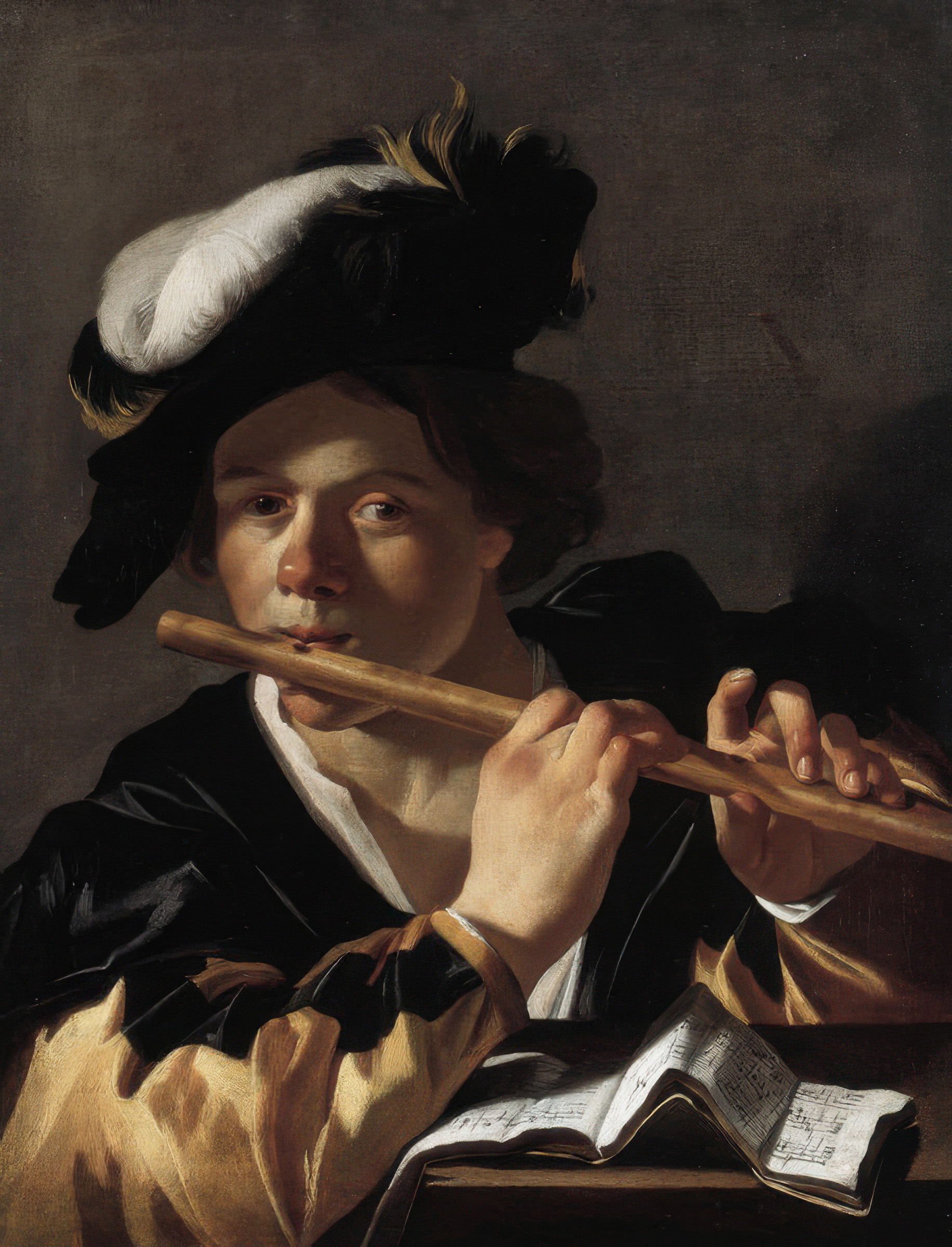
What strikes me here is the care given to the musician’s costume, and the meticulous rendering of the wooden instrument, whose grain one can almost make out beneath van Baburen’s brush. The neutral background, stripped of all decor, draws every ounce of attention to the musician and his score, a compositional choice that leaves no doubt: this is, above all, a musical work.
A breath holds a note at the mouthpiece of pale wood. You stand before this illuminated face mid-melody, the flute passing through his parted lips.
What the Canvas Tells You
Chiaroscuro bites into the musician’s right cheek, leaving the other side of his face to sink into shadow. The vivid yellow sleeve catches all the light, a sharp contrast against the black doublet. The white plume, almost incongruous, signals a costume of fantasy rather than everyday dress. Van Baburen places the fingers with precision upon the wood of the instrument, each knuckle modelled by light. Before him, an open score, barely legible, reminds us that this portrait breathes music as much as it mimes it.
What the Era Tells You
Rome, circa 1615. Here van Baburen encounters Caravaggio and his sharp-edged shadows. Back in Utrecht, he joins Hendrick ter Brugghen and Gerrit van Honthorst: together, they bring this style to the Northern Netherlands. The lone musician, a motif much prized at the time, often embodies Hearing, one of the Five Senses. This young flute player does not escape that symbolic reading, though he never openly claims it.
Dirck van Baburen (c. 1595–1624) died young, leaving behind a brief but dense body of work. Trained in Utrecht, sharpened in Rome, he became one of the leading figures of Utrecht Caravaggism, alongside ter Brugghen and van Honthorst.
Museum News
The Gemäldegalerie in Berlin has just unveiled a new hang of its permanent collection, on view until 13 September 2026, offering a fresh perspective on its masterpieces — among them Dirck van Baburen’s The Flute Player. The museum is also preparing a new temporary exhibition, opening 16 October 2026, bringing together works never before shown side by side to explore cross-cutting themes such as identity, beauty, status, and power. Further information on the Gemäldegalerie’s current exhibitions page.
A Question for You
💭 What if the true subject were not the musician, but the Caravaggesque light that Baburen brought back from Rome?
About This Work
- The Flute Player
- Dirck van Baburen
- c. 1615–1624
- Oil on canvas
- 71 x 55.4 cm
- Gemäldegalerie, Berlin
- https://recherche.smb.museum/detail/1850202/der-fl%C3%B6tenspieler