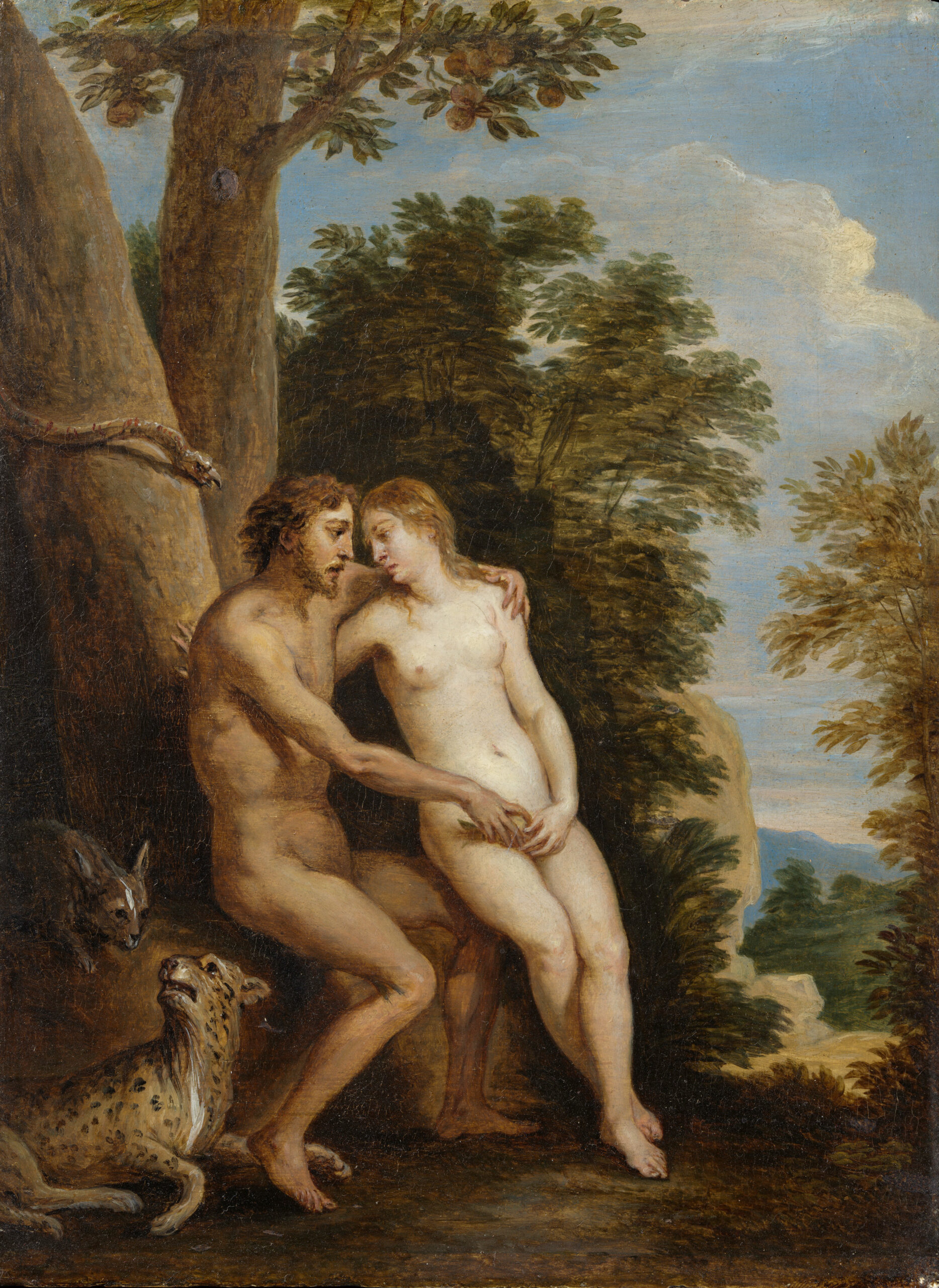
We find ourselves in Paradise, just before the Fall. And it is precisely that “just before” that makes this small panel so arresting. Teniers offers an almost literal reading of the Genesis narrative: wild animals move alongside Adam and Eve with disarming gentleness, the Tree of Knowledge bears its fruit with quiet insistence, and the serpent, already present, bides its time. Everything is in place. Nothing has yet given way.
What strikes me is that this work requires no gloss. It speaks for itself to anyone who has ever turned the pages of sacred scripture. Teniers does not seek to elevate or reinterpret: he illustrates, with an almost unguarded fidelity that, paradoxically, deepens the emotional charge. We stand before a world still whole, suspended in its fragile perfection. That fragility only grows more acute in the knowledge of what follows. A small-format panel, certainly, 22 by 16 centimetres, but one of rare narrative density.
A leopard lies in the foreground. Docile. Its gaze lifted toward the two nude figures pressed together against the trunk. That is what you see first in this twenty-two-centimetre panel: a wild beast, tamed by a world that no longer exists.
Beneath the surface
The oil is laid onto a wood support over traces of a black underdrawing, still perceptible beneath the paint layer. Teniers the Younger works small, but works swiftly. The handling is fluid, almost sketch-like in places. Eve’s flesh glows softly, modelled by a diffuse light from the right. Adam, darker in tone, inclines his face toward hers. The serpent coils around the trunk, unobtrusive, almost ornamental. Above, the apples hang heavy on their branches. The full biblical vocabulary is present, arranged like theatrical props. This attention to iconographic detail is Teniers’ Flemish inheritance: the sacred expressed through an accumulation of the concrete.
The artist and his time
David Teniers the Younger was born in Antwerp in 1610. Court painter and keeper of collections, he was working in the 1650s for an aristocratic clientele that collected tavern scenes and religious subjects with equal appetite. That ease of movement between registers, with no apparent hierarchy, is his signature. Here, Paradise resembles a Flemish park beneath a pale northern sky. The solemnity of the subject and the familiarity of the treatment never quite resolve.
The Met: an institution in motion
The Metropolitan Museum of Art in New York, which holds this panel, has just closed a landmark retrospective: Raphael: Sublime Poetry, the first exhibition of its kind devoted to Raphael ever mounted in the United States (29 March – 28 June 2026). A reminder of the breadth of the Met’s collections, which encompass Italian Renaissance masters and small Flemish cabinet paintings of the seventeenth century alike. Source: artnews.com
A question for you
💭 What if it is not Paradise that Teniers is painting here, but already its memory?
About this work
- Adam and Eve in Paradise
- David Teniers the Younger
- c. 1650s
- Oil on panel, over traces of black underdrawing
- 22.3 x 16.5 cm
- The Metropolitan Museum of Art, New York
- https://www.metmuseum.org/art/collection/search/459069