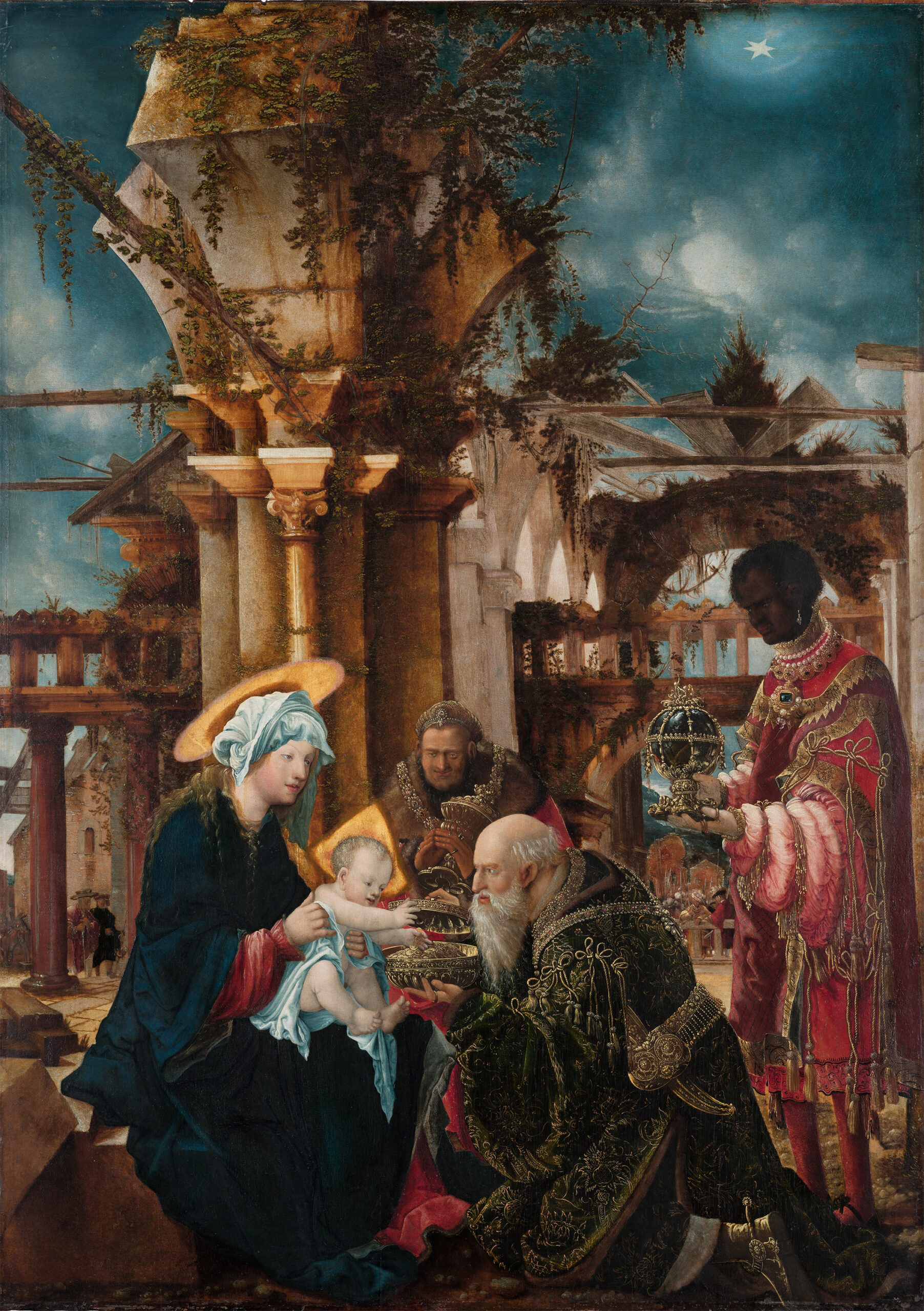
What strikes me first is the chromatic explosion. Altdorfer deploys a palette of almost excessive richness, perfectly attuned to the nature of the scene: the Adoration of the Magi is, at its core, a demonstration of splendour and devotion. The kings bring sumptuous gifts, and the painter responds to this iconographic programme with a visual generosity equal to the occasion.
What held my attention well beyond that first impression, however, is the way Altdorfer handles the ruins in the background. Far from mere decoration, they participate in the drama: their fallen grandeur contrasts with the birth taking place within them, quietly recalling that the Old World is yielding to the New. A theological tension rendered with rare elegance.
The eye then moves to the figures. Faces smile, bodies lean forward with natural ease, and the detail that genuinely moved me: the infant Jesus playing with gold coins, indifferent to their worth, as though to suggest that the wealth of the world bows before him without defining him. A humble gesture at the heart of luxury.
As for the costumes, embroideries, furs, shimmering fabrics, they are handled with the precision of an illuminator. Nothing is left to chance. Altdorfer does not seek sobriety: he seeks wonder. And he achieves it.
Ivy climbs along a fallen Corinthian column, stubborn, alive, indifferent to everything else. It is the first detail the eye catches : and it is already entirely Altdorfer.
Beneath the Surface
The gaze then extends across the linden wood panel, and richness asserts itself at every centimetre. The mixed technique allows for luminous glazes on the embroideries of the kneeling king, a dense velvet green in his cloak, golden highlights that shimmer without fading. Albrecht Altdorfer, leading master of the Danube School, paints here at the end of his career with a command of colour that goes beyond mere craft: it is visual rhetoric. The perspectives play with convention, the Star of Bethlehem rises in a steep upward view against a cloudy sky of almost unreal blue, the wooden beams tilt toward the upper edge of the panel, creating an unstable, almost vertiginous space. And within that space, the Child reaches toward the gold coins with the quiet curiosity of one who does not yet know what wealth means.
The Artist and His Time
Active in Regensburg during the first half of the sixteenth century, Albrecht Altdorfer is a singular figure of the German Renaissance. A contemporary of Dürer and Cranach, he was among the first European painters to treat landscape as an autonomous subject. This Adoration, dated to around 1530–1535, belongs to his late period and is held at the Städel Museum in Frankfurt am Main, among the masterworks of the Old Masters collection. As city architect of Regensburg, he brought a near-technical precision to built structures, these vegetation-covered ruins are not a backdrop: they are a considered, measured, inhabited architecture.
Altdorfer Rediscovered
Less celebrated than Dürer, Cranach or Holbein, Albrecht Altdorfer has gradually reclaimed his rightful place in the canon. A major monographic exhibition held at the Louvre in 2020, organised in collaboration with the Albertina in Vienna, brought together more than 200 works, paintings, drawings, prints, sculptures and decorative objects, introducing his full range to French audiences for the first time. The Adoration of the Magi at the Städel stands as one of his most accomplished religious compositions, alive with colour and dynamic in its construction.
Source: louvre.fr
A question for you
💭 Standing before this Adoration, if you had to choose between Dürer’s geometric rigour and Altdorfer’s chromatic generosity to tell the story of the Nativity : which would feel more true?
About this work
- The Adoration of the Magi
- Albrecht Altdorfer
- c. 1530–1535
- Mixed technique on linden wood
- 109.2 × 77.3 cm
- Städel Museum, Frankfurt am Main
- https://sammlung.staedelmuseum.de/en/work/the-adoration-of-the-magi-1