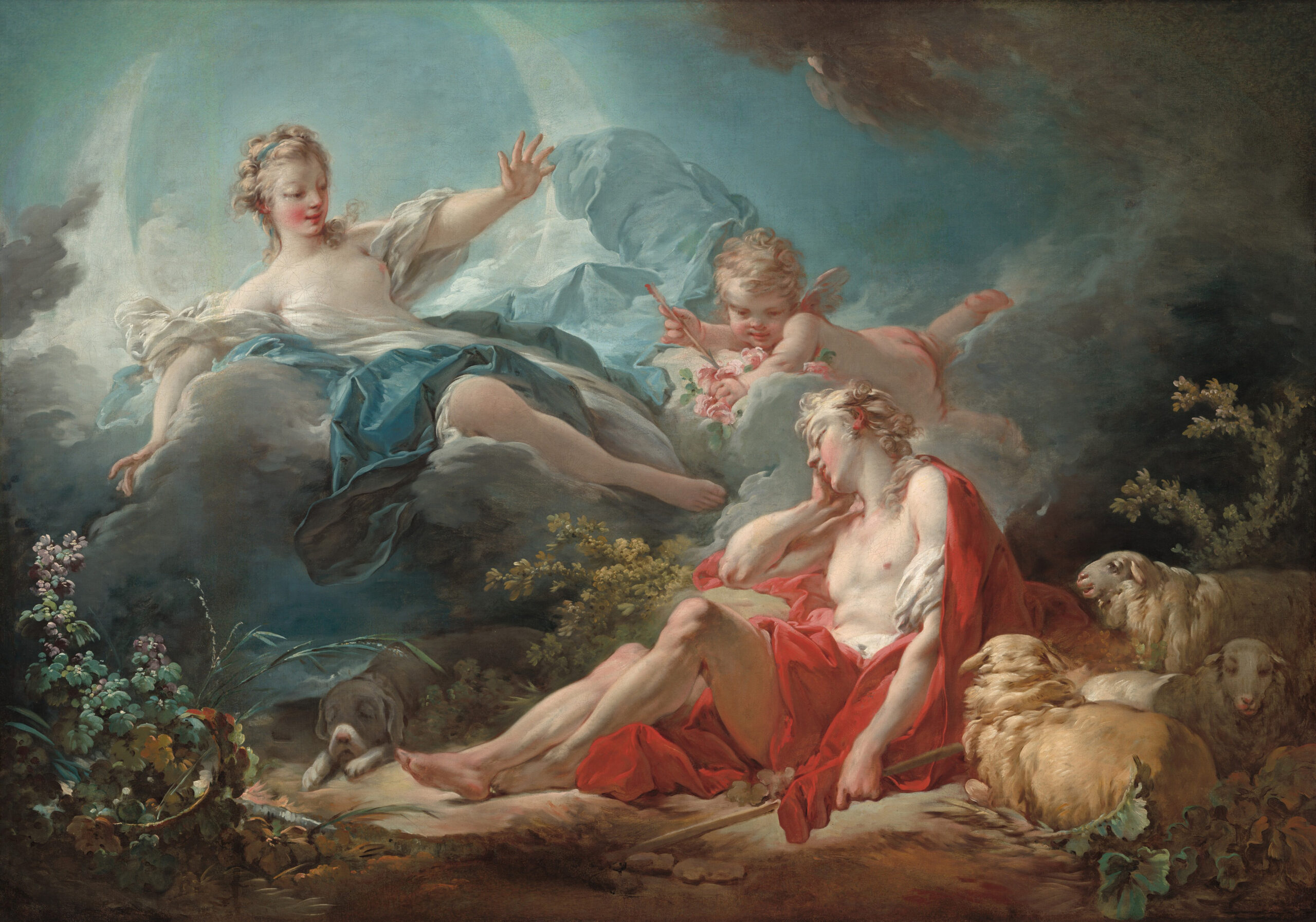
I admit that Fragonard’s Rococo sometimes unsettles me with its preciousness and its taste for ornament. But before this canvas, I find myself completely won over. What strikes me first is the soft palette, those pale pinks and milky blues that seem bathed in moonlight, and the near-suspended lightness of Endymion’s and Diana’s bodies.
The scene is sensual, yet handled with a delicacy that disarms any heaviness. The small Cupid, mischievous, arrow already in hand, adds a playful note, almost conspiratorial with the viewer: one senses what is about to happen before the figures themselves do. I am also drawn to the pastoral setting, the dense foliage, this sense of a hidden, sheltered corner of nature, the very spirit of the eighteenth century, which reimagines the pastoral as a refuge from the court.
A hand grips a bouquet of roses. An arrow protrudes from it. Cupid is about to release it. The gesture is minute. Yet it determines the entire painting.
Light Before Narrative
Look first at the skin. Diana’s, pearly, almost translucent under the moon’s glow. Endymion’s, gilded by a touch of sunlight that should not exist within this mythological night. The goddess’s blue drapery flows like water through the clouds. The shepherd’s red cloak, by contrast, blazes in a broad, flat passage against the dark grass. Fragonard applies the paint loosely, almost in sketch form, leaving the brushwork visible. Nothing is fixed. Everything still seems to be unfolding.
Diana and Endymion, a Myth Without Words
The myth does not recount an encounter but a contemplation. Diana, goddess of the moon, descends each night toward the sleeping Endymion. She is also the goddess of chastity. The shepherd is condemned to eternal sleep, the price of eternal youth. No word passes between the two figures. The silence of sleep becomes the painting’s true subject. In the eighteenth century, this theme allowed desire to be painted without being named. Fragonard draws on a formula popularized by his teacher Boucher: an open sky, bare flesh, a complicit Cupid.
Jean-Honoré Fragonard
Fragonard was born in Grasse in 1732. He trained first under Chardin, then under Boucher, a leading figure of the Rococo, whose influence shaped his early manner. The young painter won the Prix de Rome in 1752. He spent several years at the École Royale des Élèves Protégés before departing for Italy. This canvas dates from that formative period. It is held today at the National Gallery of Art in Washington.
Fragonard, 2026 News
Fragonard is once again in the spotlight. Through June 21, 2026, the Musée de Valence presents a major exhibition, The Feeling for Nature, pairing Fragonard’s work with that of Hubert Robert, two leading figures of eighteenth-century landscape painting, across nearly 80 paintings, drawings, and prints. In Grasse, the artist’s hometown, the Musée Jean-Honoré Fragonard presents a new exhibition from June 19 to October 18, 2026, Fragonard, Beloved Child of Grasse, marking the centenary of the perfume house that bears his name.
Sources: https://www.museumtv.art/artnews/agendas/hubert-robert-fragonard-valence/ and https://www.fragonard.com/fr-int/exposition-jhf-2026
A Question for You
💭 Fragonard painted this canvas before his stay in Rome. What in this composition already foreshadows the painter he would become?
About This Work
- Diana and Endymion
- Jean-Honoré Fragonard
- c. 1753–1756
- Oil on canvas
- 94.9 × 136.8 cm
- National Gallery of Art, Washington, D.C.
- https://www.nga.gov/artworks/46026-diana-and-endymion