Key facts
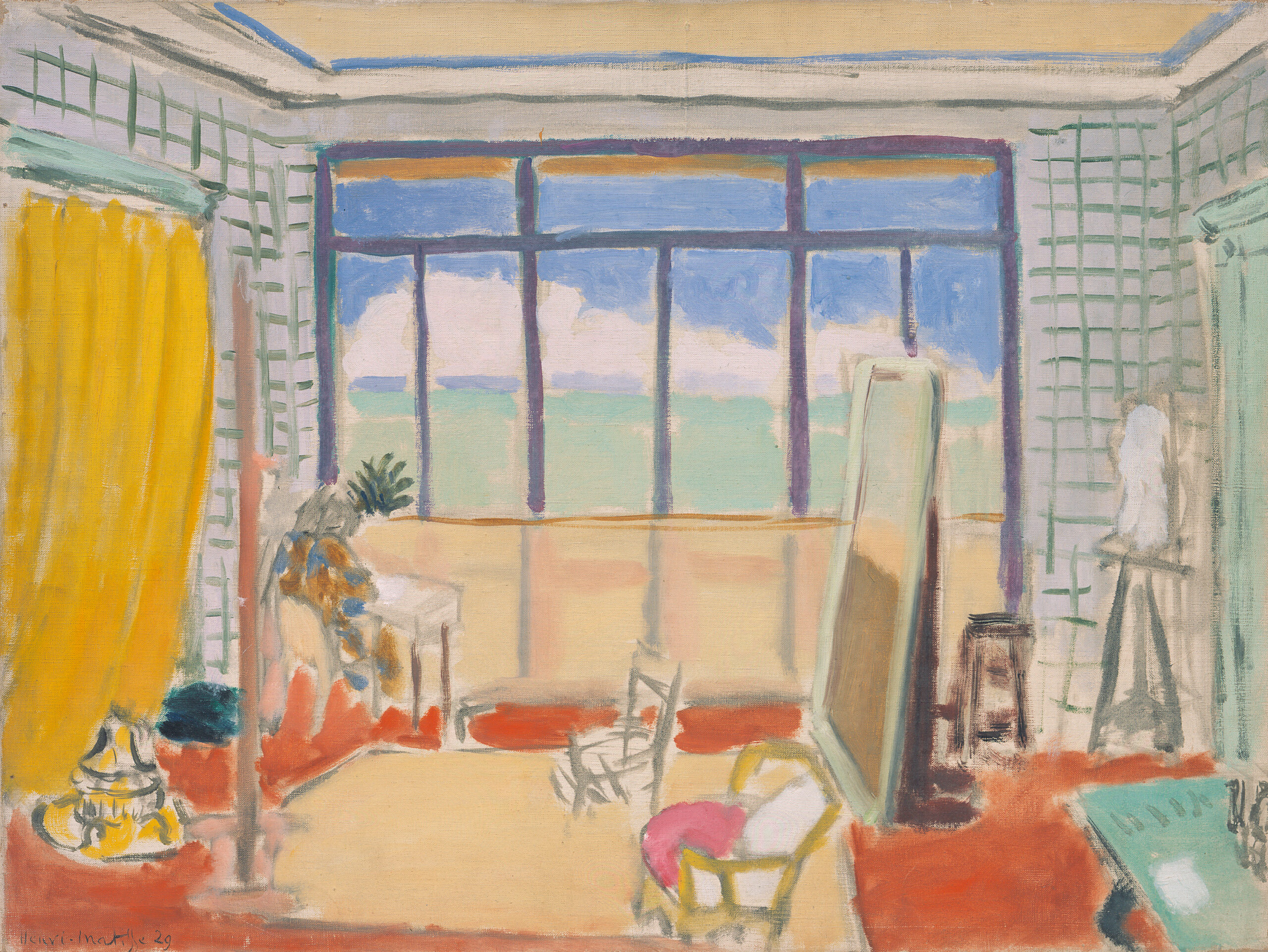
Painted in Nice in 1929, In the Studio in Nice is an oil on canvas by Henri Matisse, held at the Museum Berggruen in Berlin. It belongs to the Nice period of the artist, a leading figure of Fauvism who had settled in Nice in 1917. The painting depicts the artist’s studio, opened by a wide bay window onto the sea and sky, with a yellow curtain, chairs and a bust on its modelling stand. Its very light handling lets the grain of the canvas show through. It dates from a period of crisis: in 1928 and 1929, Matisse painted little, before his journey to Tahiti in 1930. The Berlin museums acquired it from Heinz Berggruen in 2000.
A Matisse studio: the painter depicted a great many of them throughout his career, such as Studio with Goldfish (Barnes Foundation, Philadelphia), which we have already featured here, or the famous Red Studio of 1911 (MoMA, New York). It is almost a genre in its own right for him. But what I find interesting here is that we are in a pleasant, peaceful and above all very bright space. You can feel all the light of Nice, the light that convinced Matisse to settle there from 1917 and to stay almost until the end of his life. Also interesting: a figure stands on the left of the canvas, most likely the artist himself. He seems discreet within his own setting, and I like this way of staging himself without taking centre stage. We discover the atmosphere of the studio: several sculptures, a large yellow curtain on the left, an easel with a canvas in preparation on the right. Every element speaks of work in progress, sculpture as much as painting, without anything seeming frozen. The small size of the painting (46.5 x 61 cm) heightens this sense of intimacy, as if we were quietly stepping into the painter’s home. For me, this canvas perfectly illustrates what Matisse called “an art of balance, of purity and serenity”. Everything here inspires creation, in a nurturing environment full of light. It is all the more moving given that in 1929, Matisse was going through a period of doubt in which he painted little, just before leaving for Tahiti in 1930.
You expect a cluttered studio, saturated with patterns and fabrics. Not at all. Look first at the large bay window with its violet frames. Sky and sea fill the whole centre. The studio seems to empty out towards the world beyond. And yet nothing is really missing: a yellow curtain, chairs, a white bust on its stand. Your eye hesitates between the room and the open sea. The painting does not decide.
In the Studio in Nice lets the canvas show through
Come closer. On the ceiling and walls, the grain of the canvas shows through everywhere. Here Matisse applies very thin oil paint, in light scumbles. Some shapes are no more than a grey outline. Look at the chair in the centre: a few strokes, no fill. Just in front, a yellow armchair holds a plump pink cushion. Line and colour compete for the same space. It could almost be a sketch. Yet at the bottom left, the signature is crisp: “Henri-Matisse 29”. So the painter judged the work worthy of his signature. Whether he considered it finished is less certain.
On the walls, a green grid sets the rhythm of the surface. The Centre Pompidou notes these regular squares on the walls of Matisse’s new studio. The painter had occupied it since spring 1927, on the fourth floor of 1, place Charles-Félix. So the decor really existed. But here it becomes an almost abstract trellis. The orange-red floor does not cover the whole room. It falls in patches, like rugs tossed down at random. The light comes from no precise source. It is born from the barely covered canvas.
Finally, look at the colours. The yellow curtain answers the violet window frames. The orange-red floor converses with the green grid and table. These are two pairs of complementary colours, made to clash. Here, they do not clash. The white of the canvas holds them apart and calms them.
Henri Matisse paints the studio when painting resists
In 1929, Matisse had been living in Nice for more than ten years. This is the Nice period, the time of odalisques and interiors open to the sea. In the Nice studio, the window plays a considerable role. It brings the Mediterranean horizon into the room. The leader of Fauvism now enjoys recognition. Several retrospectives are in preparation. And yet he doubts. In 1928 and 1929, he paints little. Facing the canvas, he confides, he has “no ideas”. He makes more prints and drawings. He also completes his sculpted series, the Heads of Henriette.
Here lies the paradox. A painter in a creative slump depicts the very place where he works. A figure may be standing there. But no one is painting. The large canvas, on the right, turns its back to us. In 1930, Matisse leaves for Tahiti, in search of another light. Yet he has the light of Nice before his eyes, and he paints it.
The painting long remained in the artist’s estate. The Berlin museums bought it from Heinz Berggruen in 2000, as stated on its page on the Staatliche Museen zu Berlin website.
News: the Berggruen collection on tour
Closed since September 2022 for a complete renovation of the Stüler building in Charlottenburg, the Museum Berggruen is sending its collection on tour during the works. In the Studio in Nice was one of the Matisse works shown at the Museum of Fine Arts, Houston, from 20 May to 13 September 2026, in the exhibition “Picasso–Klee–Matisse: Masterpieces from the Museum Berggruen”. It was the first presentation of the Berggruen collection in the United States. Since leaving Berlin, this international tour has drawn more than one million visitors. The Berlin museum’s reopening is officially scheduled for 2026, but in the autumn the building was still entirely covered in scaffolding, and a reopening in 2027 seems more likely. In the meantime, 2026 has also been a rich year for Matisse in France: the retrospective “Matisse, 1941–1954” at the Grand Palais, followed by the exhibition “Henri Matisse – Yves Saint Laurent” at the Musée Matisse in Nice, the city where this painting was made.
Source: Entwicklungsstadt.
A question for you
If you had to paint your own workplace, what would you put at the centre?
About this work
- In the Studio in Nice
- Henri Matisse
- 1929
- Oil on canvas
- 46.5 x 61 cm
- Museum Berggruen, Berlin
- https://search.smb.museum/object/obj-959093