Key facts
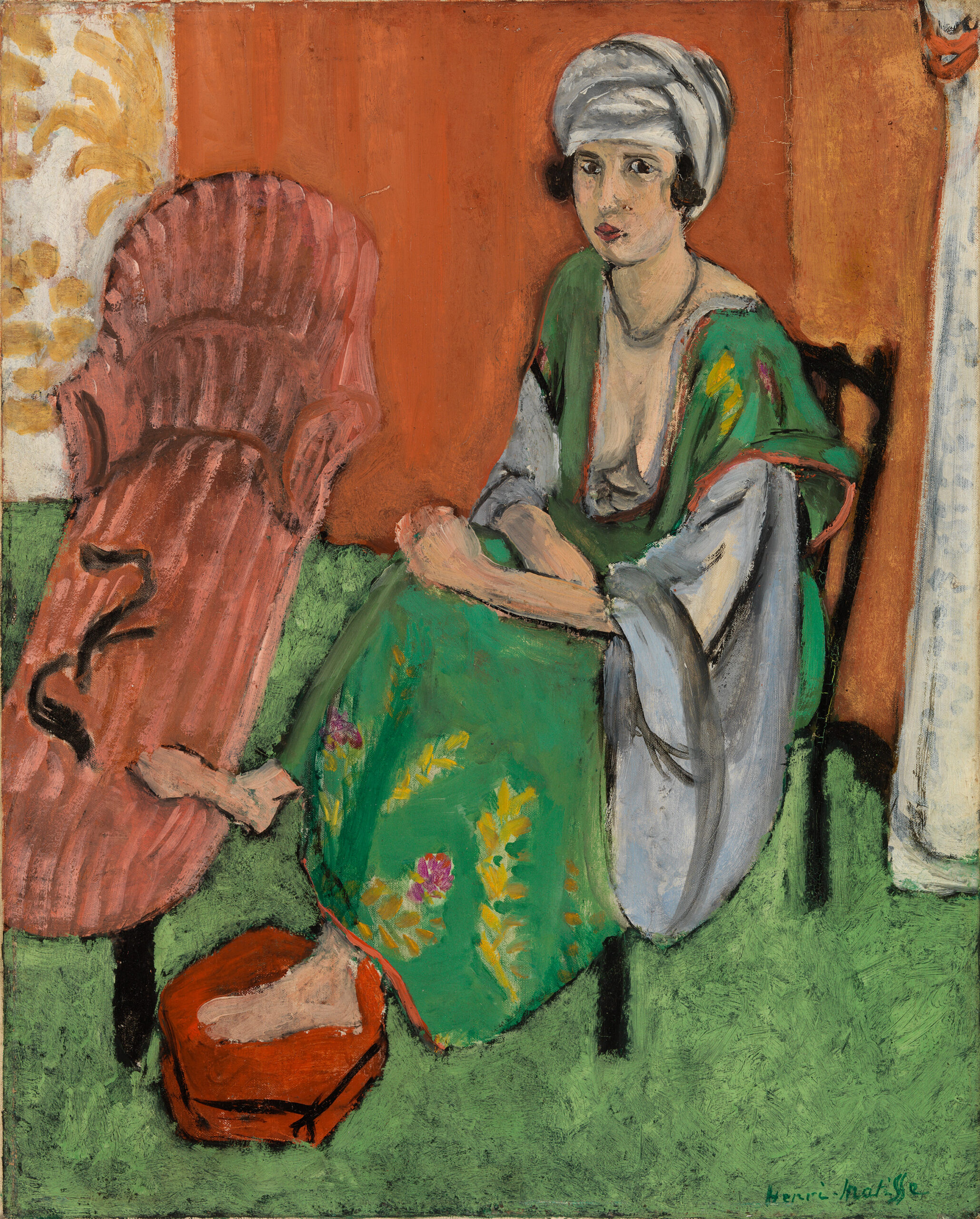
The Green Dress, painted by Henri Matisse in 1919, belongs to the artist’s Nice period, begun after he settled in Nice in December 1918. The painting depicts Antoinette Arnoud, a model dressed in a green gandoura and a white turban, seated in front of an orange wall. These oriental elements foreshadow the odalisque theme, which Matisse would develop from 1920 onward through the following decades on the Côte d’Azur. The oil on canvas, held at the Barnes Foundation in Philadelphia, illustrates the shift between the Fauvist rigor of the 1910s and the decorative freedom that would define the Nice-period Matisse. The pentimenti visible beneath the green layer show a work built through successive reworkings.
This work by Matisse foregrounds the color green: the green of the model’s dress answers the green of the rug. What strikes me here is the oriental quality of the scene, which foreshadows the odalisque paintings Matisse would go on to make. This orientalism comes through in the turban and in the “gandoura” style of the dress. I love Matisse, and I’m always fascinated by his handling of color, by the way the composition of the canvas builds itself through the play of hues. There’s also the recurring presence of fabric that marks his work: in the dress, in the upholstery of the armchair, and even on the wall on the right. So many patterns that give rhythm to the detail of the canvas, letting the eye move across it and letting the atmosphere spread.
A pearl-gray turban, tightly wound. Beneath the fabric, two dark eyes stare at the painter. Nice, the first half of 1919. Matisse has just settled into the Hôtel de la Méditerranée. With Antoinette Arnoud, his new model, he’s searching for a new synthesis.
Green against Black
Arnoud rests one foot on the pink chaise longue, where a pair of black stockings has been left behind. The other rests on a red Moroccan pouf, the only warm note on the floor. Her green dress, an ample gandoura, is patterned with yellow and mauve floral motifs that echo the palette of the wall. The orange wall behind her fills the full height of the canvas; on the right, a white curtain suggests a window that’s never shown. Matisse first paints in black, then covers the surface with two successive layers of green. The cracks visible today reveal, at the feet of the chair and the sofa, this dark layer surfacing through the paint, like a pentimento left in plain sight. The canvas’s modest size, 41.3 by 33.5 centimeters, concentrates all this dense material into a tight space.
Nice, 1919: The Making of an Odalisque
Antoinette Arnoud enters the studio in January 1919. Matisse works alone with her, far from the Paris circle, almost withdrawn from the world. He dresses her much as he had dressed Laurette three years earlier: a green dress, a white turban close to the one in Three Sisters on a Gray Background (BF888). The Moroccan pouf, the gandoura, the turban form an oriental vocabulary that Matisse would fully develop from 1920 onward, in his Nice-period odalisques. A preparatory drawing from the same year shows Arnoud in an almost identical pose, feet resting on this same geometric footstool. Praised in its own time for its chromatic freedom, this oriental vocabulary is read today in light of ongoing debates about orientalism in painting.
Henri Matisse
Matisse settles in Nice at the end of 1918, after years of war and doubt. He rents a modest room, far from his Paris studio, and lives in relative solitude. This chosen solitude feeds an intense formal search, carried out almost entirely with Antoinette Arnoud as his silent counterpart. The Green Dress sits at this turning point, between the rigor of the 1910s and the decorative freedom that would come to define, in art history, his own period: the Nice years.
In the News: Musée départemental Henri Matisse, Le Cateau-Cambrésis
The Musée départemental Henri Matisse in Le Cateau-Cambrésis (Nord), home to one of the richest collections of the artist’s work, is presenting, through September 20, 2026, the exhibition “Hommage à Auguste Herbin, Dialogue des alphabets,” in dialogue with one of Matisse’s contemporaries. The museum is also running guided tours and taking part in the European Heritage Days on September 19 and 20.
Source: Musée Matisse du Cateau-Cambrésis
A Question for You
What if the turban and the gandoura weren’t an exotic backdrop at all, but simply the pretext for a color harmony Matisse had been chasing for months?
About this Artwork
- The Green Dress
- Henri Matisse
- 1919
- Oil on canvas (later mounted on fiberboard)
- 41.3 x 33.5 cm (16 1/4 x 13 3/16 in)
- The Barnes Foundation, Philadelphia
- https://collection.barnesfoundation.org/objects/5131/The-Green-Dress-(La-Robe-verte)/