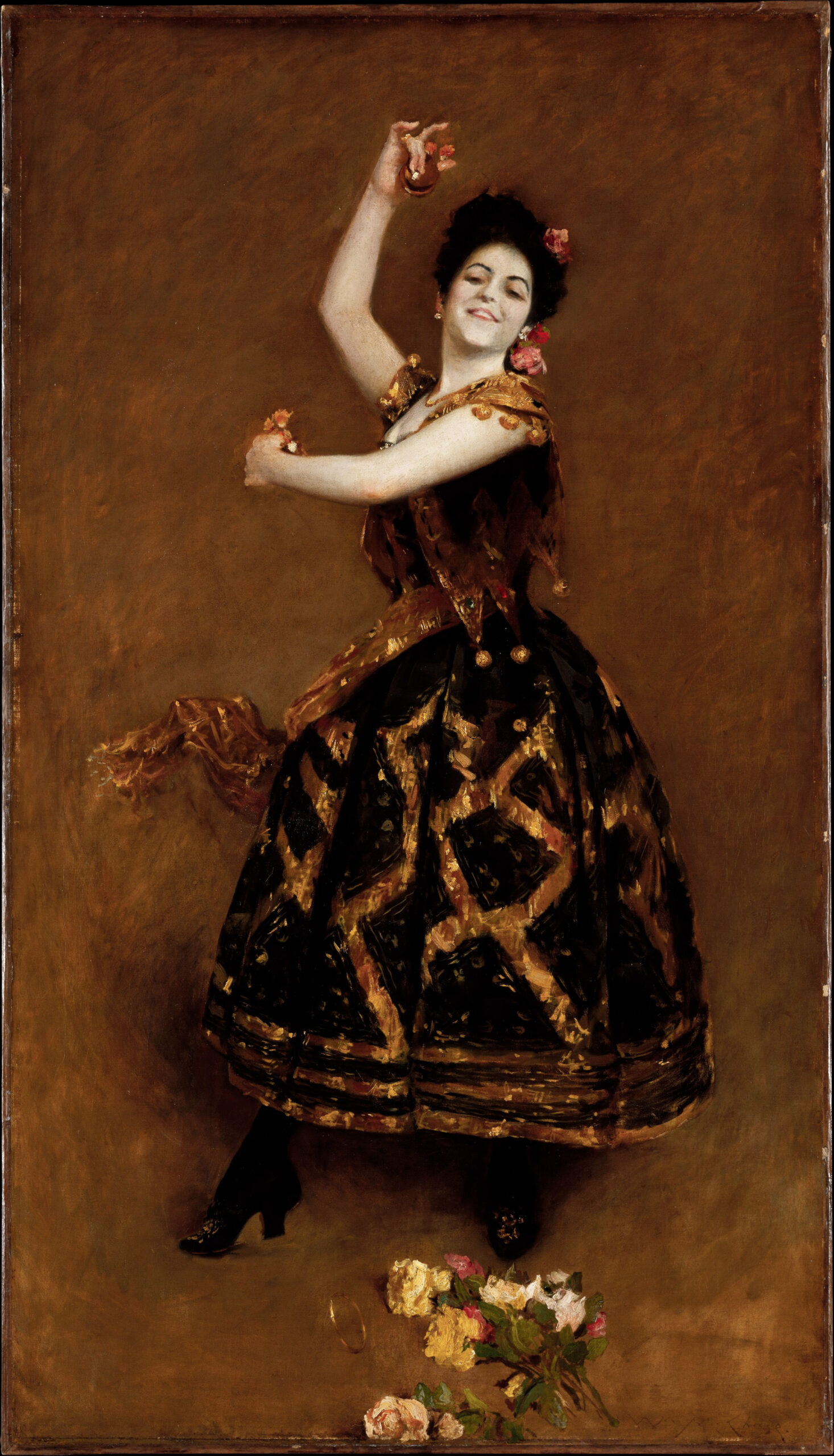
New York, 1890. In the Tenth Street Studio, a Spanish dancer electrifies the room. William Merritt Chase seizes his brush. He must capture the impossible: the electricity of a body in motion.
The Flash of an Instant
Carmencita turns. Her black-and-gold dress explodes against the amber-brown ground. Chase works in broad strokes. The golden reflections of the fabric seem to move. Her face radiates a closed, luminous, almost insolent smile. One arm rises, the other traces a graceful curve. Look at the flowers scattered across the floor: a bouquet thrown as an offering. A gold bracelet gleams at her wrist. The handling is free, impasted, generous. Every brushstroke breathes admiration.
A Star in Gilded America
Born in Almería in 1868, Carmencita conquered Spain, then France through the 1880s. In 1889 she arrived in New York and set private salons ablaze. John Singer Sargent organised a performance in Chase’s own studio. The audience threw jewels and flowers at her feet. Chase immortalises that fervour: the gifts scattered across the canvas are not a decorative detail. They are the memory of an evening. Sargent painted Carmencita that same year as well, his canvas now hangs in the Musée d’Orsay. Two giants, one shared fascination.
William Merritt Chase
William Merritt Chase (1849–1916) was the great master of American Impressionism. Trained in Munich and later shaped by Velázquez, he established himself as a virtuoso portraitist and a major teacher. He trained an entire generation of American artists, among them Georgia O’Keeffe. In Carmencita, he unites spontaneity and technical mastery in the service of a subject burning with life.
A Question for You
💭 Carmencita fascinated Gilded Age America as an exotic figure: is Chase painting an artist, or the fantasy of a dreamed-of Spain?
About this work
- Carmencita
- William Merritt Chase
- 1890
- Oil on canvas
- 177.5 × 103.8 cm
- The Metropolitan Museum of Art, New York
- https://www.metmuseum.org/fr/art/collection/search/10465
Carmencita in New York: The Dancer Who Fascinated Two Painters
Carmencita depicts the Spanish dancer María Ángeles López Moncet, known as Carmencita (born in Almería in 1868), who triumphed in New York in 1889-1890 and generated a fascination that contemporaries compared to what Isadora Duncan would inspire a generation later. John Singer Sargent, having seen her dance, organised a private performance in his New York studio and invited William Merritt Chase; each painter independently produced a large canvas from the occasion. Sargent’s painting entered the Musée d’Orsay in Paris; Chase’s was acquired by the Metropolitan Museum. This concurrence is rare in the history of American art: two friends, two distinct pictorial temperaments, the same model captured in the same impulse. For Chase, Carmencita was an occasion for virtuosity, the black-and-gold dress whose reflections seem to vibrate, the flowers scattered on the floor like offerings from an invisible audience, the dancer’s expression at once proud and fully present.
Munich, Velázquez, and American Impressionism
William Merritt Chase (1849-1916) was shaped by a European training atypical for an American of his generation: not Paris and the academic Beaux-Arts system, but Munich and its Academy, where between 1872 and 1877 he acquired a mastery of broad, impasted brushwork and luminous oil paint that owes nothing to French academic caution. In Munich he also discovered the Spanish masters, and Velázquez in particular, whose compositional restraint and painterly freedom accompanied him throughout his career. Carmencita bears the trace of these influences: the amber-brown ground that throws the golds of the dress into relief, the silhouette set against an almost empty space, the loaded and direct touch.
A Teacher Whose Students Transformed American Art
What distinguishes Chase beyond his painted work is his pedagogical influence. He taught at numerous New York institutions and in 1891 founded the Shinnecock Hills Summer School of Art on Long Island, one of the first open-air painting schools in the United States. Among his students: Georgia O’Keeffe, George Bellows, Edward Hopper, and John Marin, a substantial portion of the pantheon of 20th-century American art. Chase’s classroom is the missing link between the European Impressionism he absorbed in Munich and the American modernism that asserted itself after 1913.