Key Takeaways
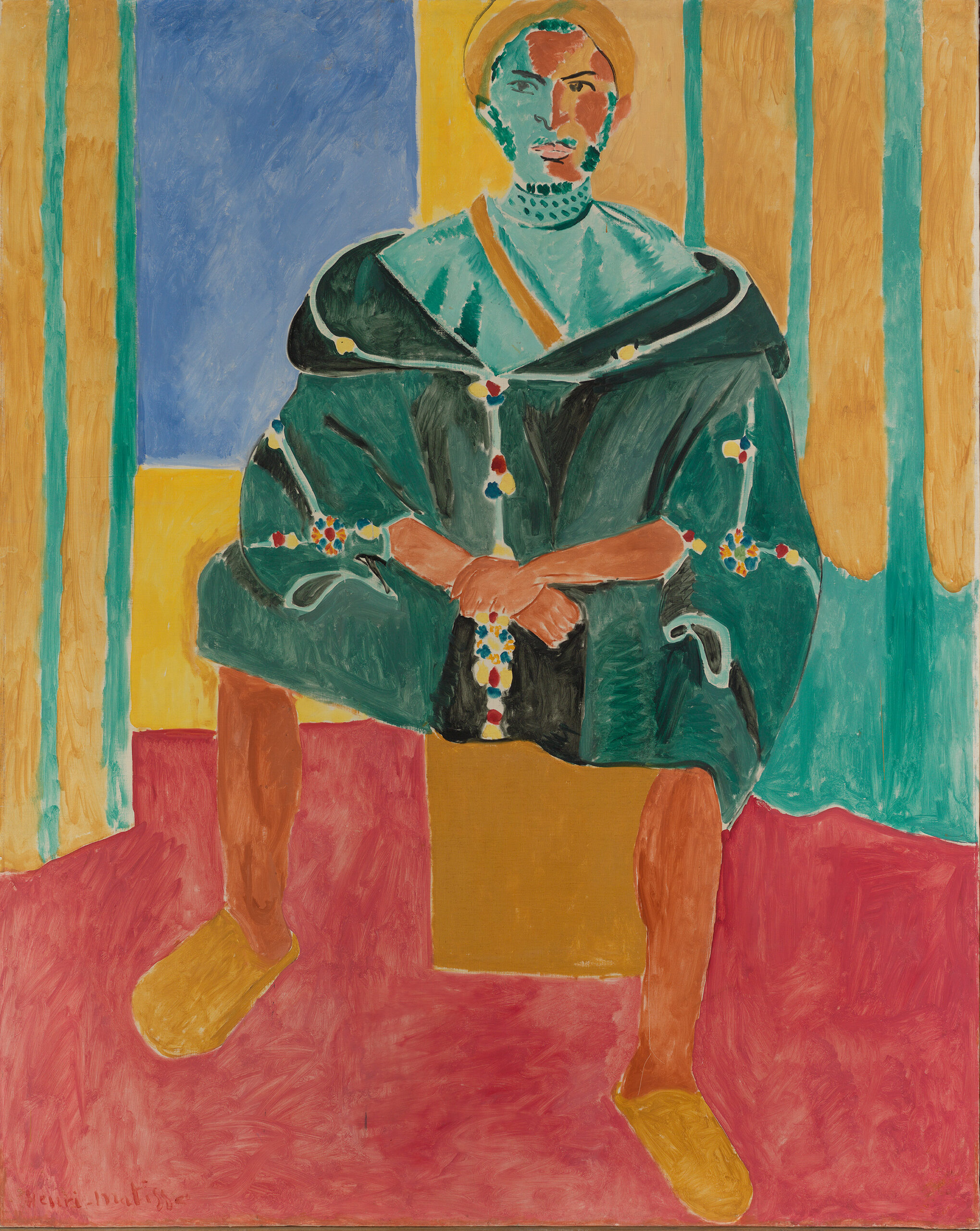
Seated Riffian is an oil on canvas painted by Henri Matisse in 1912, held in the collection of the Barnes Foundation in Philadelphia. The work belongs to the artist’s Moroccan period, created following his Fauvist years. It depicts an inhabitant of the Rif, a region in northern Morocco, whose traditional dress structures the entire composition. Matisse renders the human figure in flat planes of pure color, reducing space and volume in favor of a chromatic construction. The painting shows how the artist appropriates the codes of nineteenth-century Orientalist portraiture, notably that of Delacroix, to assert a personal pictorial language grounded in color rather than realistic depiction of the subject.
What strikes me first about Seated Riffian is the way Matisse makes color the very subject of the painting, well before the motif itself. The deep blue of the vest, the acid green structuring the shadows of the face, the warm ochre of the skin: nothing here imitates reality, everything serves to construct a presence. The black contours, inherited from his Fauvist years, do not so much draw as contain the color, like stained glass.
This way of translating Orientalism not through anecdote (costume, setting, accessories) but through an almost raw chromatic intensity strikes me as characteristic of this pivotal moment in 1912, when Matisse returned from Morocco with a palette transformed by Mediterranean light. It is this relationship to color, never decorative, always structural, that moves me most in his work. It remains the throughline of his entire career: from this canvas to the cut-outs of his final years, where color, freed even from the support of the canvas, becomes form in its own right.
What the surface conceals
Look first at his face. An invisible scar splits it in two. On the right, a muted green overtakes the cheek. On the left, orange and brown mingle in mottled patches. This is not shadow. For Matisse, light does not imitate: it colors. His crossed hands nearly vanish into the deep green of the garment.
Matisse painted Seated Riffian in 1912, upon his return from his second stay in Tangier. The oil on canvas measures 89 by 111.5 centimeters (35 by 43⅞ inches). It is held today at the Barnes Foundation in Philadelphia. The figure occupies nearly the entire frame, oversized, flattened. No temporal marker asserts itself: neither time of day nor season. The space behind him remains ambiguous, somewhere between a striped curtain and a blue rectangle suggesting the world outside. The seat on which he rests is impossible to identify. Only the costume, richly embroidered with floral motifs, anchors the figure in a recognizable identity. The hands, ordinarily the most expressive zone of a portrait, are treated with striking economy. Matisse radically simplifies what Orientalist tradition rendered in painstaking detail. The divided face might suggest an effect of light, one side illuminated, the other in shadow. It could equally evoke a tattoo or ritual paint. The costume tells us everything about him. The face, blurred by color, tells us nothing more.
The artist and his era
Henri Matisse was 42 at the time. A leading figure of Fauvism since 1905, he sought in Tangier a new kind of light, harsher than that of the south of France. He sent his son Jean a postcard of the model, describing him as a former bandit from the Rif who had become governor of a province. Matisse showed little interest in the political anecdote. He looked instead at a silhouette, a costume, a way of engaging with, and distancing himself from, the Orientalist tradition of Delacroix. Technique mattered more to him than subject: it is technique that carries the full weight of the painting.
In the news: the Barnes Foundation puts Matisse in the spotlight
Each month, the Barnes Foundation offers a themed guided tour, or “Spotlight Tour,” devoted to a particular artist or theme within its collection. In April 2026, this tour was dedicated to Matisse, Dr. Albert Barnes, and The Dance — the monumental mural the founder commissioned from the artist during his visit to the Foundation in 1930. It’s a fitting occasion to note the exceptional scope of the Matisse holdings in Philadelphia: no fewer than 59 works, including landmarks of modern art such as The Joy of Life (1906) and The Dance itself. The tour traces how Matisse’s stay at the Barnes Foundation marked a decisive turning point in his career — valuable context for understanding a work like Seated Riffian.
More information is available on the museum’s website: barnesfoundation.org.
A question for you
💭 Delacroix painted the exotic in order to narrate it. Matisse uses it in order to dismantle it. At what point does citing a tradition stop being a way of belonging to it?
About this work
- Seated Riffian
- Henri Matisse
- 1912
- Oil on canvas
- 200 x 160 cm (78 7/8 x 63 1/4 in)
- The Barnes Foundation, Philadelphia
- https://collection.barnesfoundation.org/objects/6969/Seated-Riffian-(Le-Rifain-assis)/