Key facts
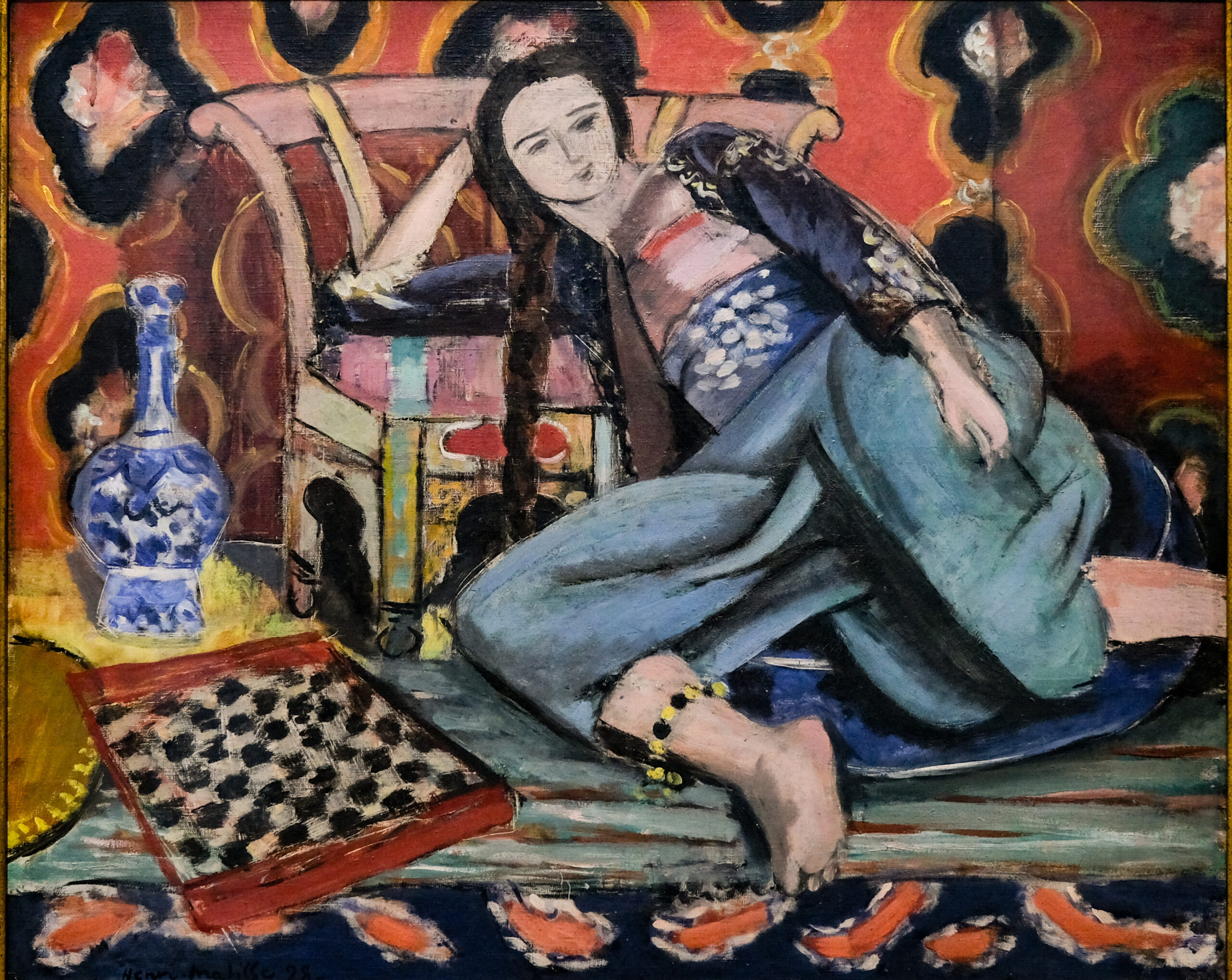
Odalisque with an Armchair is an oil painting made by Henri Matisse in 1928, during his Nice period. The work belongs to the series of odalisques the artist developed throughout the 1920s, drawing on Orientalism and on his travels to Morocco in 1912 and 1913. It pairs a reclining female figure with a richly composed setting: a padded armchair, a patterned rug, blue-and-white ceramics. Held at the Musée d’Art Moderne de Paris, in the Paris Musées collections, this canvas shows how Matisse builds, in the studio, fictional Orientalist scenes in which color and pattern take precedence over any documentary accuracy.
Matisse always delights me. His handling of color is especially interesting and fascinating: here, the pink of the armchair, the deep blue of the vase on the left, and the warm tones of the wall play off one another with an almost effortless ease, even though everything is in fact very carefully controlled. This Odalisque is striking for its sheer richness of detail, the bracelet at the ankle, the checkers set nearby, the pattern on the armchair, the decoration on the wall, all of it inviting you to linger in front of the canvas. The odalisque herself reclines nonchalantly, almost absent from the scene, and it’s this ease that brings a real softness, a real humanity, to the whole. A touch of Orientalism also comes through here, visible in particular in the loose garment she wears.
You first notice this bracelet of black and yellow beads, tight around a bare ankle. Then the foot spilling over the edge of the rug, almost carelessly. The rest follows: the pink armchair, the abandoned checkerboard, the blue-and-white vase, the reclining figure filling the entire available space of the canvas.
Odalisque with an Armchair
Henri Matisse painted this Odalisque with an Armchair in 1928, in the heart of his Nice period. The brushwork remains Fauvist in its chromatic intensity, but the subject has shifted since the movement’s early days. No more beach, no more window open onto the sea, instead a closed room, saturated with pattern. The red-and-gold wall, the padded armchair, the rug compose an almost theatrical setting, where every surface carries its own design. This decorative accumulation owes much to nineteenth-century Orientalism, to Delacroix, and to the fabrics, rugs, and ceramics Matisse collected following his trips to Morocco in 1912 and 1913. The figure’s loose garment, her crossed legs, her face turned toward the viewer: everything here belongs to a scene staged in the studio, far removed from any lived exoticism. The color, for its part, never tries to imitate reality. The blue of the vase answers the blue of the rug, the pink of the armchair converses with the reds of the wall, in a carefully calculated balance. Even the checkers set, abandoned in the foreground, seems placed there purely for its graphic value, its black-and-white squares echoing the mottled rug underfoot. The brushwork, broad and heavy in places, contrasts with the fine detail of the small patterns painted on the wall.
Another Odalisque by Matisse, made in the same setting but seated this time, is held at the Baltimore Museum of Art, just as interesting and colorful.
Henri Matisse and His Time
Born in 1869 in Le Cateau-Cambrésis, Henri Matisse gave up law for painting in the early 1890s. Leader of the Fauvist movement from 1905 onward, he settled in Nice starting in 1917. Throughout the 1920s, he produced numerous odalisques there, seeking not ethnographic accuracy but a pretext for color and pattern. This taste for southern decor, light, and printed fabrics left a lasting mark on this decade of his work. This canvas now belongs to the collections of the Musée d’Art Moderne de Paris. It extends a series in which the painter returns again and again to the same repertoire: armchairs, fabrics, reclining figures, exhausting every possible combination between setting and body. Each variation shifts the same objects slightly, like a painter endlessly replaying the same visual score.
News
Interest in Matisse shows no sign of fading: in spring 2026, the Grand Palais presented, in coproduction with the Centre Pompidou, a major retrospective devoted to the artist’s final years of creation (1941-1954), bringing together more than 300 works and numerous international loans previously unseen in France. This exhibition confirms the central place Matisse’s work still holds today within major cultural institutions.
Source: Grand Palais
A Question for You
What if the title weren’t about her, but about us: in looking at her, are we the heirs of that nineteenth-century Orientalist gaze?
About This Work
- Odalisque with an Armchair
- Henri Matisse
- 1928
- Oil on canvas
- Musée d’Art Moderne de Paris, Paris Musées
- https://www.parismuseescollections.paris.fr/fr/musee-d-art-moderne/oeuvres/odalisque-au-fauteuil