Key facts
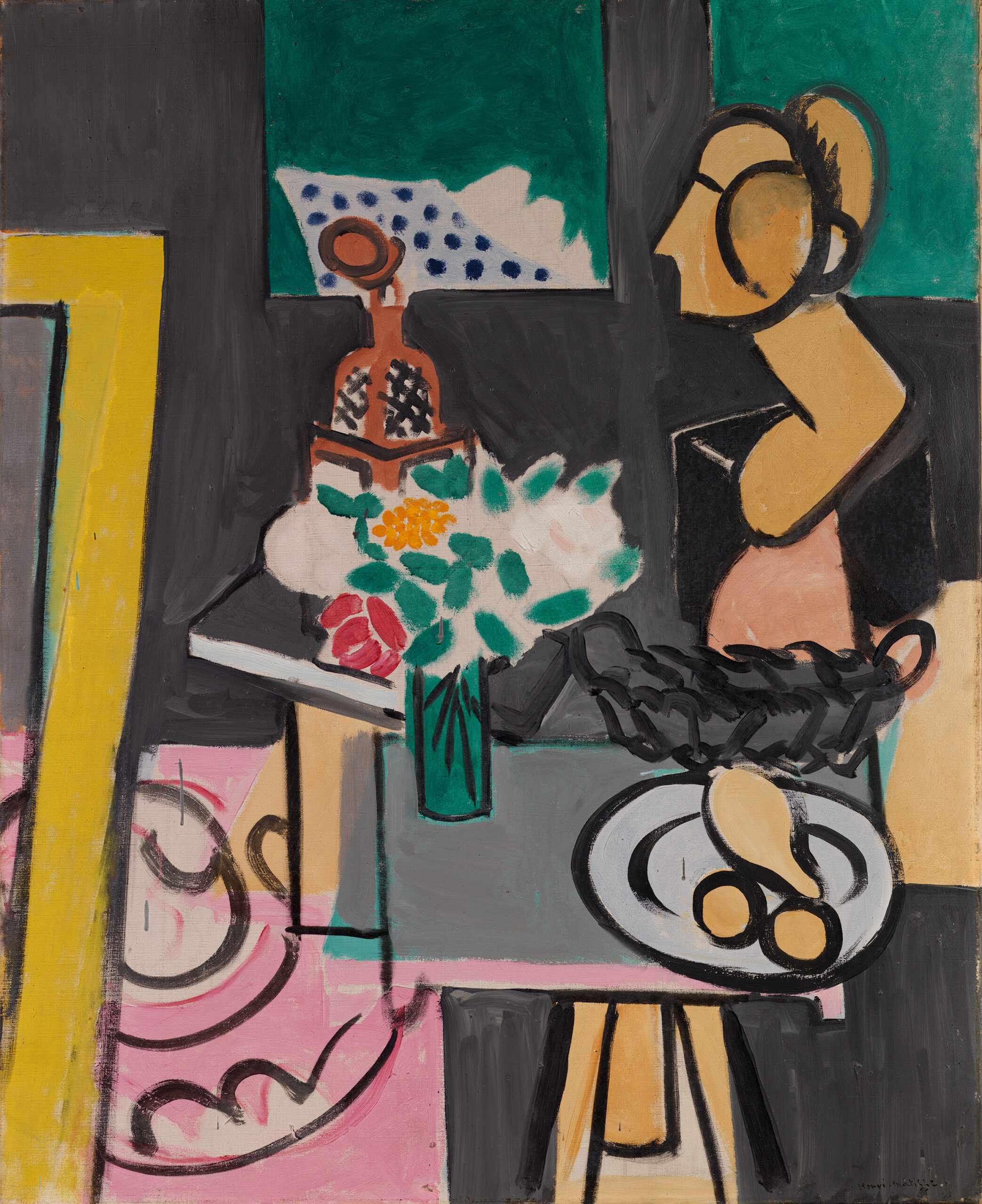
Still Life with Gourds, painted by Henri Matisse around July 1916, belongs to the period when the artist, working from his studio in Issy-les-Moulineaux, appropriated certain strategies of the Cubism invented by Pablo Picasso, without adopting its systematic grid. The oil on canvas, held at the Barnes Foundation in Philadelphia, depicts a studio motif: a bust from the Jeannette series, a three-legged stand, a bouquet, and a plate of gourds, arranged within a compressed space where black contours and areas of color come apart from one another. This dissociation, combined with large areas of bare, unpainted canvas, places the work among Matisse’s most abstract experiments during the First World War, before his return to calmer figuration in the 1920s.
Here is a rather experimental Matisse, painted in 1916, in the midst of the First World War, a period when the artist ventured furthest into abstraction. I strongly sense the influence of Cubism here, which Matisse appropriates in his own way: these different planes, these juxtaposed or overlapping squares that organize almost the entire surface into a geometric grid. And yet we still find Matisse’s own style here, his colors answering one another, the freedom of composition and form that would go on to mark his work for years to come. I particularly love this painting, which holds my gaze: each element is treated with real specificity, giving the whole composition its rhythm. The plane is nonetheless very compressed, the table and fruit lean forward in an almost impossible balance, as though space itself refused to settle. Only the gilded frame, quite classical in feel, disrupts this rigor and reminds me that Matisse never fully left behind his own pictorial tradition, even in his most radical experiments.
Looking at Still Life with Gourds
Matisse’s black contours enclose flat areas of color. They never quite align with them: gray, yellow, pink, all set slightly off. A stand holds a bust. A table holds a bouquet of flowers and a plate of fruit. The wall, the floor, and the table blend into one continuous gray. There is no cast shadow, no classical depth.
Understanding Henri Matisse
Henri Matisse painted this still life around July 1916, in the midst of the First World War. The work comes at the tail end of a period when the artist intensely explored Pablo Picasso’s Cubist strategies. He kept the bold black contours and the layering of planes. Yet he broke free of Analytic Cubism’s rigid grid. His technical discovery lies in one simple gesture: separating color from contour. The gray, yellow, and pink areas spill past the black lines, or stop short of them. This slight offset creates movement across the surface. Large areas are left unpainted, particularly in the foliage and the bouquet. The setting suggests Matisse’s studio in Issy-les-Moulineaux. A bust from his Jeannette series is visible, along with a window in the background. The frame of a neighboring painting juts in from the left. This studio scene anchors the abstraction in a specific, almost documentary place.
Feeling It
Look at the light in the bouquet. It doesn’t come from a brushstroke, but from an absence: the bare canvas breathing between the leaves. This simple device creates a backlit effect, as though the window behind it still lit the room. A second, warmer light seems to come from the right. It may come from a doorway left out of frame, casting patches of ochre downward. Matisse’s abstraction doesn’t erase the world. It holds onto it in fragments, gray on gray, in the precise light of a wartime studio.
Current news: Matisse and fashion in Nice
Through September 28, 2026, the Matisse Museum in Nice is presenting an exhibition on Matisse and Yves Saint Laurent. Titled “Le beau, la mode et le bonheur” (Beauty, Fashion, and Happiness), it brings together 160 works spanning painting and haute couture, drawn from the collections of the museum and the Fondation Pierre Bergé–Yves Saint Laurent. The exhibition traces how Matisse’s taste for pattern fed into the couturier’s world.
Source: Musée Matisse Nice
A question for you
Matisse keeps Cubism’s black contours and layered planes, but separates color from them. Is this still a borrowing from Cubism, or already something else?
About this work
- Still Life with Gourds (Nature morte aux coloquintes)
- Henri Matisse
- 1916
- Oil on canvas
- 100 x 81.3 cm
- The Barnes Foundation, Philadelphia
- https://collection.barnesfoundation.org/objects/5435/Still-Life-with-Gourds-(Nature-morte-aux-coloquintes)/