In Brief
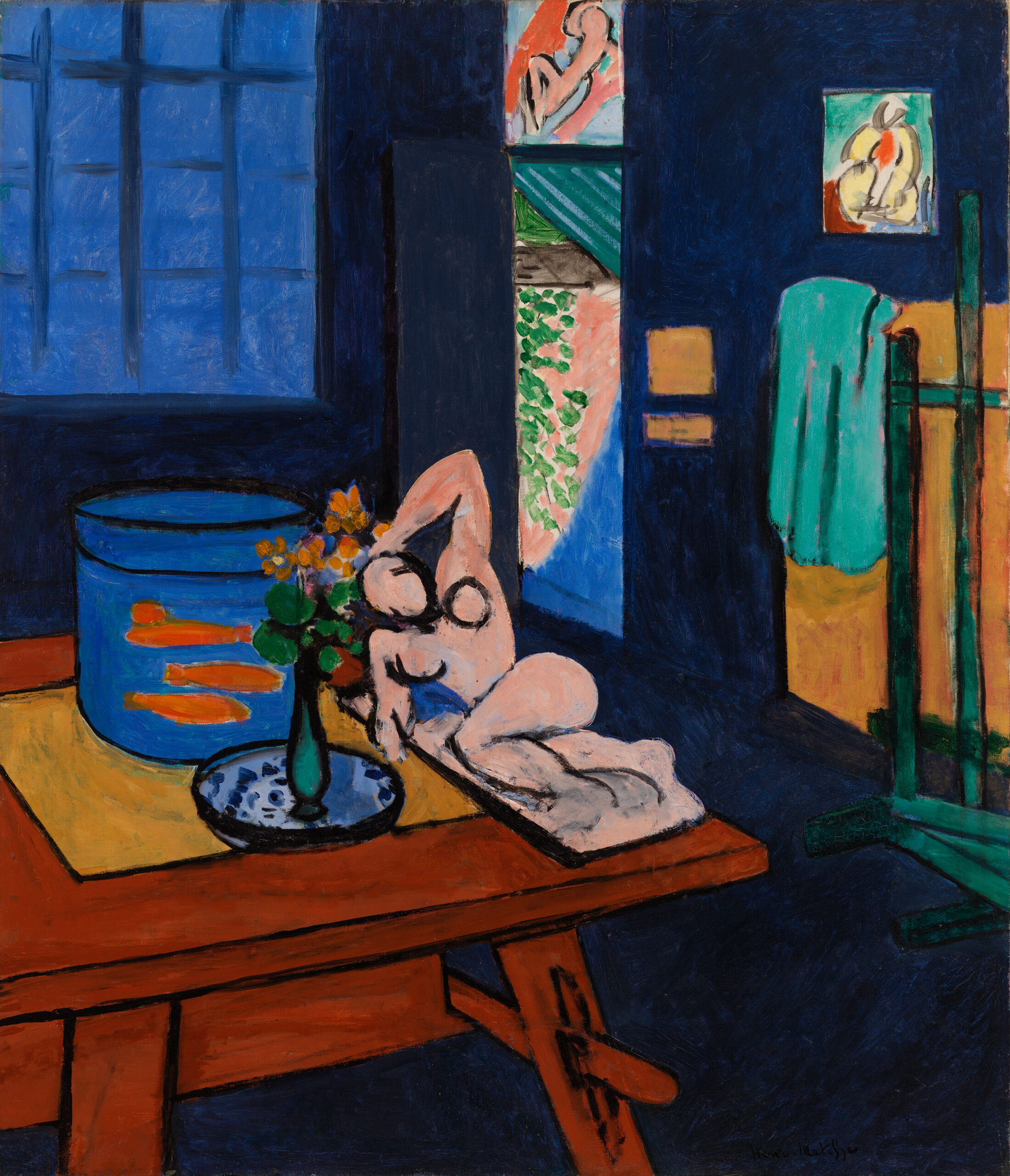
Painted in the spring of 1912, following a journey to Morocco, Studio with Goldfish (L’Atelier aux poissons rouges) by Henri Matisse depicts the interior of his studio at Issy-les-Moulineaux. A leading figure of Fauvism, Matisse develops here the motif of the goldfish bowl, an emblem of contemplation and of the act of looking, while dissolving the boundary between real space and painted space. The composition rests on forceful diagonals and on the contrast between the blue of the room and the vermilion of the fish. Held by the Barnes Foundation in Philadelphia, this oil on canvas marks a pivotal moment in the artist’s reflection on the act of painting at the dawn of the twentieth century.
Matisse had this studio built at Issy-les-Moulineaux, and it is almost there that the reading of the painting begins, for me: a painter at home, in his place of work, arrested by a scene so ordinary that he feels the need to fix it on canvas.
The studio is bathed in a bluish half-light, while the door opens onto an exterior flooded with light. In this almost suspended atmosphere, life gathers at a single point: the goldfish, the only bright, warm notes in the composition, moving silently in the water of their bowl. They are the sole movement in the room, as though everything around them were waiting. For an action, an inspiration, the impulse that would make creation begin again.
Before this work I feel an invitation to contemplation: of the fish, of the paintings and the sculpture already present in the studio, of the place itself as a space of creation. Matisse sets down here an inner reflection, his own, and by the same gesture invites mine, I who am looking. Perhaps that is what holds me longest before it: that loop in which the artist’s work exists fully only through the gaze we bring to it. And this Studio with Goldfish brings to mind another famous studio, The Red Studio, which I had the chance to admire at MoMA in New York.
Issy-les-Moulineaux, spring 1912. A goldfish, painted in sharp foreshortening, seems to swim toward you. Around it, Henri Matisse‘s studio settles into a deep blue. The painter has just returned from Morocco. He brings back new colors. You push open the door.
A Room That Breathes Through Color
Look at the table. It tilts toward you, a red trapezoid against a ground of blue night. A cylindrical bowl holds the fish, the only flashes of vermilion. The vermilion of the fish answers the red of the table. Matisse builds the space through powerful diagonals. The floor runs toward the garden; the table opens toward the viewer. The reclining sculpture, arm raised, leg folded, twists the composition upward. Look closely at the surface. The painter incises contours with a pointed tool, scrapes back his layers, lets the underpainting resurface. The objects take on a body. This oil on canvas thinks in volumes as much as in flat planes of color.
Why Goldfish?
The idea is born in Morocco. There Matisse watches men leaning over a bowl, absorbed in contemplation. The motif pursues him. In 1912 he turns it into a theme, almost a meditation on looking. The studio at Issy becomes his laboratory. There the painter dissolves the boundary between the real world and the painted world. The bouquet and the bowl secure the passage from indoors to the garden. No figure looks in our place. The painting addresses you directly. The title announces a simple scene. The composition, for its part, never stops contradicting it.
Henri Matisse is born in 1869, in the north of France. A leader of Fauvism from 1905, he pursues the harmony of pure color. At Issy he presses this quest for equilibrium further. Albert Barnes, the great American collector, becomes one of his foremost patrons. He dies in 1954, at the height of his renown. The Barnes Foundation, in Philadelphia, holds this oil on canvas today.
Matisse in 2026
As we write these lines, Henri Matisse is the subject of intense museum attention. In 2026, several major institutions are devoting exhibitions to him around the world: in Paris, the Grand Palais, in partnership with the Centre Pompidou, has staged “Matisse, 1941–1954,” devoted to his final period, from the outbreak of the Second World War to his death; in San Francisco, SFMOMA presents “Matisse’s Femme au chapeau: A Modern Scandal,” from 16 May to 13 September 2026. In France, too, the Musée d’Art Moderne de Paris has recently announced a gift of more than sixty works by Matisse, most of them depicting his daughter Marguerite.
Source: SFMOMA
A Question for You
💭 A year earlier, in The Red Studio, Matisse had already painted his own studio. Why, at that moment in the history of painting, does the place of creation itself become a subject?
📌 About This Work
- Studio with Goldfish (L’Atelier aux poissons rouges)
- Henri Matisse
- May-end of September 1912
- Oil on canvas
- 118 × 101.5 cm (46 7/16 × 39 15/16 in.)
- The Barnes Foundation, Philadelphia
- https://collection.barnesfoundation.org/objects/5780/Studio-with-Goldfish-(L’Atelier-aux-poissons-rouges)/