Key Takeaways
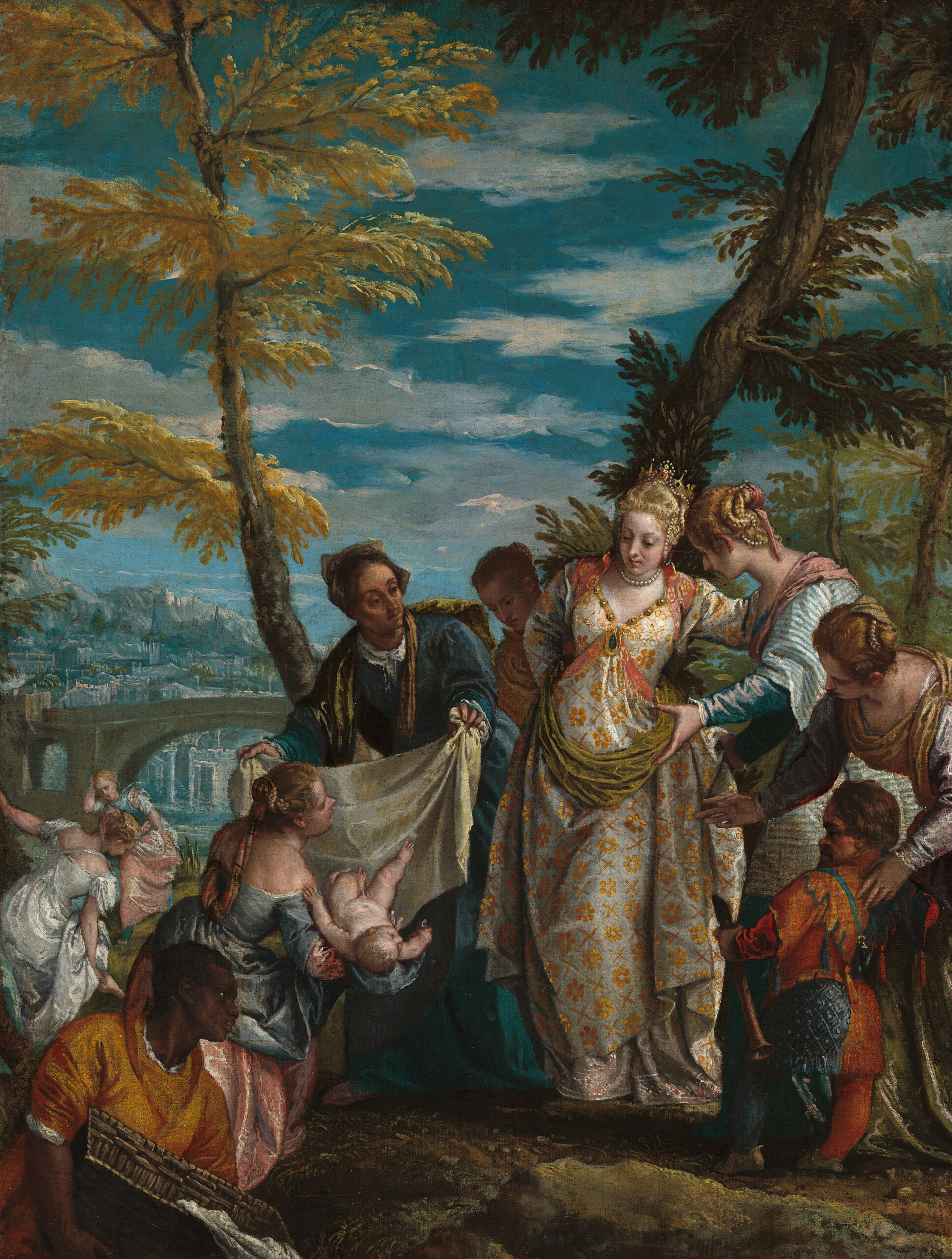
Painted around 1581–1582 by Paolo Caliari, known as Veronese, The Finding of Moses depicts an episode from the Book of Exodus: the rescue of the infant Moses by Pharaoh’s daughter. Modest in scale, this oil on canvas is one of several variants of the subject produced by the painter and his workshop. It belongs to the Venetian Renaissance, a movement in which Veronese shares pre-eminence with Titian and Tintoretto. The artist relocates the biblical scene to a contemporary setting, combining patrician costume with a North Italian landscape. Executed during the artist’s maturity, the work is held at the National Gallery of Art, Washington, D.C.
Veronese and colour. Even on a modest scale, the colour here strikes me as quite simply superb. It is the first thing that catches my eye: within these reduced dimensions, Veronese concentrates the same chromatic richness found in his vast Venetian canvases. Each length of drapery has its own tonality, each figure its own nuance; nothing repeats. The scene is alive, expressive, and the figures are readily identified. True to his habit, the artist transposes the biblical episode into a world of his own: Pharaoh’s daughter and her retinue wear the sumptuous fabrics of the patrician women of sixteenth-century Venice, as though the story unfolded on the banks of a river in northern Italy rather than beside the Nile. Look at the sky, the trees, the folds of the fabrics, the bearing of each figure: everything differs, everything breathes. The page of sacred narrative takes shape beneath the master’s brush. A true feast for the eyes.
A tiny foot, pink and warm, emerges from the white cloth. You almost touch it with your eyes. This is Moses, drawn from the waters. Around him, everything gleams. The gold brocade catches the light. The damp silk clings to the bodies. The bark of the trees shines. The canvas seizes you through the skin before the mind.
The Finding of Moses
Come closer still. The material tells all. Veronese paints in oil on canvas, in fluid, vibrant strokes. The princess’s brocade interweaves threads of gold and silver. He lays them down in small, dry touches, almost sculpted. The light glides across the fabrics. It settles upon the flesh. It lingers in the golden foliage of the trees. This reduced format belongs to a series. Veronese and his workshop painted several variants of the subject around 1580. The painter relocates the episode from Exodus to a Venetian setting. A bridge, a Lombard town and the trees of northern Italy replace the banks of the Nile. The sacred is arrayed in the trappings of patrician luxury. This freedom belongs fully to the Venetian Renaissance.
Veronese and His Age
Paolo Caliari was born in Verona in 1528. He is nicknamed Veronese, after the name of his native city. He arrived in Venice and triumphed there as early as 1551. With Titian and Tintoretto, he dominates the painting of the Venetian Renaissance. He delights in grand biblical feasts, allegories and unmixed colours. His workshop ran at full capacity, repeating his inventions. Around 1580, his palette grows graver. His light becomes more directed, almost symbolic. The Finding of Moses belongs to this late maturity. Veronese died in Venice in 1588, at the height of his renown. The canvas is today at the National Gallery of Art, Washington, D.C.
Veronese on View
Interest in Veronese shows no sign of waning. In 2025, the Museo del Prado devoted to him, in Madrid, its first major Spanish retrospective. More than a hundred works were lent by the Louvre, the Metropolitan Museum and the National Gallery, London, among others. The Finding of Moses belongs to this same Venetian maturity.
Source: Museo del Prado
A Question for You
💭 Titian, Tintoretto, Veronese: all transpose biblical narratives into the Venice of their own day. Should we see in this a want of rigour, or the invention of a pictorial language?
About This Work
- The Finding of Moses
- Veronese (Paolo Caliari)
- c. 1581–1582
- Oil on canvas
- 58 × 44.5 cm
- National Gallery of Art, Washington, D.C.
- https://www.nga.gov/artworks/45-finding-moses