Yesterday on VMuseum, I presented a painting by Tintoretto’s eldest son, Domenico Robusti. It seemed only natural to return today to a work by the master himself. I have chosen this majestic canvas from the Gonzaga Cycle, commissioned from Tintoretto around 1578–1579 to celebrate the illustrious ducal family of Mantua. With sovereign ease, the painter unfolds the scene of Giovanni Francesco Gonzaga’s investiture as first Marquis of Mantua, a defining moment for a dynasty that would become one of the greatest patrons of the Italian Renaissance. What struck me immediately upon encountering this large-format work is the chromatic richness and the density of presences: sumptuous fabrics, individualised faces, light that structures the composition without ever burdening it. This is a painting to be contemplated at length, the better to grasp every detail, and to appreciate how masterfully Tintoretto reconciled ceremonial splendour with human truth.
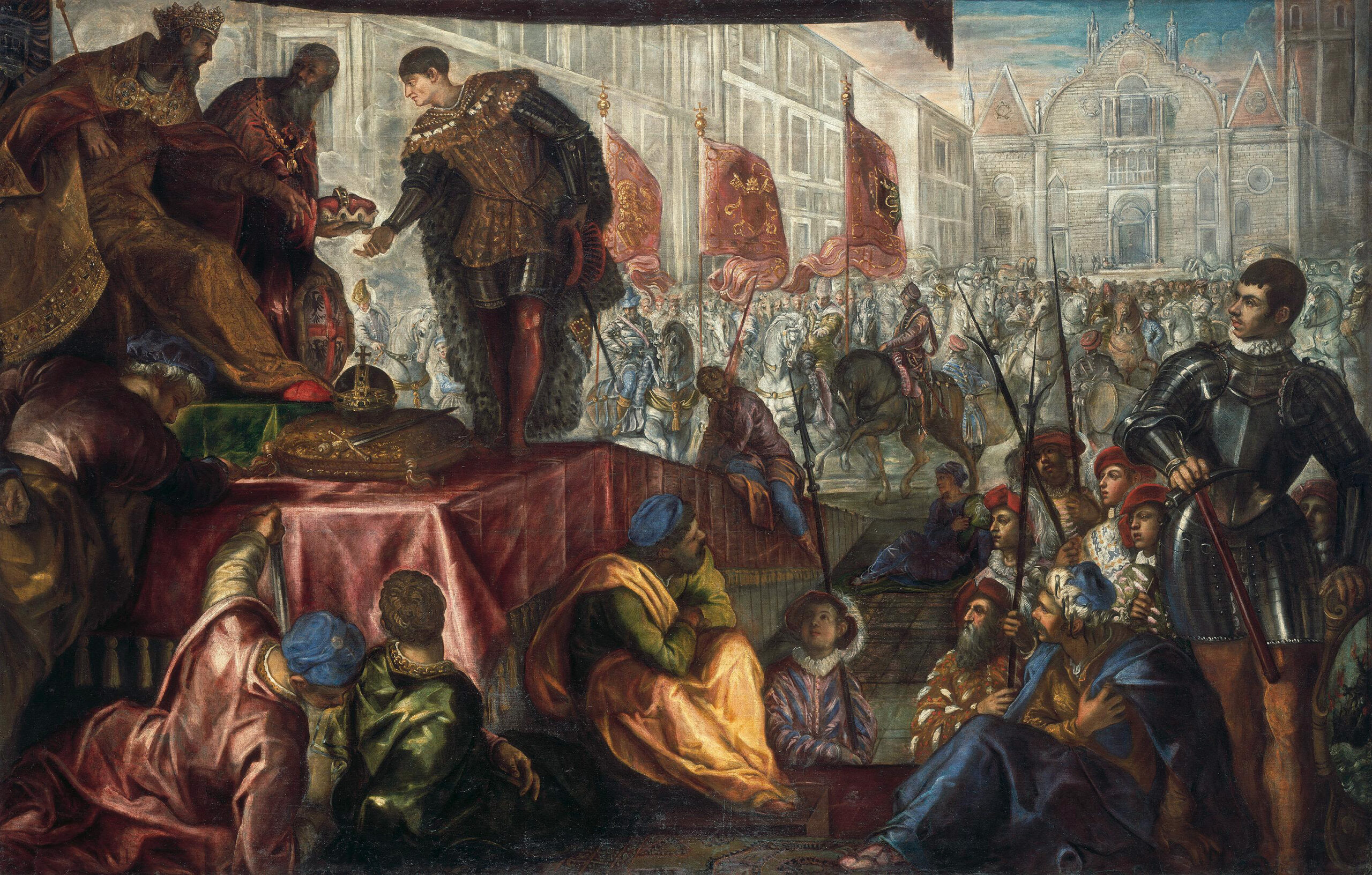
Mantua, 1433. Emperor Sigismund extends the princely hat. Giovanni Francesco Gonzaga steps forward. A single gesture seals the fate of one of Italy’s greatest families.
A Scene of Power, Fully Inhabited
On this monumental canvas, Tintoretto orchestrates space with absolute command. In the foreground, seated figures robed in shimmering textiles, pale rose, deep green, golden ochre, anchor the composition in a tangible, almost sculptural density. Look at Giovanni Francesco, standing, clad in armour, receiving the princely hat: his silhouette dominates without overwhelming. Behind him, the crowd extends toward banners bearing the Gonzaga arms, then recedes into an architectural backdrop reminiscent of the Piazza San Marco. Tintoretto works the oil on canvas with luminous glazes. The faces are individualised, approaching portraiture. Light strikes the armour, animates the silks, and binds ceremonial grandeur to the living moment.
Glorifying the Gonzagas, Painting History
Around 1578–1579, Duke Guglielmo Gonzaga commissioned Tintoretto to paint a cycle of eight monumental canvases for the Ducal Palace in Mantua. Each painting commemorates a founding episode in the dynasty’s history. This opening canvas restages the imperial ceremony of 1433: Sigismund elevates Giovanni Francesco to the marquisate, affirming Gonzaga power on the European stage. Tintoretto does not merely document a historical event: he constructs a dynastic memory. The theatrical framing, the animated crowd, the architectural setting in the background: every element conspires to transform a political act into an enduring image.
Jacopo Robusti, known as Tintoretto (Venice, 1518–1594), ranks among the foremost masters of Venetian Mannerist painting. Trained in Titian’s workshop, he developed a dramatic pictorial language grounded in light, movement, and spatial depth. The Gonzaga Cycle belongs to the fullest expression of his maturity.
Current Exhibition: Tintoretto at the Gallerie dell’Accademia, Venice, 2026
Directly relevant to this work: from 11 February to 7 June 2026, the Gallerie dell’Accademia in Venice is presenting Tintoretto Tells Genesis. For the first time since the cycle’s dispersal in the nineteenth century, the canvases from the Genesis series (1550–1553) are reunited, alongside Adam and Eve before the Eternal, on exceptional loan from the Uffizi Galleries in Florence.
Source: gallerieaccademia.it
A Question for You
💭 In this canvas, Tintoretto depicts a ceremony of 1433 in the dress of his own time, around 1578: deliberate anachronism, or the considered freedom of a history painter?
About this work
- The Investiture of Giovanni Francesco Gonzaga as First Marquis of Mantua
- Jacopo Tintoretto
- c. 1578–1579
- Oil on canvas
- 272.5 × 432 cm
- Bavarian State Painting Collections – Alte Pinakothek, Munich
- https://www.sammlung.pinakothek.de/de/artwork/jpxeVw3LJ7/jacopo-tintoretto-jacopo-robusti/der-gonzaga-zyklus-die-erhebung-des-giovanni-francesco-zum-markgrafen-von-mantua-7303