Key Facts
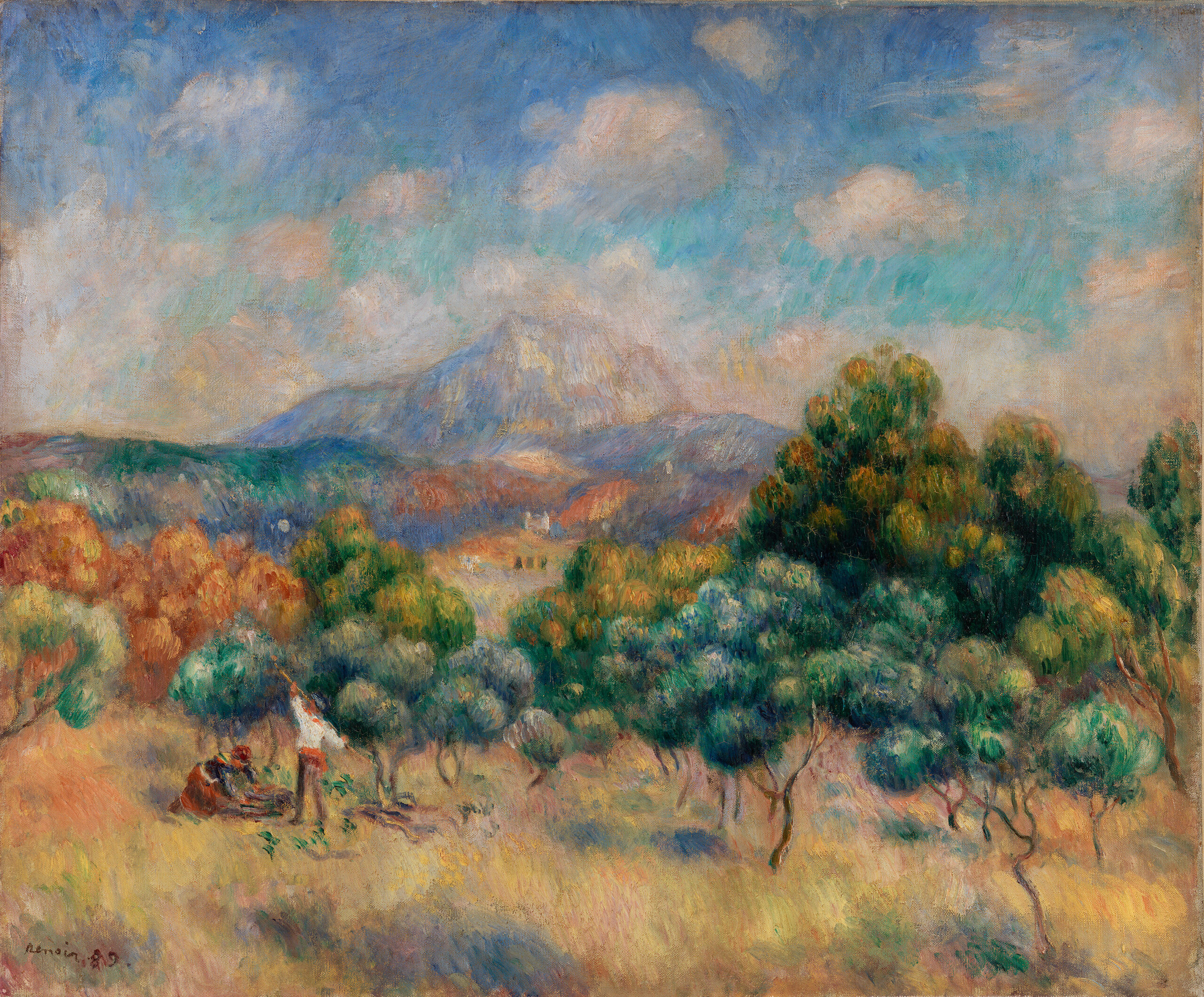
Montagne Sainte-Victoire (Landscape) was painted by Pierre-Auguste Renoir in 1889, during a stay near Aix-en-Provence in a house rented from Paul Cézanne’s family. The work belongs to Impressionism, dating from a moment when Renoir was softening his brushwork after a period marked by the influence of Ingres and Raphael. Unlike Cézanne’s solitary treatments of the same peak, Renoir populates his landscape with olive pickers, lending the scene a narrative dimension rare in his landscape work. Held at the Barnes Foundation in Philadelphia, the painting illuminates the personal and artistic closeness between Renoir and Cézanne, two major figures of late nineteenth-century French painting.
A Sainte-Victoire painted by one of Cézanne’s contemporaries! I make this discovery while browsing the Barnes Foundation’s collections, and it immediately holds my attention. Finding a version of this mythic mountain, immortalized by Cézanne, but painted this time by another giant of art history, is a wonderful surprise. Here I find that happiness so characteristic of Renoir: nature magnified by color, and above all the presence of figures in the foreground, a choice that sets it apart from Cézanne’s starker approach, usually alone before his mountain. What a fascinating work, this Sainte-Victoire as seen by Renoir!
The Sainte-Victoire
Figures beneath the olive trees. Renoir places his pickers there, tiny against the vast blue mass of the Sainte-Victoire. The olive branches twist in tender green and silvery grey. Further back, the mountain nearly dissolves into the sky, barely denser than the clouds surrounding it. The light of Provence flattens contours, gilds the earth, softens every form. In the distance, a hamlet can be made out among the hills, barely sketched. Renoir signs and dates the canvas at lower left: Renoir 89.
Pierre-Auguste Renoir
In 1889, Pierre-Auguste Renoir spends time near Aix-en-Provence. He rents a house belonging to the sister and brother-in-law of Paul Cézanne. The two painters have known each other since the 1860s, both formed within the same Impressionist ferment alongside Monet and Sisley. Cézanne paints the Sainte-Victoire in dozens of variations, almost always devoid of human presence. Renoir, by contrast, chooses to populate it with olive pickers. The mountain becomes a backdrop rather than the sole subject.
Pierre-Auguste Renoir is born in Limoges in 1841. He begins as a porcelain painter before joining the studio of painter Charles Gleyre in Paris, where he meets Claude Monet, Alfred Sisley, and Frédéric Bazille. Together, they lay the foundations of Impressionism. Renoir exhibits as early as 1874, at the first Impressionist exhibition. A trip to Italy in the early 1880s transforms his painting: he discovers Raphael and Ingres, and his line hardens for a time. This so-called “Ingres period” culminates with The Large Bathers in 1887. Two years later, in Aix-en-Provence, his touch loosens once again. The oil on canvas retains, nonetheless, a firm construction: the figures anchor the eye before it rises toward the summit.
Feeling the Scene
Notice the heat rising from the ochre ground. Sense the weight of the olive basket, the repeated gesture of the pickers. Renoir paints the simple happiness of labor beneath the sun, free of any grandiosity. The mountain, sublime as it is, remains almost secondary to this scene of daily life. One senses a tenderness for the people as much as for the landscape. Perhaps Renoir seeks less to rival Cézanne than to share a place he loves. This canvas speaks as much of friendship as of landscape.
Current News from the Barnes Foundation
In 2026, the Barnes Foundation remains a site of artistic relevance: to mark the 250th anniversary of the United States, it presents, through January 18, 2027, an immersive installation by Native American artist Sky Hopinka in the Annenberg Court, examining the complex history of the United States with its Indigenous peoples. The museum, which has held Impressionist and Post-Impressionist masterpieces such as Renoir’s Montagne Sainte-Victoire (Landscape) since 1912, continues in this way its mission of dialogue between heritage and contemporary creation.
Source: Barnes Foundation
A Question for You
Does a single canvas give Renoir grounds to contest Cézanne’s artistic claim to this mountain?
About This Work
- Montagne Sainte-Victoire (Landscape)
- Pierre-Auguste Renoir
- 1889
- Oil on canvas
- 54.4 × 65.5 cm
- The Barnes Foundation, Philadelphia
- https://collection.barnesfoundation.org/objects/4997/Montagne-Sainte-Victoire-(Paysage)/