Key facts
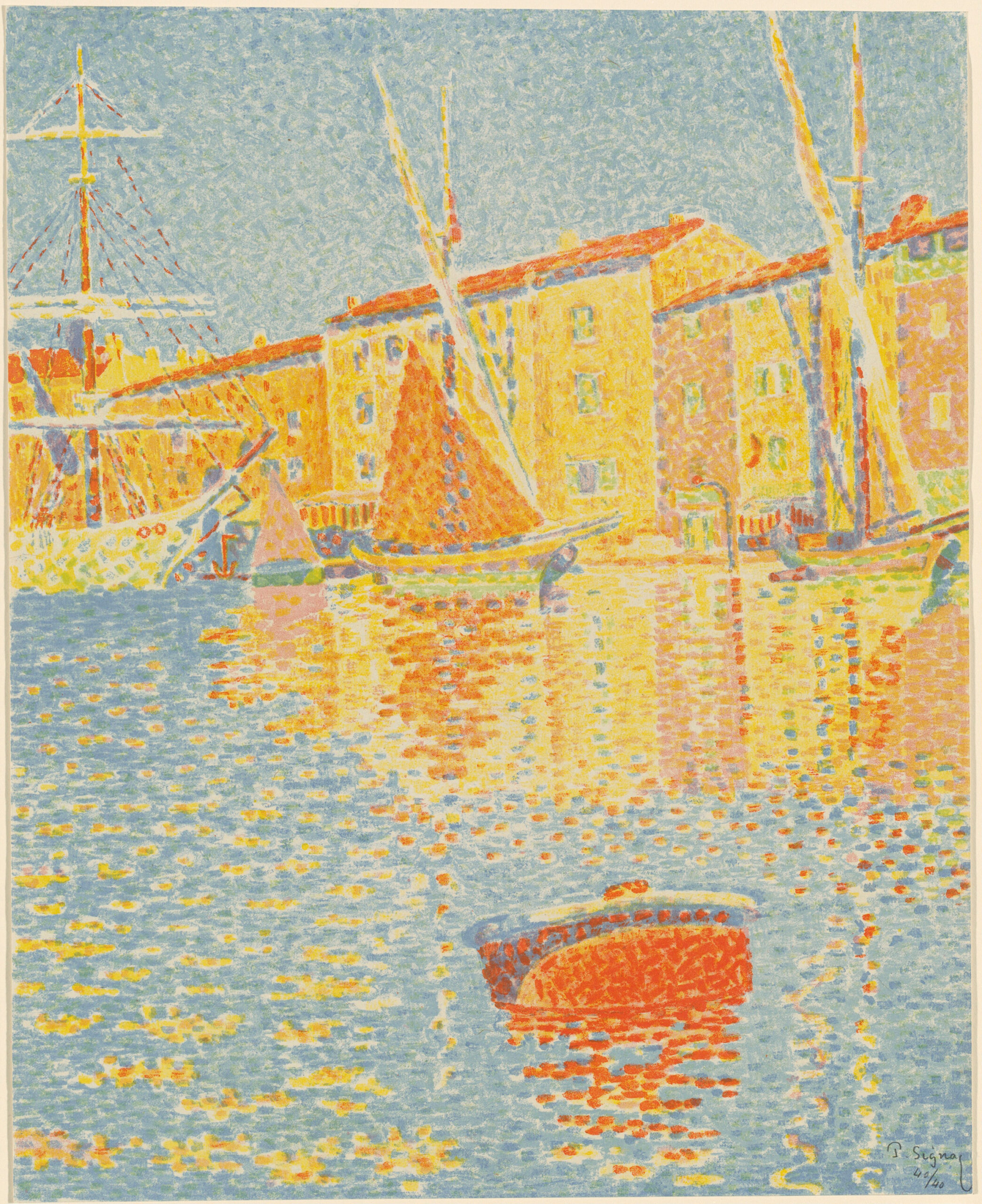
The Buoy (La Bouée), also catalogued under the title Saint-Tropez: le port, is a six-colour lithograph made by Paul Signac in 1894. It depicts the harbour of Saint-Tropez, where the painter settled in 1892, with a red buoy in the foreground. In this print, Signac transposes the divided brushwork of Neo-Impressionism, a movement based on the juxtaposition of pure colours, of which he became the leading theorist after Georges Seurat. Published by Gustave Pellet, the print predates by one year the painting Saint-Tropez. La Bouée rouge (The Red Buoy, 1895), held at the Musée d’Orsay, which revisits the same motif. An impression is held at the National Gallery of Art in Washington.
What fascinates me about Signac is his technique. What a brilliant idea Pointillism is! Seeing a scientific theory of colour give rise to a way of painting, and then to an entire art movement, Neo-Impressionism, amazes me every time. Signac did not invent it: it was Georges Seurat who laid the foundations of the method in the mid-1880s. But Signac became its great champion and theorist, and he actually preferred the term “Divisionism”. The principle is simple and bold: place small touches of pure colour side by side and let the viewer’s eye do the mixing. I sense in him a desire to go beyond a mere depiction of reality, to make colour vibrate for its own sake. What strikes me most here is that this is not a painting but a lithograph. Signac managed to transpose his divided touch into printmaking, layering six colours, each printed from its own stone. The technical challenge is considerable, because every pass must land exactly in the right place for the dots to interact with one another. The scene itself is remarkably simple: a harbour, boats, rigging and sailboats in the background, a buoy in the foreground. Blue, yellow and ochre tones dominate, evoking the soft light of a sunset. It is this economy of means in the service of colour that moves me.
A red-orange spot floats at the bottom of the sheet. Look at it closely: it is not a flat area of colour but a swarm of tightly packed touches. Beneath it, its reflection breaks apart into small commas of fire. All around, the blue water shimmers like fabric in the sun. You can almost feel the heat of the quay.
Saint-Tropez, the harbour
This harbour has a name. Print catalogues also title the sheet Saint-Tropez: le port. Signac discovered this fishing village in 1892, aboard his yacht L’Olympia. Observe the yellow façades topped with red tiles. Follow the moored sailboats, then the tall ship on the left. The blue of the sky and the water frames the scene. In the centre, the ochres blaze and spill into the basin. Come closer still. The touch is not round: it has a rough grain, as if rubbed. Between the dots, the white of the paper breathes. The publisher Gustave Pellet issued the print in an edition, on China paper. An impression is held at the National Gallery of Art in Washington. One year later, Signac revisited the motif in oil. Saint-Tropez. La Bouée rouge (1895) now hangs in the Musée d’Orsay. Same buoy, same façades, same blaze of reflections. Signac painted the canvas in the studio, from studies. Put the two images side by side: the motif is the same, but the medium changes everything.
Paul Signac
Paul Signac is in his early thirties. A passionate sailor, he turns the harbour of Saint-Tropez into an entire series. He returns to it in lithography in 1897–1898, with another view of the port. Here, the print is anything but a by-product. It becomes a laboratory where colour must hold without mixing. The buoy sums up this gamble. It is made to stay still, anchored to the seabed. And yet it is the buoy that vibrates the most.
News: Signac in Rotterdam
This autumn, Paul Signac’s maritime work returns to the spotlight in Europe. The Kunsthal Rotterdam is devoting a major exhibition to Signac and his contemporaries, on view from 24 October 2026 to 28 February 2027. It brings together many works and explores his influence on Neo-Impressionism as well as his ties with Georges Seurat and Camille Pissarro. The exhibition focuses on the painter as sailor. Signac owned boats, sailed tirelessly and painted harbours the way others keep a diary. The exhibition is built around two paintings made fifteen years apart: Le Port au soleil couchant, Opus 236 (Saint-Tropez, 1892) and Le Port de Rotterdam (1907). This theme echoes La Bouée directly.
Source: Kunsthal Rotterdam.
A question for you
In your view, what makes a work enter art history: its subject, its technique, or the gaze of later generations?
About this work
- The Buoy (La Bouée)
- Paul Signac
- 1894
- Six-colour lithograph
- 40.1 x 32.4 cm (15 13/16 x 12 3/4 in.)
- National Gallery of Art, Washington D.C.
- https://www.nga.gov/artworks/39166-buoy-la-bouee