Key facts
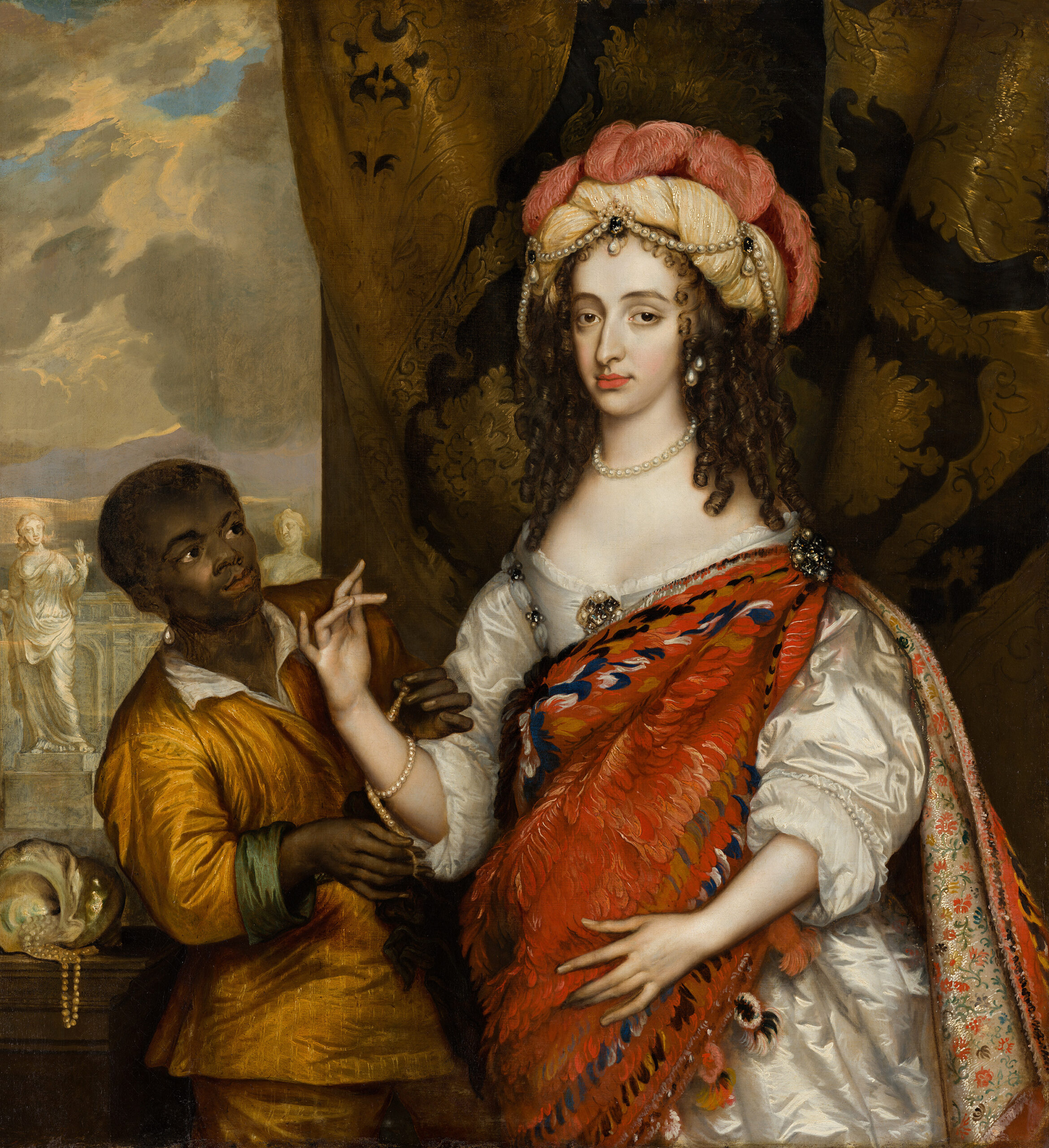
The Posthumous Portrait of Mary I Stuart (1631–1660) with a Servant is an oil on canvas painted around 1664 by Adriaen Hanneman, a Dutch Golden Age painter active chiefly in The Hague. Trained in the circle of Anthony van Dyck during his years in England, Hanneman established himself as the portraitist of choice for the exiled Stuart court in the Netherlands. Painted several years after the death of Mary Stuart, Princess of Orange, this canvas belongs to the tradition of Baroque court portraiture and reflects the fashion for oriental costume then prevalent in aristocratic circles. The work, now held at the Mauritshuis in The Hague, occupies a significant place within the artist’s body of portraits of the exiled British royal family.
What strikes me first is the presence of the young Black servant beside Mary Stuart: his contrast with the princess’s pale complexion is far from incidental, it speaks to the colonial gaze of the period. The portrait itself seemed to me to draw on an orientalising aesthetic, with the turban crowning her head and the fabric whose drape catches the eye. And yet, what precision, what mastery of colour this painting displays. The rendering of the fabrics is superb, and every element of the composition seems designed to exalt the sitter. As a posthumous portrait, one may reasonably assume an underlying hagiographic intent.
Look first at the servant’s hand, closed around a string of pearls. His dark fingers close near Mary Stuart’s pale wrist. Light glides across the white satin, then stops abruptly on the hand. One gesture, two skins, a single canvas, a silence between them.
What Lies Beneath the Surface of this Portrait of Mary I Stuart
The turban is crowned with pink ostrich feathers, tied in the oriental manner then highly fashionable in court portraiture. Draped over Mary Stuart’s shoulders is a feathered mantle in red, blue and gold, evoking a distant exoticism she never actually experienced. This masquerade costume transforms the princess into an idealised oriental figure. Hanneman renders her complexion smooth and almost pearlescent, in the manner of Van Dyck, a debt to the Flemish master so close that his contemporaries already reproached him for it. The feathers, by contrast, are handled with a freer, almost heavier touch, the paint thickening in small clustered strokes. The pearl bracelet slips between the young servant’s fingers, yet Mary does not turn her head toward him. Her gaze remains fixed on the viewer, in a pose of formal display rather than shared encounter. The boy himself is given neither name nor independent status within the composition; his role is confined to setting off, by contrast, the whiteness of the princess’s skin. Hanneman constructs a social hierarchy here, not a scene of lived intimacy. The exoticism staged in this portrait circulated widely through the courts of Europe at the time, fed by Dutch colonial trade and travellers’ accounts. The painting documents nothing; it constructs an imagined world. Rare feathers and a Black presence alike become signs of refinement rather than portrayals of individuals.
Hanneman and His Time
Adriaen Hanneman was born in The Hague around 1603, into a patrician family. He trained under the portraitist Anthony van Ravesteyn. Around 1626 he travelled to England, where he remained for sixteen years. Van Dyck’s arrival in London in 1632 transformed his approach; some of Hanneman’s paintings would later be mistaken for the Flemish master’s own work. Hanneman returned to The Hague following the outbreak of the English Civil War and became the principal portraitist to the exiled Stuart court in the Netherlands. He painted Mary Stuart, her son William Henry, as well as the future Charles II and his brother Henry. In 1665 he became director of the Academy in The Hague. This posthumous portrait, painted around 1664, extends that late loyalty to a court already scattered by exile. Three marriages marked his life, none producing any known children. Hanneman died in The Hague in 1671, having trained an entire generation of Dutch portraitists.
Current News
The Mauritshuis, home to this posthumous portrait of Mary Stuart, remains a museum in motion: from 15 October 2026 to 17 January 2027 it will host the exhibition “Thyssen-Bornemisza ❤ Mauritshuis,” the result of an unprecedented exchange of 25 masterpieces with the Madrid museum. Visitors should also note that the institution will close temporarily from 24 August to 20 September 2026 for renovation works, and that Vermeer’s Girl with a Pearl Earring will itself be absent from the galleries until 4 October.
Source: Mauritshuis
A Question for You
💭 What if Mary were not the true enigma of this painting, but rather this young man who remains unnamed?
About This Work
- Posthumous Portrait of Mary I Stuart (1631–1660) with a Servant
- Adriaen Hanneman
- c. 1664
- Oil on canvas
- 129.5 × 119.3 cm
- Mauritshuis, The Hague
- https://www.mauritshuis.nl/fr/decouvrir-la-collection/oeuvres-d-art/429-posthumous-portrait-of-mary-i-stuart-1631-1660-with-a-servant