Key facts
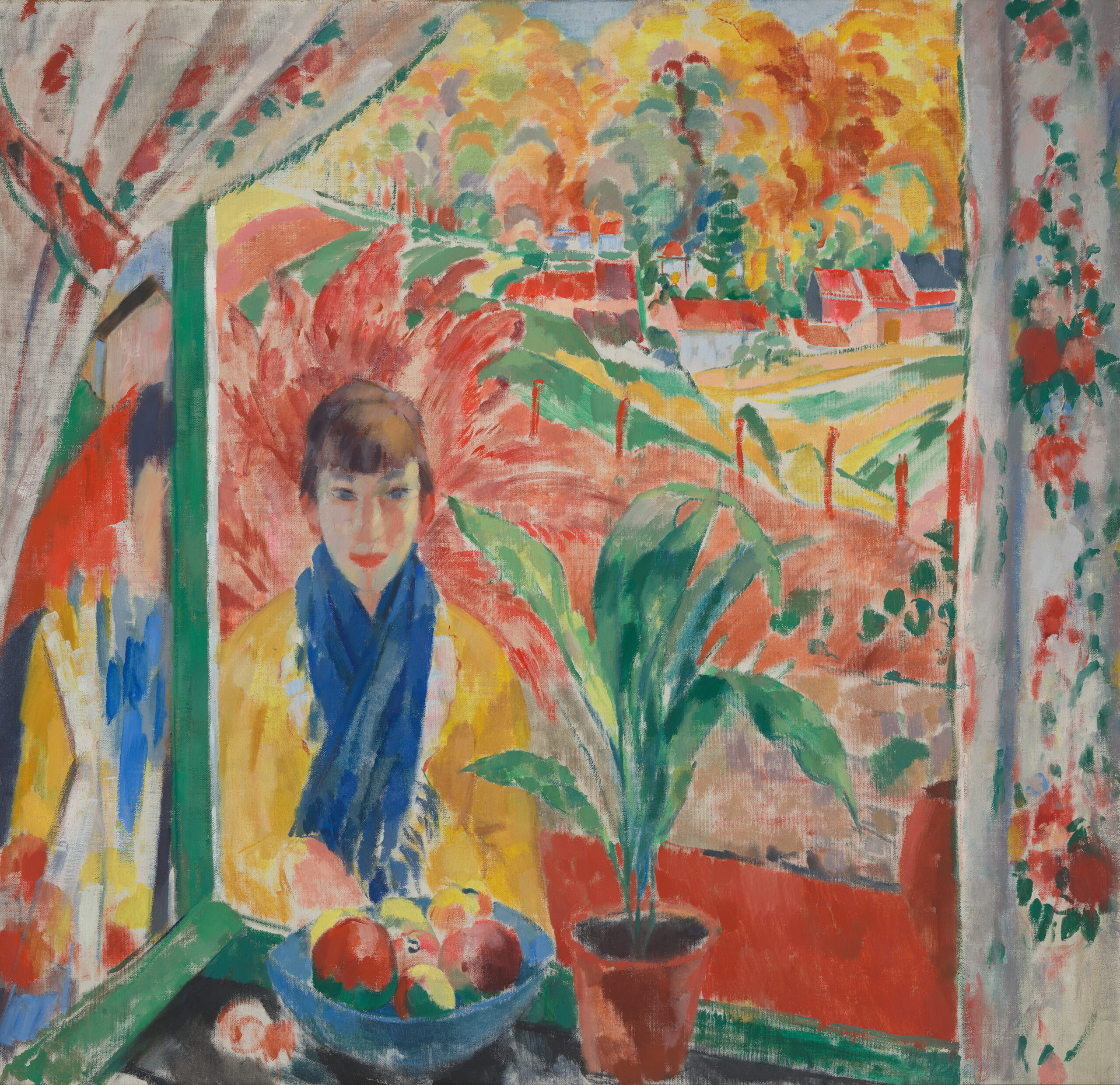
Autumn is an oil on canvas painted in 1913 by Rik Wouters (1882–1916), a leading figure of Brabant Fauvism. The painting shows a young woman standing outside, behind an open window, against an autumn landscape. A still life of apples and a potted plant occupy the windowsill in the foreground. Painted the same year as The Red Curtains, the canvas belongs to the artist’s happy years, before the war and his death at the age of 33. Donated by the neurologist Ludo van Bogaert, it is held at the KMSKA, the Royal Museum of Fine Arts Antwerp.
I must admit I had never heard of Rik Wouters. I discovered him while browsing the KMSKA’s collections, and this canvas immediately caught my eye. Wouters was a modern Belgian painter whose career was very short: born in 1882, he died in 1916, aged 33, taken by illness after the hardships of the Great War. In barely ten years, he nonetheless left behind a body of work as a painter, sculptor and draughtsman. His painting here is richly coloured, close to the Fauves, and he would later be associated with “Brabant Fauvism”. In Autumn, you can feel the warm, red colours of the season, and the subject is full of references to autumn: the foliage, the still life, the window opening onto the garden. What strikes me is the brushwork: quick and free, sometimes letting the canvas breathe, as if the painter wanted to capture the moment rather than freeze it. It is a lively canvas, and the presence of the figure gives it an unmistakable humanity. It shows what Wouters does best: finding the extraordinary in the everyday life of a home, an interior, an ordinary day. Painted the same year as The Red Curtains, it belongs to that happy period of 1913, just before war and illness turned his life upside down.
You are looking at a reflection. On the left, in the glass pane of the open window, a patch of yellow and a patch of blue float. It is the young woman’s jacket, mirrored in the glass. Come closer. The whole painting is already contained in this discreet double.
What Autumn tells us
First, feel the warmth. The foliage blazes in orange, ochre and brick red. The village roofs answer in vermilion. On the sill, the still life rounds its apples in a blue bowl. The young woman stands outside, on the other side of the window. Her yellow jacket and blue scarf catch the daylight. Now look at the flowered curtains. Wouters lays the colour on in scumbles so thin that the weave of the canvas shows through. These bare patches let the surface breathe. The apples, by contrast, receive a denser paint, almost modelled.
What Rik Wouters’ era tells us
It is 1913, most likely in the couple’s house in Boitsfort. Behind the young woman stretches a familiar landscape: hills, fences, low houses. That same year, Rik Wouters painted The Red Curtains. It features the open window, the curtains, and his wife at the centre. The point of view, however, is reversed. There, his wife is inside the house. Here, the young woman is outside, looking in. His contemporaries compared Wouters to Ensor, then to Cézanne. The bowl of apples still carries that echo. The title announces the season of decline. Yet nothing on this canvas declines.
Born in Mechelen, Rik Wouters came to painting from sculpture before establishing himself as a colourist. A leading figure of Brabant Fauvism, he worked in painting, drawing and sculpture side by side. The painting entered the KMSKA through a donation from the neurologist Ludo van Bogaert.
Wouters at the KMSKA in 2026
2026 has been a rich year for Rik Wouters enthusiasts. Throughout spring and summer, the KMSKA presented Un rouge qui chante. Chefs-d’œuvre d’Ensor, Wouters et Schmalzigaug, an exhibition devoted to the great Belgian colourists, which closed on 30 August 2026. It offered the chance to discover The Red Curtains, shown in the museum’s galleries for the first time since the Flemish Government acquired it in 2025. Painted the same year as Autumn, the canvas depicts Nel, the artist’s wife and muse, wearing her famous red-and-white striped dress in their home in Boitsfort. Source: KMSKA.
Nel had already been the focus of another recent exhibition: the Hof van Busleyden Museum in Mechelen paid tribute to her not only as a model and muse, but also as the manager of the painter’s career and the guardian of his legacy after his death (October 2025 to April 2026). As for its programme, the KMSKA continues its momentum this autumn with a solo exhibition devoted to the Belgian sculptor Philip Aguirre y Otegui, from 3 October 2026 to 17 January 2027. The museum is also preparing for 2027: the restoration of Rubens‘ Adoration of the Magi, carried out with the University of Antwerp, is expected to be completed in time for the Rubens Year celebrating the old master’s 450th anniversary. Source: KMSKA.
A question for you
The Fauves freed colour from description. In this autumn landscape with its vermilion roofs, where does what Wouters saw end, and where does what he felt begin?
About this work
- Autumn
- Rik Wouters
- 1913
- Oil on canvas
- 135 × 140 cm
- KMSKA, Royal Museum of Fine Arts Antwerp
- https://kmska.be/fr/chefdoeuvre/automne-2