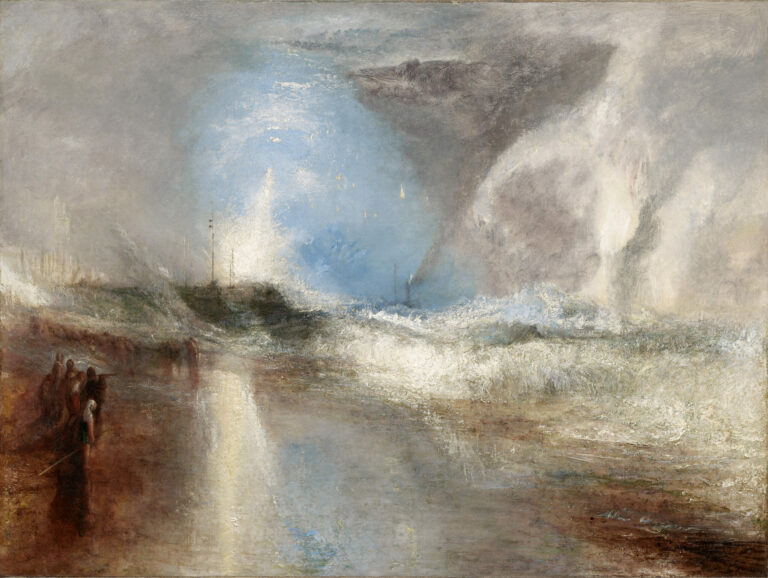
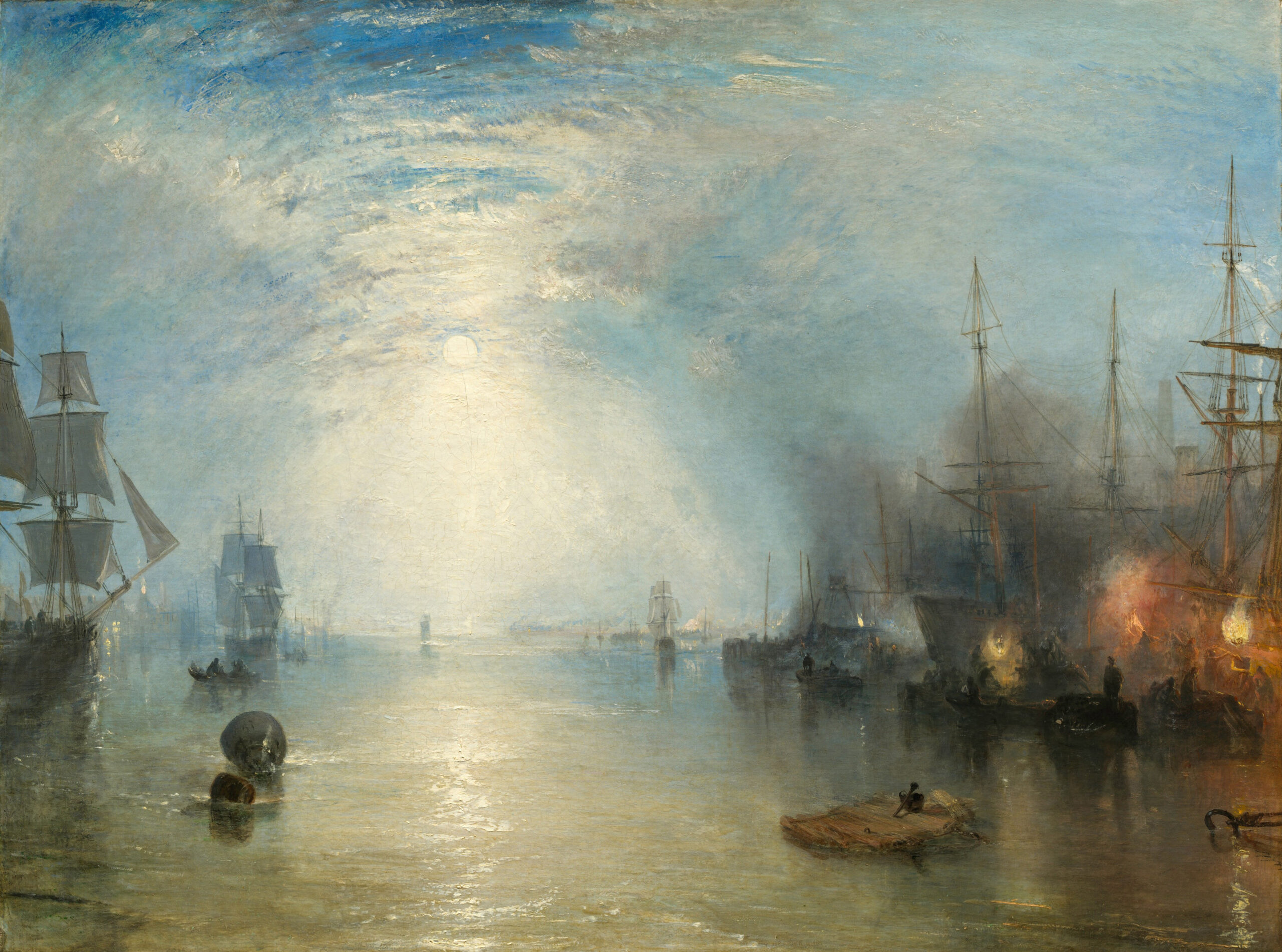
What a light. It strikes me with particular force in this canvas. Turner sets two light sources in permanent tension: the cool blue of the moon, radiating through the harbour mist, and the warm orange glow of the workers’ torches in the foreground. This dialogue between natural and industrial light is far from incidental. We are in 1835, at the height of the Industrial Revolution, and Turner captures with remarkable precision this pivotal moment between two worlds.
At the port of Newcastle, the keelmen, those bargemen who transferred coal from flat-bottomed boats to ocean-going vessels, labour through the night, almost dissolved into the immensity of the landscape surrounding them. Rather than casting them as heroes, Turner absorbs them into the light, as though nature always reclaims its sovereignty over man and his machines.
What strikes me each time I stand before a work by Turner is this capacity to be at once wholly of his time and unmistakably ahead of it. This canvas resembles nothing else being painted in Europe at the moment, and yet it anticipates Impressionism by several decades. It moves me, perhaps because it refuses to choose between beauty and the reality of labour. It holds both, within the same moonlight.
The first thing you see is a white disc. The moon breaks through the mist above the port of Newcastle. Its light runs across the water like a physical substance. It overwhelms everything else.
Beneath the surface
Look to the right. Torchlight bites into the darkness. The keelmen load coal in the night. Turner places these two light sources in direct opposition: the cold of the moon, the heat of industrial fire. The oil on canvas, worked in rapid impasto, vibrates between transparency and opacity. The masts of sailing ships rise through the sky with ease. Black smoke, at the right, climbs toward a sky still blue. Joseph Mallord William Turner paints, in 1835, a port in full nocturnal labour. Yet the scene resists any simple reading: the workers are there, minute, absorbed by light more than by their toil. The Industrial Revolution rumbles. Beauty, for its part, holds.
Turner and industrial Romanticism
Born in London in 1775, Joseph Mallord William Turner entered the Royal Academy at fourteen. He became the preeminent British painter of light and movement. His Romanticism is not nostalgic. He faces modernity directly: the machines, the steam, the coal. This oil, exhibited at the Royal Academy in 1835, is held today in the National Gallery of Art in Washington. It documents a world in transformation. And transcends it.
Turner in 2026
In March 2026, director David Bickerstaff released Turner and Constable (Exhibition on Screen: Turner & Constable), a documentary film produced in close collaboration with Tate Britain to mark the 250th anniversary of both artists’ births. The film traces the rivalry between the two greatest British landscape painters.
Source: Film listing on AlloCiné
A question for you
💭 Constable, Turner’s great rival, painted the gentle light of the English countryside. Standing before this burning harbour, what might he have felt?
About this work
- Keelmen Heaving in Coals by Moonlight
- Joseph Mallord William Turner
- 1835
- Oil on canvas
- 92.3 x 122.8 cm
- National Gallery of Art, Washington D.C.
- https://www.nga.gov/artworks/1225-keelmen-heaving-coals-moonlight