Bringing together Venice and Turner in a single article on VMuseum makes me particularly happy, as both the place and the artist rank among my most enduring passions. I have been fortunate enough to see Venice at the hour when the sun tilts behind the lagoon, that suspended moment when water, sky and stone merge into a single golden and rose-tinted light. That is precisely what Turner captured in this canvas: not Venice as it is, but Venice as it feels. The luminous halo enveloping the sails and gondolas, the dissolving of contours into the haze, speak to anyone who has lived that sunset from the water’s edge. Turner does not paint the city. He paints the emotion it stirs. And perhaps that is why Venice and he seem made for each other: two phenomena that transcend the real.
See
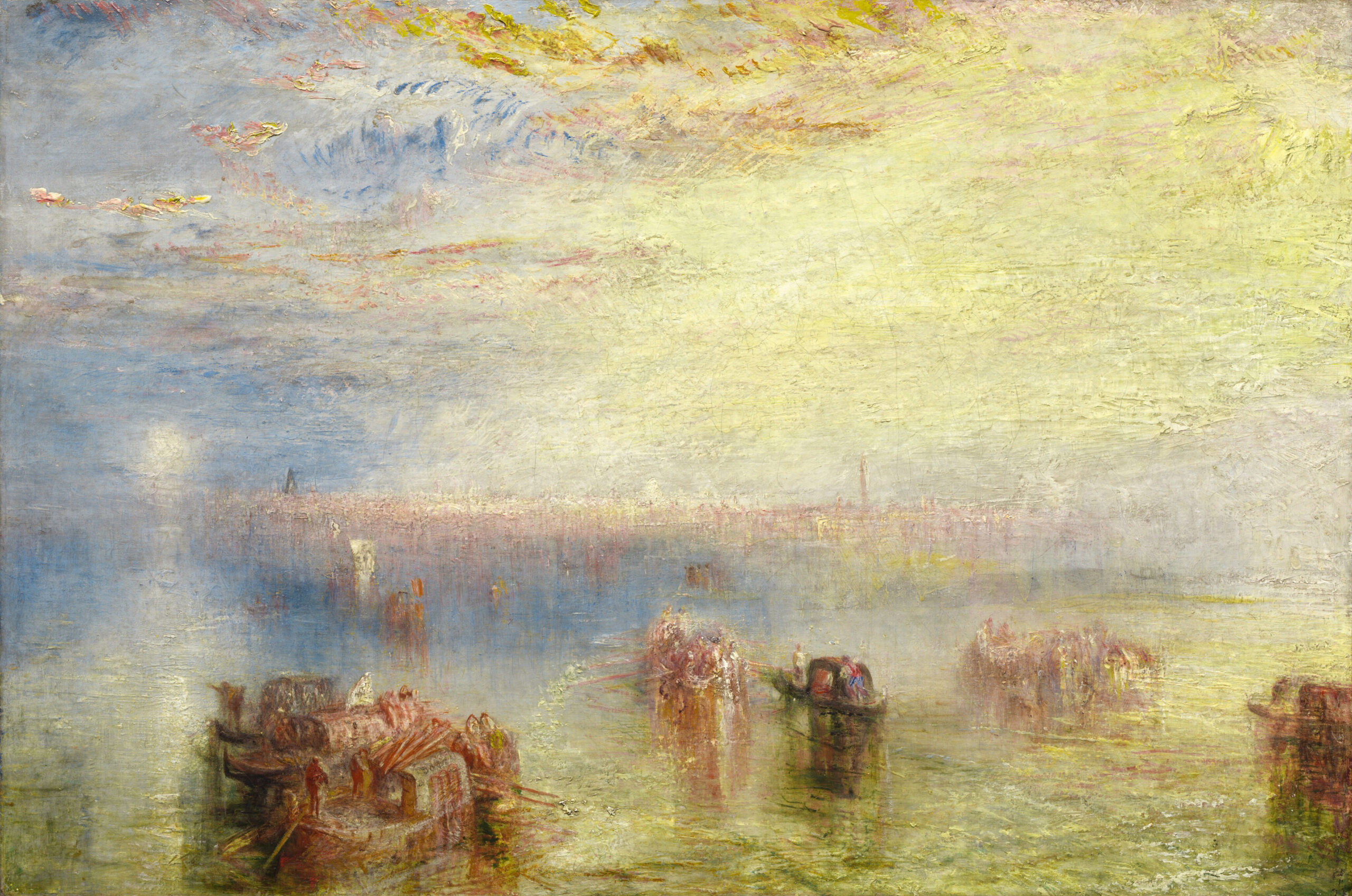
Look at this sky. It belongs to neither day nor night. To the right, a sulphurous yellow sets the canvas ablaze. To the left, a lunar disc bleaches the mist. Between the two, the lagoon shimmers. Barges and gondolas glide toward the city. Venice itself floats on the horizon, a pink silhouette barely distinct from the water. Turner works with brush and palette knife, in nervous impasto. Nothing is sharp. Everything glows.
What the Light Conceals
The year is 1844. Turner is sixty-nine. This is one of his last great oils. In the Royal Academy catalogue he quotes Byron: “The moon is up, and yet it is not night / The sun as yet disputes the day with her.” These lines are no ornament. They are the true subject of the painting. Turner paints an in-between: between lights, between states, between the real world and pure vision. Venice had fascinated him for twenty years, in watercolour as in oil. He sees it less as a city than as an atmospheric phenomenon, air, water and light dissolved into one. His late Romanticism already anticipates the Impressionism that Monet, an avowed admirer, would develop thirty years later.
Feel
Standing before this canvas, you do not visit Venice. You arrive. You sense the swaying of the barges, the salt-laden humidity of the lagoon, the light shifting from one second to the next. Turner does not freeze a moment. He paints a duration : that fragment of twilight when everything seems possible and nothing is yet decided. A painting that breathes.
The National Gallery of Art and Access to Art
The museum that holds this major work has just reached a historic milestone. In May 2026, the National Gallery of Art in Washington received a $116 million gift to endow its Across the Nation programme in perpetuity, bringing masterworks from its collection to regional museums across the United States. Nearly 900,000 visitors have already benefited.
Source: nga.gov/press/historic-gift-endows-national-lending-program
A question for you
💭 Have you ever seen Venice from the water, at the hour when the light hesitates between two worlds?
About this work
- Approach to Venice
- Joseph Mallord William Turner (1775-1851)
- 1844
- Oil on canvas
- 62 × 94 cm
- National Gallery of Art, Washington DC
- https://www.nga.gov/artworks/117-approach-venice