Key facts
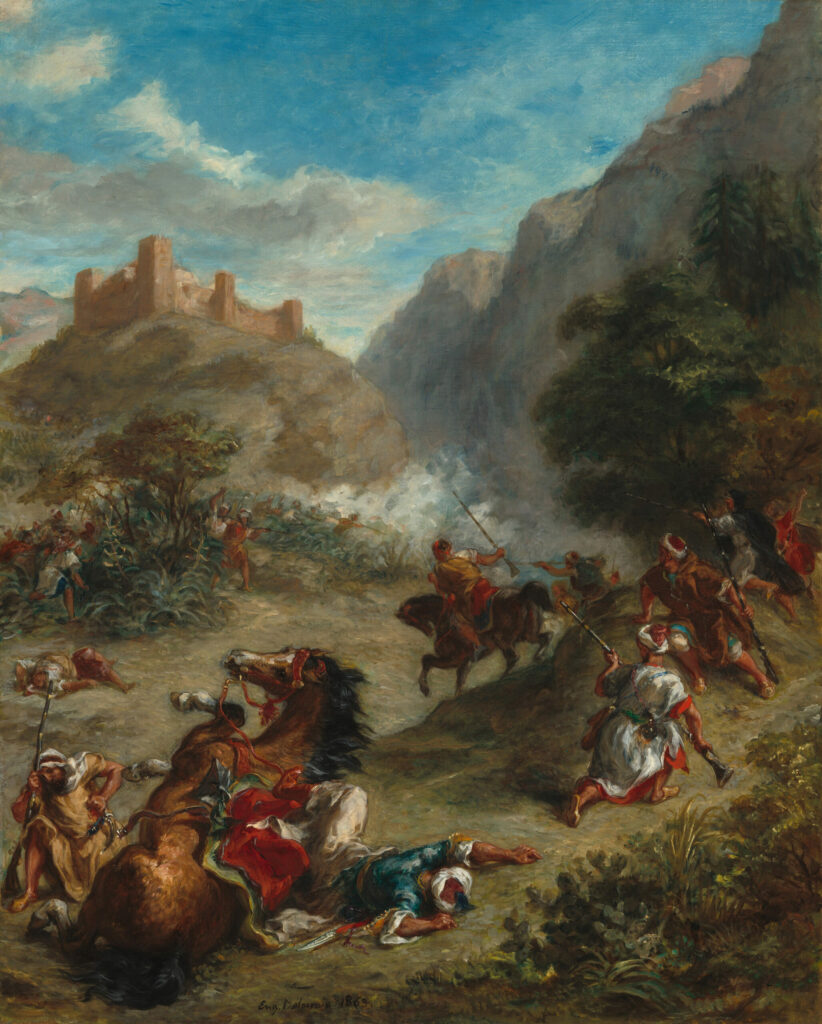
Painted in 1863, the year of Eugène Delacroix’s death, Arabs Skirmishing in the Mountains is an oil on canvas held at the National Gallery of Art in Washington. A leading figure of French Romanticism, Delacroix deploys his Orientalist manner here: intense color, free handling, a diagonal composition. The scene, drawn from his 1832 journey to Morocco, is a late invention rather than an observed event. It reflects the painter’s attraction to a dreamed Orient while also contributing to the spread of enduring stereotypes. A final echo of his Moroccan experience, it ranks among his last compositions and distills his art of movement and light.
Delacroix fascinates me. His handling, his choice of color, the energy of his subjects: everything works together to turn his paintings into stories one contemplates at length. I am struck by the surface itself, at once precise and vibrant, and by the way the skirmish dissolves into the landscape, the riders, the dust and the mountain seeming made of the same matter. His canvases resonate like symphonies played allegro.
What strikes me here is that this is one of his last works, painted in 1863, the very year of his death, more than thirty years after his 1832 journey to Morocco. The memory, however, has lost none of its freshness: Delacroix renders the atmosphere, the light and the tension of a scene that is partly reconstructed, almost dreamed, with an intensity that makes it startlingly real. Perhaps that is what holds me longest before it: a memory turned into paint.
Can a battle smell of gunpowder and dust when it never took place?
What the foreground throws in your face
Look first at the bay horse collapsing in the foreground. Its black mane lashes the air. Its hooves beat at nothing. Beneath it, a rider in blue lies face down, his hand emptied of its saber. The ochre ground gives back the heat. At the center, a plume of white smoke tears through the ravine. You can almost hear the shot. A man in a pale burnous raises his long rifle. On the ridge, a ruined kasbah stands out against the sky. Delacroix’s touch stays thick and nervous, laid down in small commas of red, white and green. The paint still trembles, like the scene itself. Notice the raw light striking the turbans and setting each fabric alight. Nothing here is smooth. Everything quivers. Blood is barely visible. It is color itself that strikes and wounds.
A scene dreamed, thirty years later
Delacroix painted this oil on canvas in 1863. The scene is pure invention. No real battle underlies it. The artist draws on the memory of a single journey to Morocco, in 1832, more than thirty years earlier. There he had seen the violent light, the horsemen, the burnouses. He judged that society simpler and prouder than Europe. Here he dreams of the warriors of antiquity in the guise of North African fighters. Romanticism and Orientalism find in this imagined East their ideal material: brilliant color, energy, violence. The composition follows the diagonals of the mountain. He does not seek the truth of a fact. He seeks that of a sensation. This North Africa he paints as a lost ideal, set against his own age. Yet that same admiration fed a persistent cliché: that of an East fixed, primitive, given over to combat.
Eugène Delacroix dominates French Romantic painting. Born in 1798, he asserts color over line, gesture over academic finish. His great history paintings, his wild beasts, his Oriental scenes mark the entire nineteenth century. The Moroccan journey of 1832 haunts his work to the end. This skirmish delivers one of its very last echoes. He died in Paris that same year, 1863.
Delacroix in the news
While Arabs Skirmishing in the Mountains (1863) is today held at the National Gallery of Art in Washington, the work resonates directly with current French museum programming: from September 12, 2026 to April 18, 2027, the Musée national Eugène-Delacroix, set in the painter’s last studio on the rue de Furstenberg in Paris, devotes the exhibition Delacroix, Horses and Other Animals to this vein so characteristic of his art. Riders launched into action, spirited horses, the tension of combat: so many motifs, born notably of his 1832 journey to Morocco, that recur at the heart of this late canvas. A chance to recall the central place of the animal and of movement in Delacroix’s Orientalist imagination. Source: Musée Delacroix
A question for you
💭 From Delacroix’s free brushwork to the pure touch of the Impressionists, where does Romanticism end and modern painting begin?
About this work
- Arabs Skirmishing in the Mountains
- Eugène Delacroix
- 1863
- Oil on canvas
- 92.5 × 74.5 cm
- National Gallery of Art, Washington D.C.
- https://www.nga.gov/artworks/50686-arabs-skirmishing-mountains