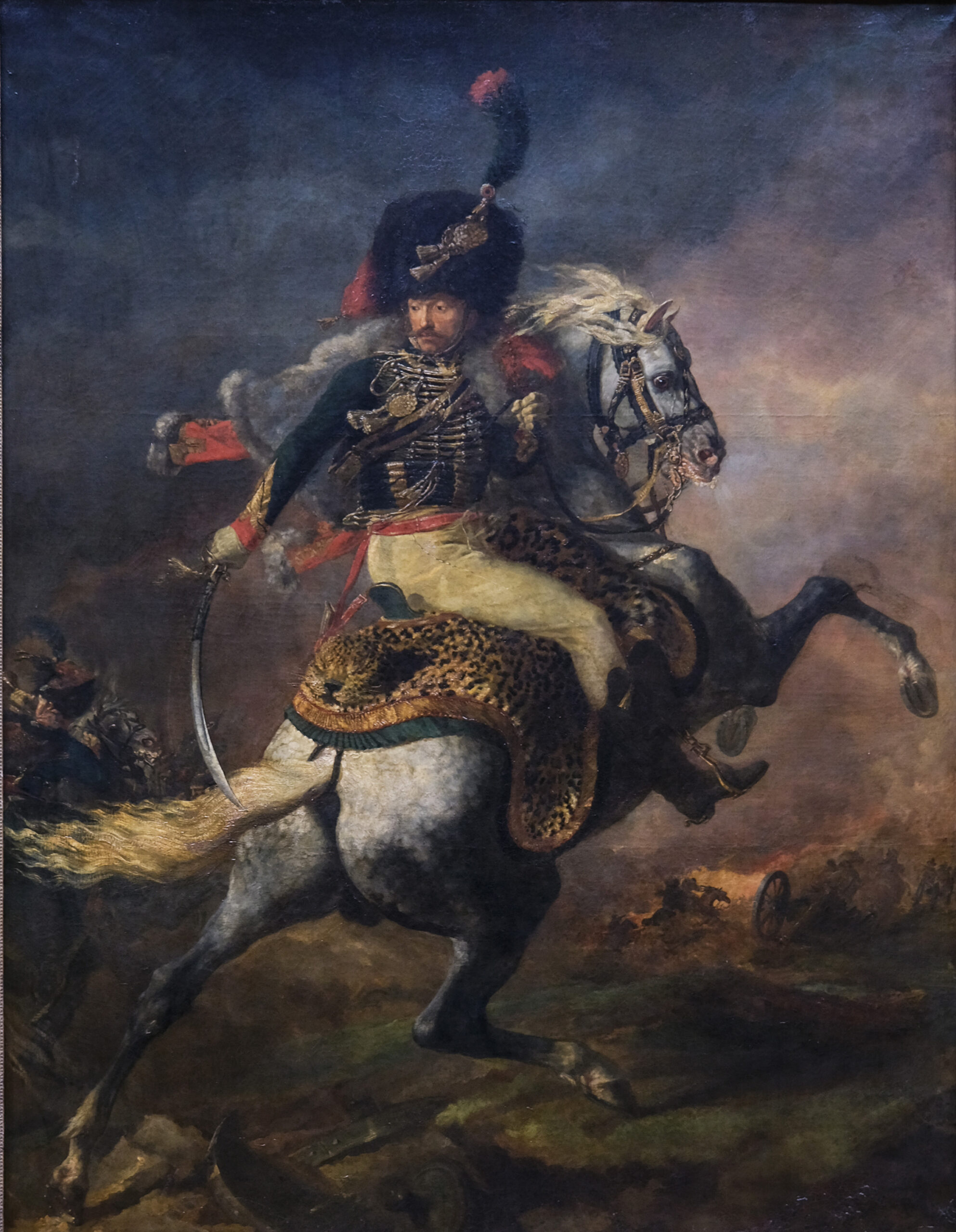
This painting fascinates me every time I visit the Louvre, and I never fail to stop in front of it. The Salle Mollien composes a vertiginous triptych: Géricault’s Officer faces the Raft of the Medusa, not far from Delacroix’s Liberty Leading the People. Three founding works of French Romanticism, gathered in the same space, and yet it is often the Officer that catches the eye first, with its sweeping diagonal and the warmth of its reds and golds.
What strikes me most deeply is the constitutive paradox of the work: Géricault is 21 years old, he paints in five weeks a canvas nearly 3.50 metres high, in a format reserved for grand history painting, and he chooses to depict an unknown man. Not a general, not an emperor, not an allegory: an anonymous lieutenant of the Imperial Guard, his friend Alexandre Dieudonné, concealed behind the initials “M.D.” in the 1812 Salon catalogue. It is a silent but decisive rupture in the history of art: the large format ceases to be the privilege of the named hero. Heroism becomes a posture, an energy, almost an interior state, the one we read in the fleeting, almost melancholic gaze of this officer who charges without looking at the enemy.
This detail never ceases to hold my attention. In a painting that embodies dash and movement, the officer does not look ahead. He turns back. Toward us, toward the painter, toward something undefined. In 1812, the Empire embarks on its Russian campaign. Géricault does not yet know it, but this oblique gaze resembles that of someone who senses an impending collapse. This may be the modernity of this early work: it glorifies and doubts in the same breath, and it is precisely this that makes it inexhaustible, two centuries later.
This is not a war painting. Or rather: not only. Paris, Salon of 1812. A young unknown of 21 hangs a canvas 3.49 metres tall. The public stops.
What the canvas says, and what it withholds
Look at the diagonal of the rearing horse. It tears through the composition from lower left to upper right. Géricault works with a broad, almost violent touch. The reds of the dolman burn against the smoky grey of the sky. The leopard skin across the saddle shimmers. But the officer’s face contradicts all of this. He turns back. His gaze flees the battle. In a painting of a charge, the hero looks elsewhere. It is this contradiction that Géricault plants at the centre, and does not resolve.
An unknown elevated to the rank of history
The large format, in 1812, is reserved for glorious battles and powerful named figures. Géricault paints his friend, Lieutenant Alexandre Dieudonné, behind the veil of a barely concealed anonymity: “Equestrian Portrait of M.D.” in the Salon catalogue. The Empire departs for the Russian campaign. Dominique Vivant Denon awards the young painter a medal. The painting would be sold at Géricault’s estate sale in 1824, acquired by the Duke of Orléans, the future Louis-Philippe, then entered into the national collections in 1851 for 23,400 francs. Nascent Romanticism had found its first visual shock.
Théodore Géricault was born in Rouen in 1791. A pupil of Carle Vernet and then of Guérin, he died at the age of 32. This painting was his first submission to the Salon.
News: A Géricault Study Resurfaces at Auction After Two Centuries
Two centuries after Géricault’s death, the Louvre painting continues to make art market news. The auction house Osenat is offering for sale, as part of its “Les Grands Siècles” sale in Versailles, June 21, 2026, a preparatory study directly related to the Officer of Chasseurs, a double-sided canvas of 53.5 x 43 cm, estimated between 100,000 and 150,000 euros (lot 518).
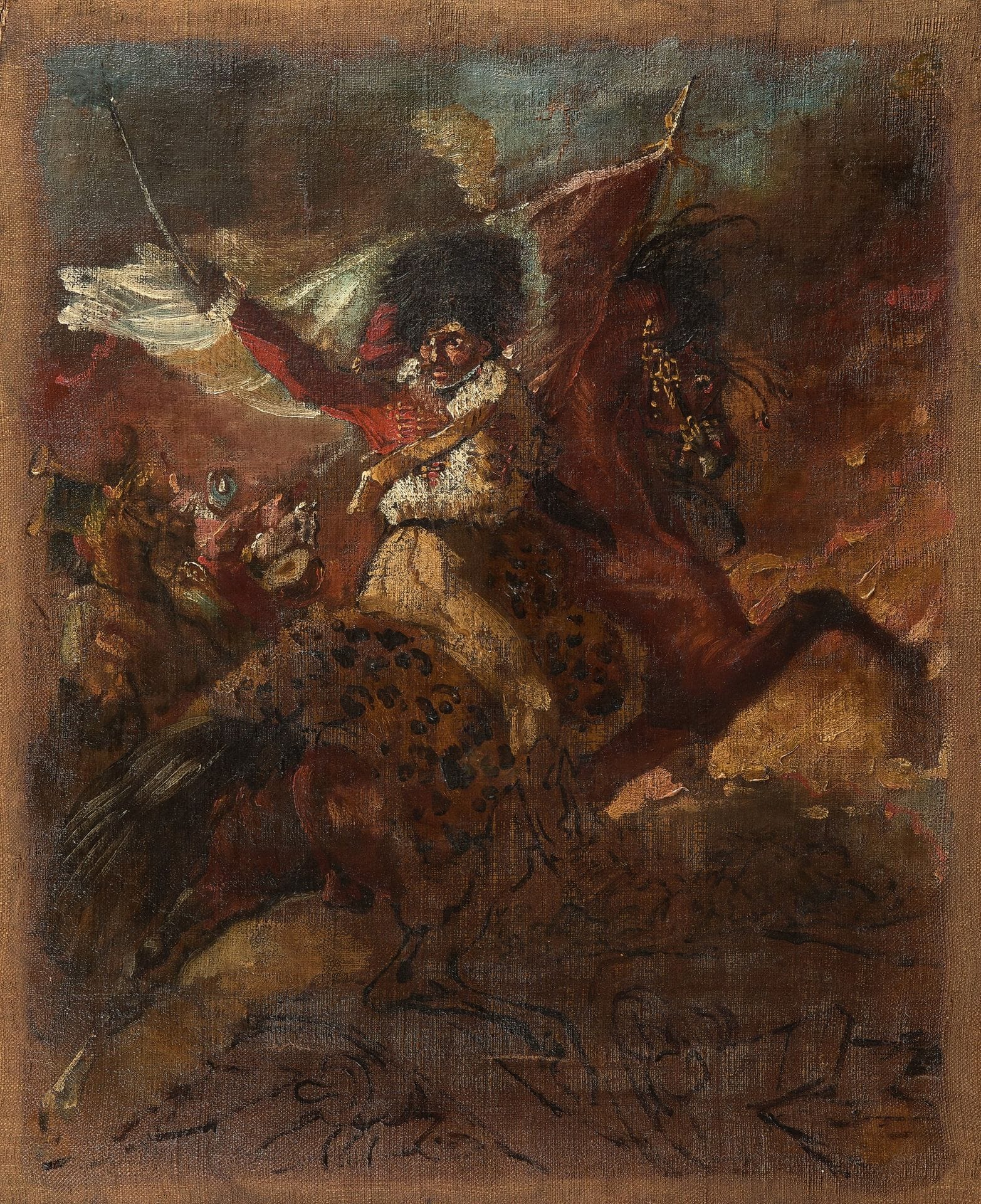
Its provenance is exceptional: the work appears in the painter’s estate sale as early as November 1824, just months after his death, before entering the collection of Félix Feuillet de Conches (1798-1887), diplomat and scholar, then passing to his son-in-law Charles Jagerschmidt, where it has remained until today, never having left the family. Two centuries of unbroken continuity for a work that had never previously appeared at auction. The Feuillet de Conches collection notably included Fragonard’s The Love Letter, now in the Metropolitan Museum of Art in New York.
A Canvas That Opens Two Doors into Géricault’s Genesis
The interest of this canvas is doubled by its reverse: a copy after Jean Jouvenet’s Descent from the Cross, a masterpiece of 17th-century French painting that entered the Louvre in 1796. Géricault, pupil of Carle Vernet and then of Pierre-Narcisse Guérin, trained by copying the masters assiduously at the Musée Napoléon. This recto-verso encapsulates in itself the method of the young 21-year-old painter: on one side, deference to the French tradition; on the other, the impulse toward a modernity he is in the process of inventing. According to the Osenat catalogue, both artists, born in Rouen a century apart, faced the same challenge: how to move beyond a classicism grown academic and sterile by returning to Rubens for the vigour and vitality of his art.
Cited but Never Exhibited: A Gap Filled by the Market
Listed in the major scholarly references, from Charles Clément (1868) to Germain Bazin (1987) and Philippe Grunchec, this sketch had been cited and reproduced in the catalogue of the exhibition Les Chevaux de Géricault (Musée de la Vie Romantique, Paris, May-September 2024), without ever having been exhibited. Its sale thus constitutes a first public appearance, and a rare opportunity for collectors and institutions to access a working document that sheds direct light on the largest painting in the Salle Mollien. It is also a reminder that the works of the Louvre are not fixed monuments: they have a continuing history, a network of sketches, copies and legacies still in circulation today, making headlines in the sale rooms two centuries on.
Source: osenat.com
A question for you
💭 How many masterpieces in the Louvre were painted in five weeks, by an unknown 21-year-old, to depict another unknown?
About this work
- An Officer of the Imperial Horse Guards Charging
- Théodore Géricault
- 1812
- Oil on canvas
- 349 x 266 cm
- Musée du Louvre, Paris
- https://collections.louvre.fr/ark:/53355/cl010059198