Key facts
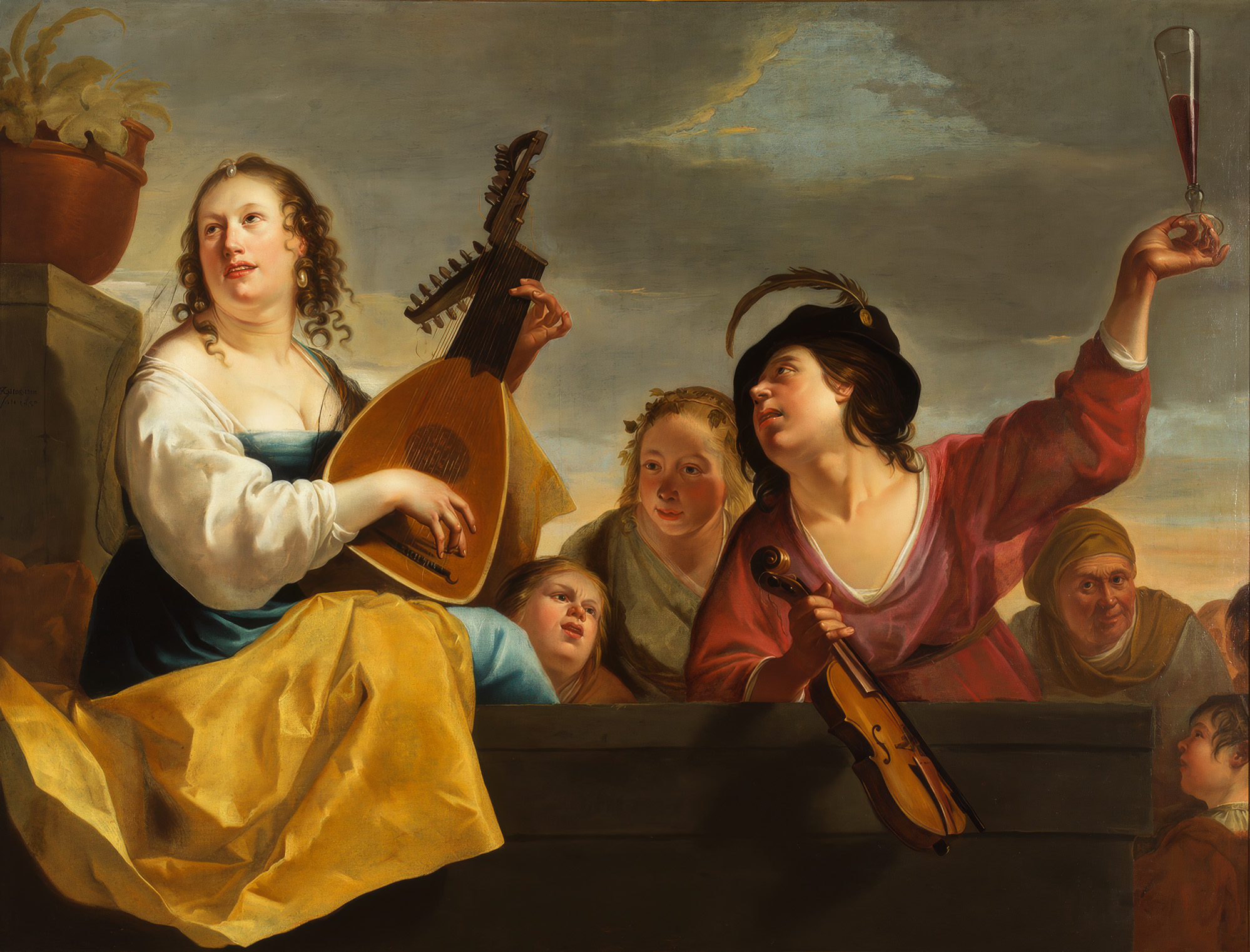
Company of Musicians, painted by Jan Gerritsz. van Bronchorst in 1646, belongs to the circle of Utrecht Caravaggisti active during the Dutch Golden Age. Trained under Cornelis van Poelenburch, the artist inherited an Italianate manner combining chiaroscuro with a keen sensitivity to texture and material, which he applied to genre scenes intended for Utrecht’s bourgeois clientele. Held at the Centraal Museum in Utrecht, the canvas exemplifies the Dutch taste for depictions of merry companies, in which music and wine sit alongside an implicit meditation on the passage of time. It places Van Bronchorst among the painters who, while also working as glass painters, helped disseminate Roman aesthetics throughout the Dutch Republic in the mid-seventeenth century.
Standing before this canvas, I find myself smiling: here is another joyful musical company, a genre I hold a particular fondness for within Dutch Golden Age painting. Everything is present: the singing, the instruments, the gathered company, the glass of wine being passed around. Van Bronchorst excels at rendering light: it caresses the faces, sets the satin and velvet fabrics shimmering, and lends each figure an almost tangible presence. I linger over the hands plucking the lute’s strings, over the knowing glances exchanged between the guests. These details speak of far more than a simple genre scene: they convey a way of life, a carefree spirit asserted in a Holland then at the height of its prosperity. One can easily picture the joyful din, the laughter, the music rising through the room. This is the very power of these paintings: they do not merely depict a moment, they carry us into it.
A fingernail brushes a lute string. The yellow silk catches the last light of evening. Jan Gerritsz. van Bronchorst sets down his brush, 1646.
Gesture and Light
Van Bronchorst builds the scene in layered registers: the woman with the lute in the foreground, the violin held out toward the viewer, the faces behind sunk into a golden half-light. The chiaroscuro, inherited from the Utrecht Caravaggisti, structures each plane without ever hardening the contours. The fabrics, yellow satin, deep red velvet, the drinker’s dark wool in the middle ground, occupy nearly as much space as the faces themselves. This attention to material betrays a training as a glass painter, accustomed to making colour glow through rigid lead. The violin extended toward us breaks with classical composition. It opens the scene to the viewer, like an invitation to step inside the painting.
Utrecht, Between Rome and the North
In 1646, Utrecht remained a Catholic stronghold within the Protestant Dutch Republic, open to Roman influence through a generation of painters who had travelled to study in Italy. Van Bronchorst, trained under Cornelis van Poelenburch, inherited this double perspective: Italian in its light, Dutch in its subject. Musical companies, much sought after on the bourgeois market, often served as a pretext for a quiet meditation on the passing of time. The fixed smiles on these faces do not tell us whether to read them as joy or as its reverse. Van Bronchorst paints revelry with the precision of a craftsman of the sacred, as though profane merriment demanded the same rigour as a church window.
News
The Centraal Museum, which holds Company of Musicians, devotes its flagship 2026 programme to another leading figure of the Utrecht Golden Age school, Gerard van Honthorst (1592–1656), with the very first monographic retrospective ever devoted to the artist, in the city where he was born and died. Like Van Bronchorst, Honthorst belongs to the generation of Utrecht painters shaped by their time in Rome and by Caravaggio’s influence, an essential context for situating Company of Musicians within its era.
Source: Centraal Museum
A Question for You
Following the classic symbolic reading of the Dutch Golden Age, in which music evokes harmony as much as its own disappearance in the instant it is heard, which instrument in this canvas would you say carries the greatest weight of meaning: the lute, the violin, or the raised glass?
Share your thoughts in the comments!
About This Work
- Company of Musicians
- Jan Gerritsz. van Bronchorst
- 1646
- Oil on canvas
- 149.1 x 192 cm
- Centraal Museum, Utrecht
- https://collectie.centraalmuseum.nl/details/collection/9578