Paris, 1882. Manet is sixty years old. Illness is consuming him, but his brushes still tremble with life. He seizes a bouquet, a few cut flowers in a crystal vase. A humble motif. A devastating work.
Light Held Captive in Glass
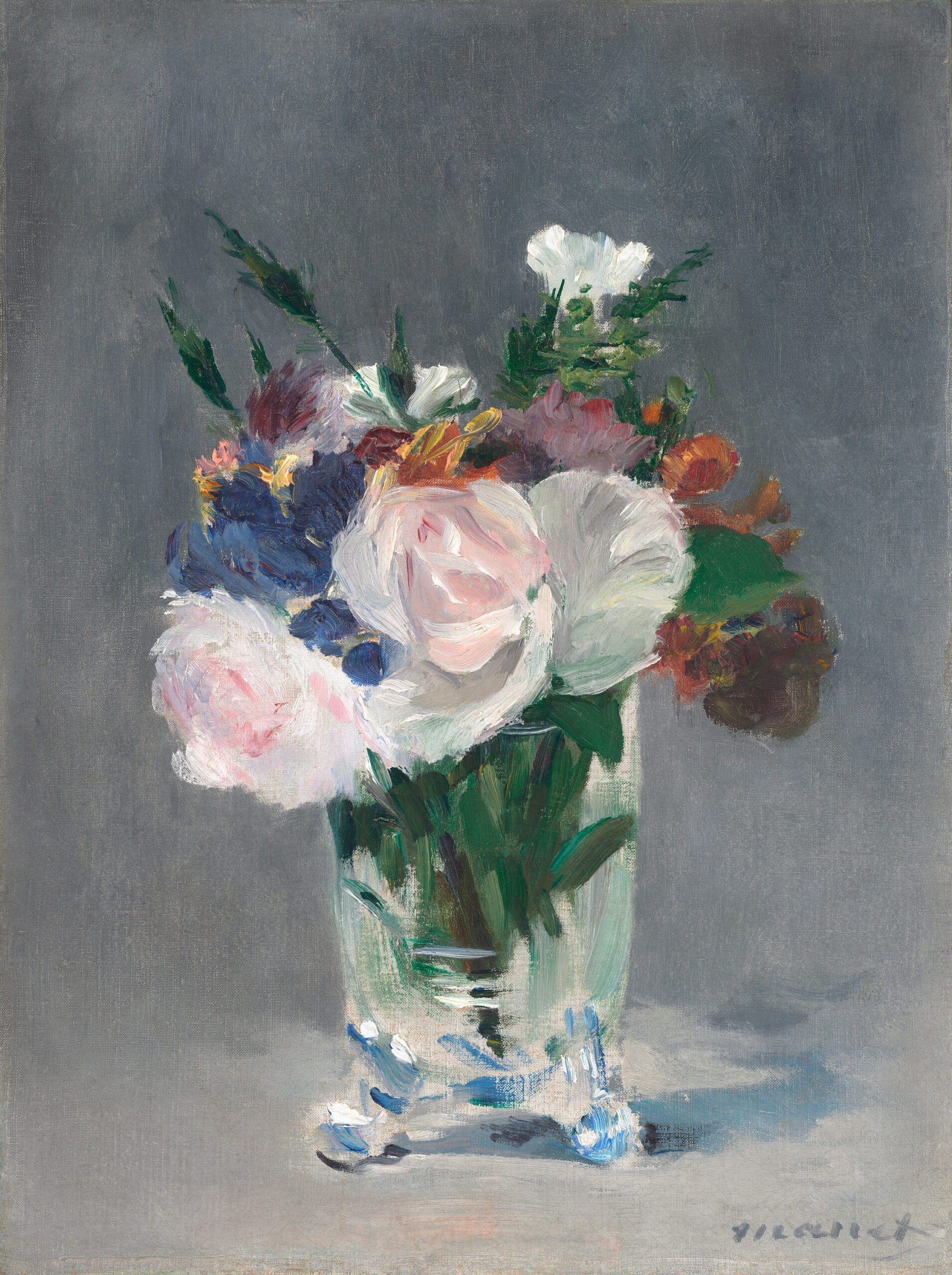
Look at this straight-sided vase resting on its small round feet. Crystal breathes through the paint, blue touches, white reflections, a cast shadow to the right. The pictorial matter plays. Thick over the roses, it lightens elsewhere, almost airborne. Large white roses dominate, open, generous. Around them: rapid strokes of delphinium blue, marigold orange, butter yellow. Green stems plunge into foliage drowned in water. A pearl-grey background lets every colour breathe.
The Last Flowers of a Master
From 1880 onward, locomotor ataxia confined Manet to his home. He turned to floral still lifes, small, intimate formats, often given away as gifts. These bouquets are not exercises in style. They are an act of resistance. Manet condenses everything into them: his direct touch inherited from Velázquez, his avowed modernity in the face of academicism, his love of the motif caught on the spot. In the Paris of the 1880s, between triumphant Impressionism and bourgeois Realism, these flowers embody a third way, that of a painter who kept inventing until the very end.
Manet, the Man Behind the Brush
Édouard Manet (1832–1883) upended French painting from Le Déjeuner sur l’herbe onward in 1863. Neither truly Impressionist nor academic, he forged a radically modern pictorial language. These flowers distil his genius entire.
A Question for You
💭 These flowers will be dead within days. Manet knows it. And yet, look how they live. What other work in the history of art gives you that same sense of urgency in the face of fragile beauty?
About this work
- Flowers in a Crystal Vase
- Édouard Manet
- c. 1882
- Oil on canvas
- 32.7 × 24.5 cm
- National Gallery of Art, Washington
- https://www.nga.gov/artworks/52181-flowers-crystal-vase
The Late Bouquets: A Practice of Giving
Flowers in a Crystal Vase (c. 1882) belongs to the series of small bouquets that Manet painted in the final years of his life, when the locomotor ataxia that had been affecting him since 1879 significantly limited his mobility. Increasingly confined to his studio, he turned to subjects that allowed him to paint seated, without displacement: flowers arranged in crystal or faience vases, brought by friends or purchased at the market. These bouquets, roses, peonies, clematis, lilacs, were often given as gifts after being painted. The small-format canvas (32.7 × 24.5 cm) is held at the National Gallery of Art in Washington. The directness of the brushwork, the light filtering through the glass, and the barely sketched white and pink flowers all bear witness to a technical freedom that Manet reached by releasing himself from any monumental ambition.
The Legacy of Velázquez in Direct Painting
Manet never concealed his debt to Velázquez, whom he considered the greatest painter in history. Direct painting, setting down the right colour in one go, without overpainting or successive glazes, is one of the lessons Manet took from the Spanish master. In the late-period bouquets, this method achieves its most refined form: few layers, no visible underdrawing, a construction through chromatic patches that suggest form without entirely describing it. Flowers in a Crystal Vase embodies this economy of means: the glass is rendered by a few precisely placed reflections, the petals are barely differentiated from one another, and yet the whole vibrates with an immediate luminous presence.