Key facts
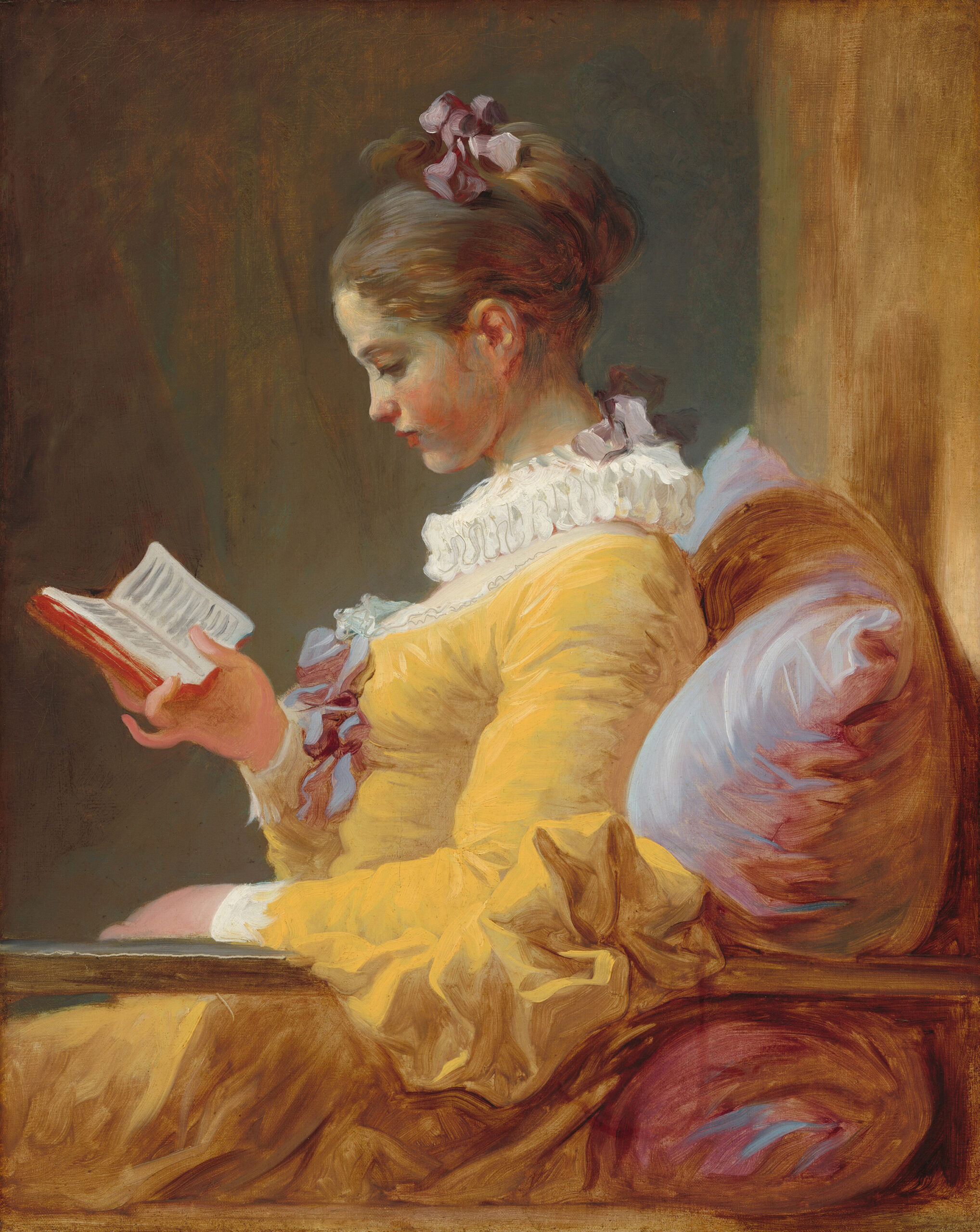
Painted around 1769 by Jean-Honoré Fragonard (1732–1806), Young Girl Reading is held at the National Gallery of Art in Washington, D.C. The painting belongs to the series of “fantasy figures,” costumed portraits executed with remarkable speed and emblematic of French Rococo. Imaging analyses carried out by the museum, published in 2015 in The Burlington Magazine, uncovered an earlier composition in which the sitter faced the viewer. Fragonard then repainted her in profile, absorbed in her reading. This change of composition made it possible to link the work to the series. The canvas displays the free, visible brushwork that sets the painter apart from his contemporaries.
This is one of Fragonard’s “fantasy figures,” costumed portraits he dashed off at astonishing speed. It is even said that some canvases in the series bear the inscription “painted in one hour” on the back. Their sitters were most often friends or acquaintances of the painter. We have already looked at Fragonard’s The Warrior here, another figure from this series. I find this young girl reading brighter and more colorful: the yellow of the dress, the pink cushion and the background bathe the whole canvas in a soft light. The painter’s dexterity is remarkable. With just a few brushstrokes, he captures his subject and renders her costume with elegance and liveliness. The collar and sleeves seem flung onto the canvas in a single gesture, and yet everything holds together. I love this side of Fragonard, freer and more spontaneous than the painter of gallant scenes. This painting also has a feature that moves me: analyses by the National Gallery of Art showed that Fragonard first painted the young woman facing us. He then reworked his canvas to show her in profile, absorbed in her reading. This change transforms everything: instead of a sitter posing, we catch a moment of intimacy. That is probably why I find the rendering of her face so delightful. In this peaceful profile, at once focused and dreamy, lies all the tenderness Fragonard was capable of.
You are standing before a hand. Pink, barely curled, it holds the red edge of a small book. Come closer. The flesh is built from a handful of strokes. The pages are nothing but grey scratches, illegible. You can already feel the speed of the hand.
What Young Girl Reading Tells Us
Look at the ruff. Its folds are not painted, they are carved. Fragonard drags the handle of his brush through the still-wet paint. The same groove runs across the bodice. The yellow dress advances in broad flows of unmixed color. The cushion swells with pink, lilac and bright whites. The face barely blushes beneath a shower of quick strokes. Everything here is gesture, thickness, matter that catches the light coming from the left. And yet the young girl does not move. An oil on canvas painted at a gallop to capture the stillness of a moment of reading.
What the Era Tells Us About Fragonard
Around 1769, Fragonard produces one “fantasy figure” after another. Friends and patrons pose in elaborate costumes, turned toward the viewer. So did this reader, originally. A drawing that resurfaced at a Paris auction lines up sketches of the series, hers included. Teams at the National Gallery of Art then examine the canvas closely. Near-infrared hyperspectral imaging and X-ray fluorescence mapping of mercury bring a first face to light, seen from the front. The Burlington Magazine publishes these findings in April 2015. The change does not erase the pose. It turns it toward the book.
Born in Grasse in 1732, died in 1806, Jean-Honoré Fragonard embodies Rococo painting. He is loved for his gallant scenes. These rapid figures reveal another painter, almost unrestrained, who lets the brushstroke speak.
News: The Fragonard Centenary, from Grasse to Paris
Autumn 2026 is a particularly rich season for Fragonard enthusiasts. To mark the centenary of the Fragonard perfume house, the Musée Jean-Honoré Fragonard in Grasse devoted an exhibition to the artist, Fragonard, The Beloved Child of Grasse, which closed on October 18, 2026. It brought together some thirty works, some never shown before, on loan from French and international institutions and private collections. It was curated by Carole Blumenfeld. The tribute continues in Paris: the Grasse-based house takes over the salons of the Monnaie de Paris from November 13, 2026 to January 10, 2027 with Fragonard, 100 Years of Collections and Craft. This heritage exhibition traces a story from the painter’s brushes to the perfume house’s bottles, and presents some pieces from the collections outside Grasse for the first time.
Source: Sortir à Paris.
A Question for You
A century before the Impressionists, Fragonard lets every brushstroke show: to your eyes, is this painting finished?
About this work
- Young Girl Reading
- Jean-Honoré Fragonard
- c. 1769
- Oil on canvas
- 81.1 × 64.8 cm (31 15/16 × 25 1/2 in.)
- National Gallery of Art, Washington, D.C.
- https://www.nga.gov/artworks/46303-young-girl-reading