Key facts
Autumn, painted by Corrado Giaquinto around 1740-1750, belongs to the rococo movement that flourished in Rome during the first half of the eighteenth century. Trained in Naples before settling in Rome and later in Madrid as court painter to Ferdinand VI, Giaquinto developed a style that would foreshadow that of Tiepolo. The canvas depicts Bacchus and mythological figures in an abundant landscape, an allegory of the autumn season. It originally belonged to a series of four allegories of the seasons, of which only Winter also survived; Spring and Summer are now lost. Held at the National Gallery of Art in Washington, the work entered the collection in 2001 as a gift from the Rizik family.
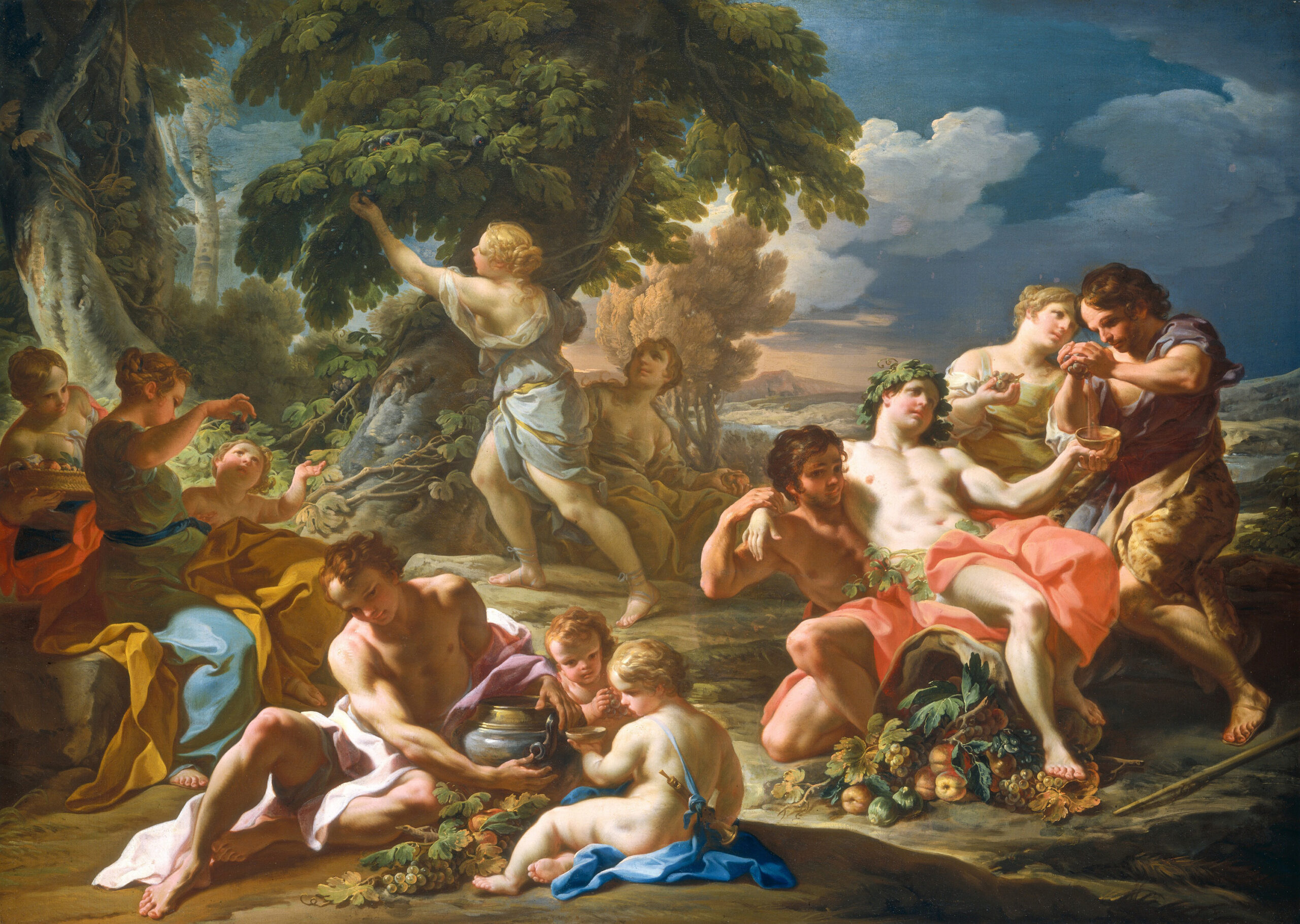
Autumn is an allegorical work that evokes the season through figures and a mythological scene. We see Bacchus, reclining, a crown of vine leaves on his head and a coral-red cloth knotted at his waist. He is being served grape juice by a bearded man wearing a cheetah skin, who presses grapes bare-handed above his cup. Around them, various figures: the men in the foreground take part in the feast, while women stand in the background.
I love this rococo treatment that stays simple and rich at once, all roundness and softness: the bodies are modeled without hardness, the gestures are slow, almost languid. Fruit and grapes abound, right down to a pile beneath Bacchus’s feet, as if the ground itself were overflowing with the harvest. All the light falls on Bacchus, who remains the central figure of the scene.
I’m struck by the treatment of the landscape, which fills nearly the left half of the canvas with dense trees and shrubs, while the right side opens onto hills and hazy mountains. The sky itself slides from a peach tone on the horizon to a twilight blue at the top, a gradient that gives the whole scene this end-of-day light, as if autumn were not just a season depicted, but a precise hour, the one when the light has just begun to fade.
Look at the hand of the man on the right. Two fingers press a grape, a drop falls into the cup Bacchus holds out. This tiny gesture is almost invisible within the composition. Yet it condenses the whole subject of the painting: the grape harvest turned into nectar, right before your eyes.
Autumn
Corrado Giaquinto painted this scene around 1740, at the height of his maturity, after leaving Naples for Rome in 1727. The glaze applied to the sky explains the smooth transition between peach and blue at the zenith. Several transparent layers, typical of Roman rococo colorito, let the light pass through the paint rather than fixing it in flat color. The same suppleness appears in the modeling of the flesh, built up through successive glazes rather than sharp contrast. Trained in Naples, Giaquinto developed a more restrained classicism in Rome. He later became court painter to King Ferdinand VI in Madrid. Autumn originally belonged to a series of four allegories of the seasons. Only Winter survived alongside it; Spring and Summer survive only through old photographs.
Corrado Giaquinto and His Time
Giaquinto was born in Molfetta, in the Kingdom of Naples, before moving to Rome in 1727. He established himself as one of the major representatives of Roman rococo of his time. His style directly foreshadows that of Giovanni Battista Tiepolo, who succeeded him at the Spanish court. The National Gallery, in fact, holds a canvas by Tiepolo from 1762, conceived as a direct echo of this legacy. Giaquinto died in 1766, four years after his return to Italy.
Nothing in the scene pins down the season precisely: no fallen leaves, no finished harvest. Only the title imposes autumn on a timeless bacchanal. It’s impossible to say for certain: is this really autumn, or abundance itself, dressed up for the occasion?
The Series of the Four Seasons
Autumn should not be read in isolation: it originally belonged to a complete allegorical cycle of the four seasons painted by Corrado Giaquinto in the 1740s, during his artistic maturity. Spring and Summer from this series have since disappeared and survive only as old photographs, while Autumn and Winter have come down through the centuries together and are both now held at the National Gallery of Art. The painting portrays autumn through a Bacchic scene: Bacchus and mythological figures reclining in a lush landscape, surrounded by grapes, figs, and an improvised wine press, in a languid atmosphere typical of the artist’s rococo style. Before entering the museum’s collection in 2001 as a gift from the Rizik family of Washington, the work passed through several New York galleries in the 1930s and 1940s and was exhibited in Birmingham (1931), New York (1932), Memphis (1938), and San Francisco (1941), a history that attests to its early recognition on the American market.
A Question for You
If you had to reconstruct the full cycle using only photographs of Spring and Summer, which clue would you look for first: the palette, the pose, or the plant motif?
About This Work
- Autumn
- Corrado Giaquinto
- c. 1740-1750
- Oil on canvas
- 108.4 x 151.5 cm (42 11/16 x 59 5/8 in.)
- National Gallery of Art, Washington, D.C.
- https://www.nga.gov/artworks/119006-autumn