Key facts
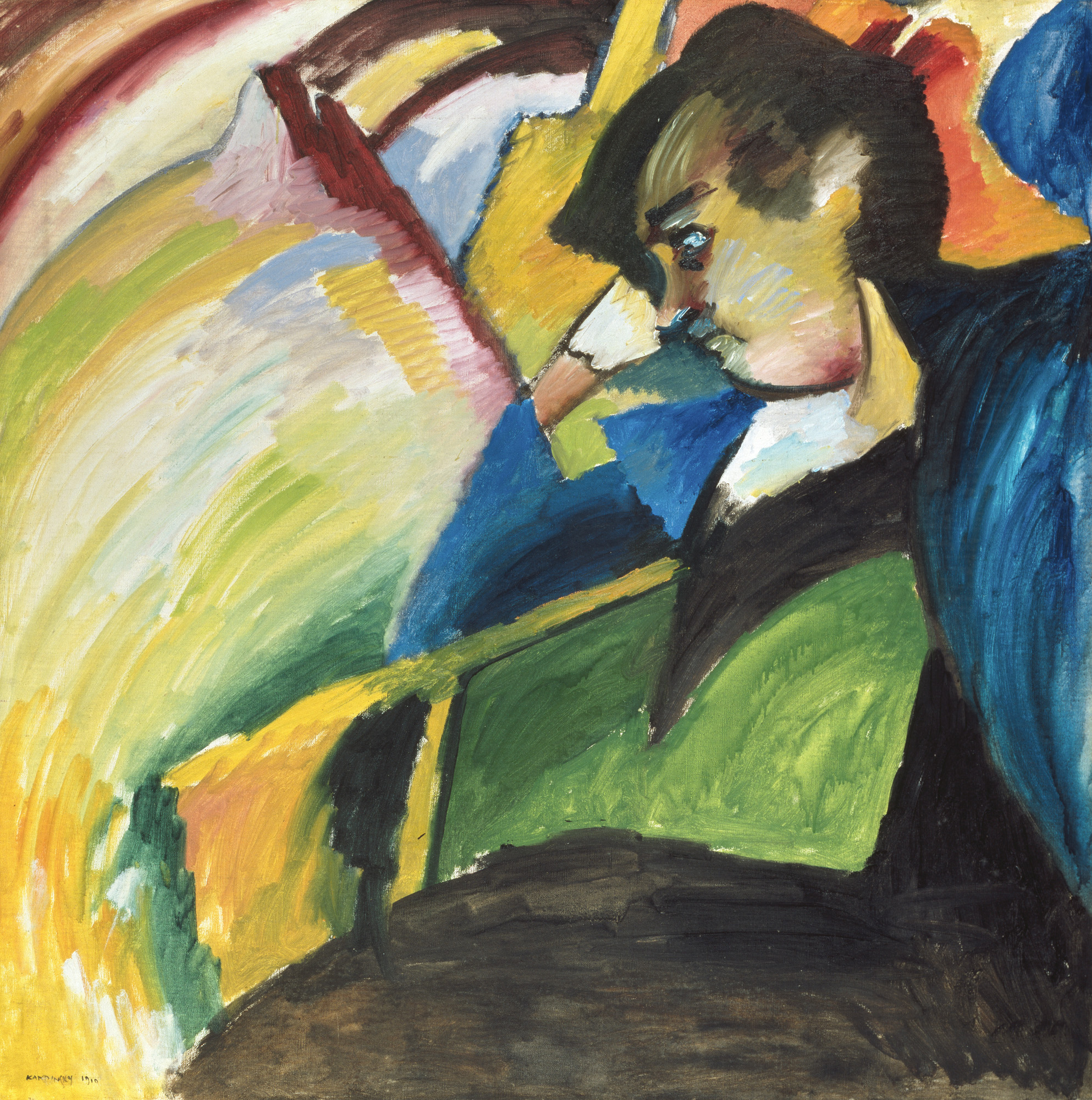
Lady (Dame) is an oil on canvas painted by Wassily Kandinsky in 1910. It is held at the Städtische Galerie im Lenbachhaus und Kunstbau in Munich, which received it in 1957 as part of Gabriele Münter’s donation. The artist himself inscribed the title on the back of the canvas, on the stretcher. The painting belongs to Kandinsky’s Munich period, just before the Blue Rider exhibitions of 1911 and 1912. Only the sitter’s face remains legible, while the rest of the composition resolves into arcs and masses of colour. It captures the moment when the painter slips from figuration towards abstraction.
We are clearly on the road to abstraction in this portrait: almost nothing but the figure’s face remains figurative, and everything else is already dissolving into colour. The body, the dress, the setting are no longer really described; they are suggested by patches and masses of colour that answer one another across the canvas. The colours are handled independently of representation. They are no longer there to imitate reality but to express something, and that is what fascinates me about this portrait. I love these bright, expressive colours, this dynamism of forms that creates a sense of movement, as if the figure were taking shape and coming apart before our eyes. This is far from a static portrait, and that is what I particularly love about this period of Kandinsky’s work. It is worth remembering that in 1910 he is in the midst of writing Concerning the Spiritual in Art, where he theorises precisely the power of colour to touch the soul directly, like music. When I look at Dame, I feel I am watching this theory being born: the face is still there, like a last anchor point, but you sense that soon nothing of the subject will remain. For me, that is the whole interest of this painting: it captures a period when Kandinsky is still navigating between two worlds, and I find this in-between moment just as moving as total abstraction.
Lady (Dame)
A dot of pure blue, ringed with black. It is the eye. Or rather, it is all that remains of a gaze. Look at the bowed head, dark, almost carved with a knife. Then let your eyes drift to the left. Yellow, green and pink arcs sweep across the canvas like a torn rainbow. A red band cuts through it diagonally. Below, a brown mass weighs down, heavy, motionless.
Kandinsky
Turn the canvas over, in your mind. On the stretcher, Kandinsky himself wrote: “KANDINSKY Dame (1910)”. So the title comes from the painter. It asserts a subject that the painting almost refuses to show. Look at the handling of this oil on canvas. On the left, the paint is thin, and the weave of the canvas shows through beneath the curves. Pinks and yellows are laid down in short, tight, parallel hatchings. On the right, by contrast, black outlines the forms with a heavy line. Two ways of writing coexist on the same square, just over a metre wide. One builds, the other dissolves. And yet nothing truly contradicts. We are in 1910, one year after Improvisation 3. The Blue Rider exhibitions have not yet taken place: they will be held in Munich in 1911 and 1912. The canvas entered the Lenbachhaus in 1957, with Gabriele Münter’s donation.
Feel
The title says “Lady”. The profile keeps its secret: short hair, white collar, dark jacket. Nothing confirms. Nothing denies. The figure leans towards something we cannot see. And the colour around it never stops. We look for the calm of a portrait. We find a whirlwind. Stay a moment before this vertigo.
News: the Blue Rider rehung in Munich
Since 10 March 2026 and until 5 September 2027, the Lenbachhaus is presenting a new display of its Blue Rider collection, Beyond the World (Über die Welt hinaus). It brings together more than 240 works and gives unprecedented prominence to the women of the movement, from Gabriele Münter to Marianne von Werefkin. Kandinsky has a room with midnight-blue walls devoted to his move towards abstraction, featuring major canvases such as Impression III (Konzert), Improvisation 19 and Improvisation Sintflut. This new hang is part of the preparations for the museum’s centenary in 2029.
Source: Lenbachhaus.
A question for you
Kandinsky readily compared painting to music. What if Dame were already a score? Which note would this bowed face play?
About this work
- Lady (Dame)
- Wassily Kandinsky
- 1910
- Oil on canvas
- 110.6 x 109.8 cm
- Städtische Galerie im Lenbachhaus und Kunstbau, Munich
- https://www.lenbachhaus.de/en/digital/collection-online/detail/dame-30004482