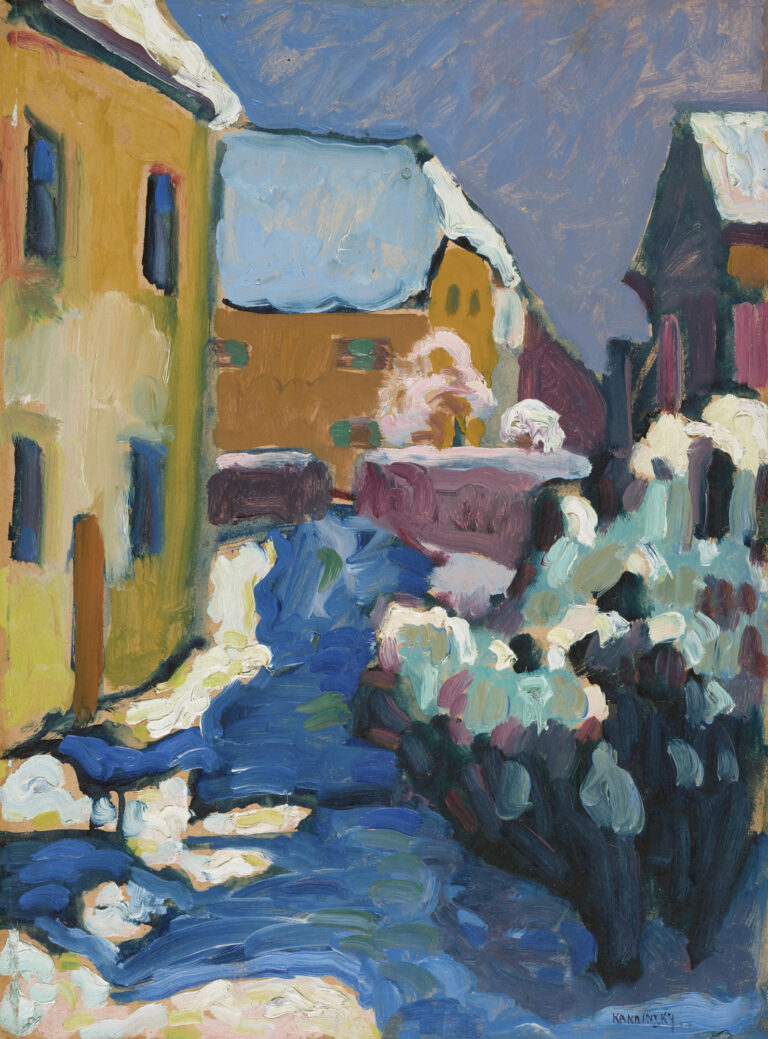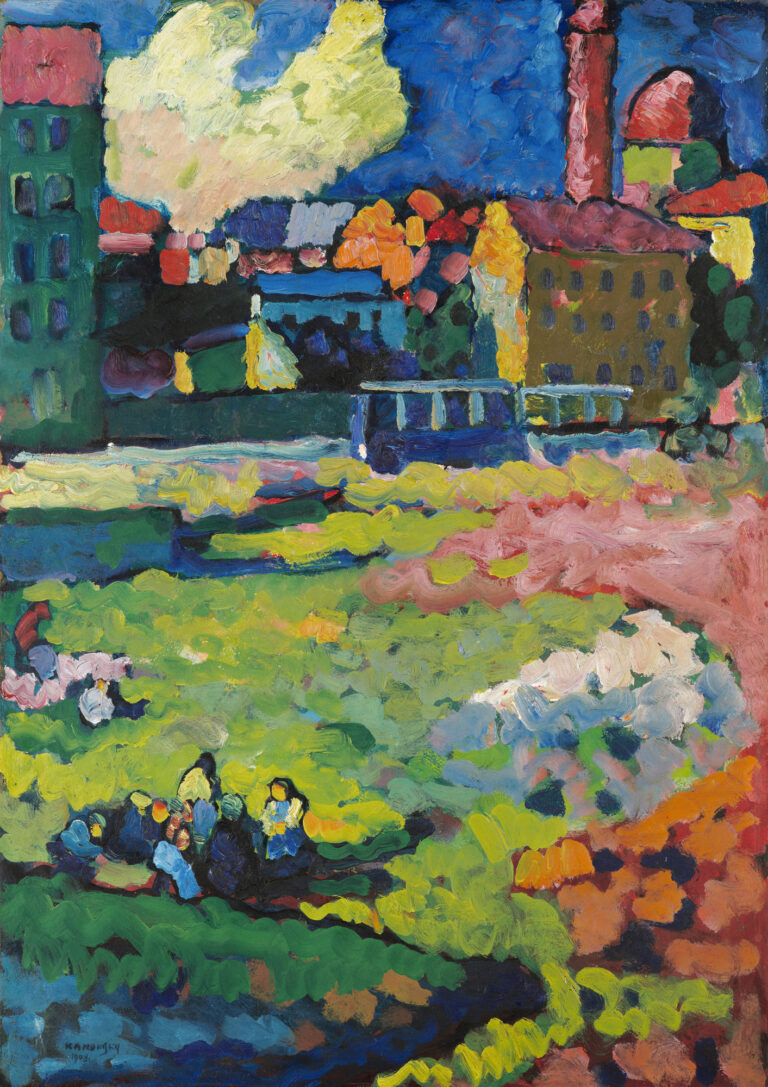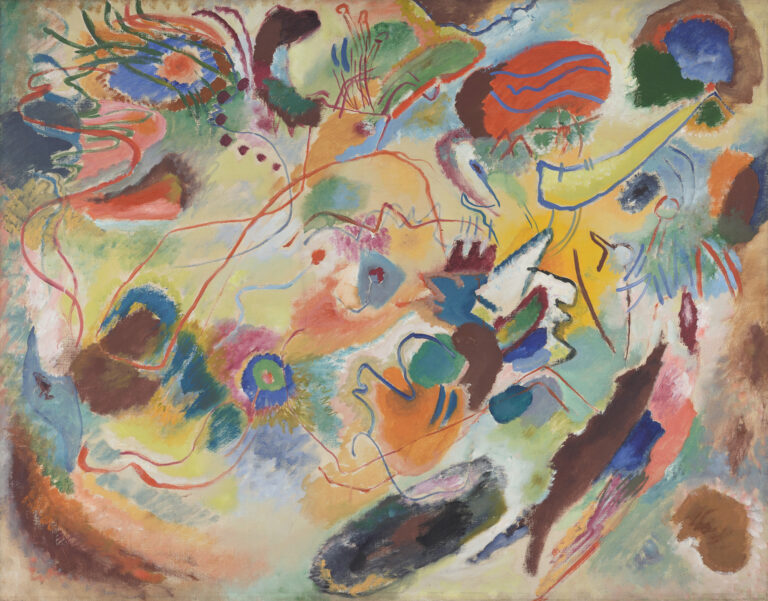
I never tire of Kandinsky. He is, for me, one of those rare artists who relentlessly seek to cast new light on their own artistic pursuit, perpetually questioning their achievements in order to press further still. What a trajectory: from the expressionist landscapes of his early Munich years to the most refined abstract compositions of his Parisian period.
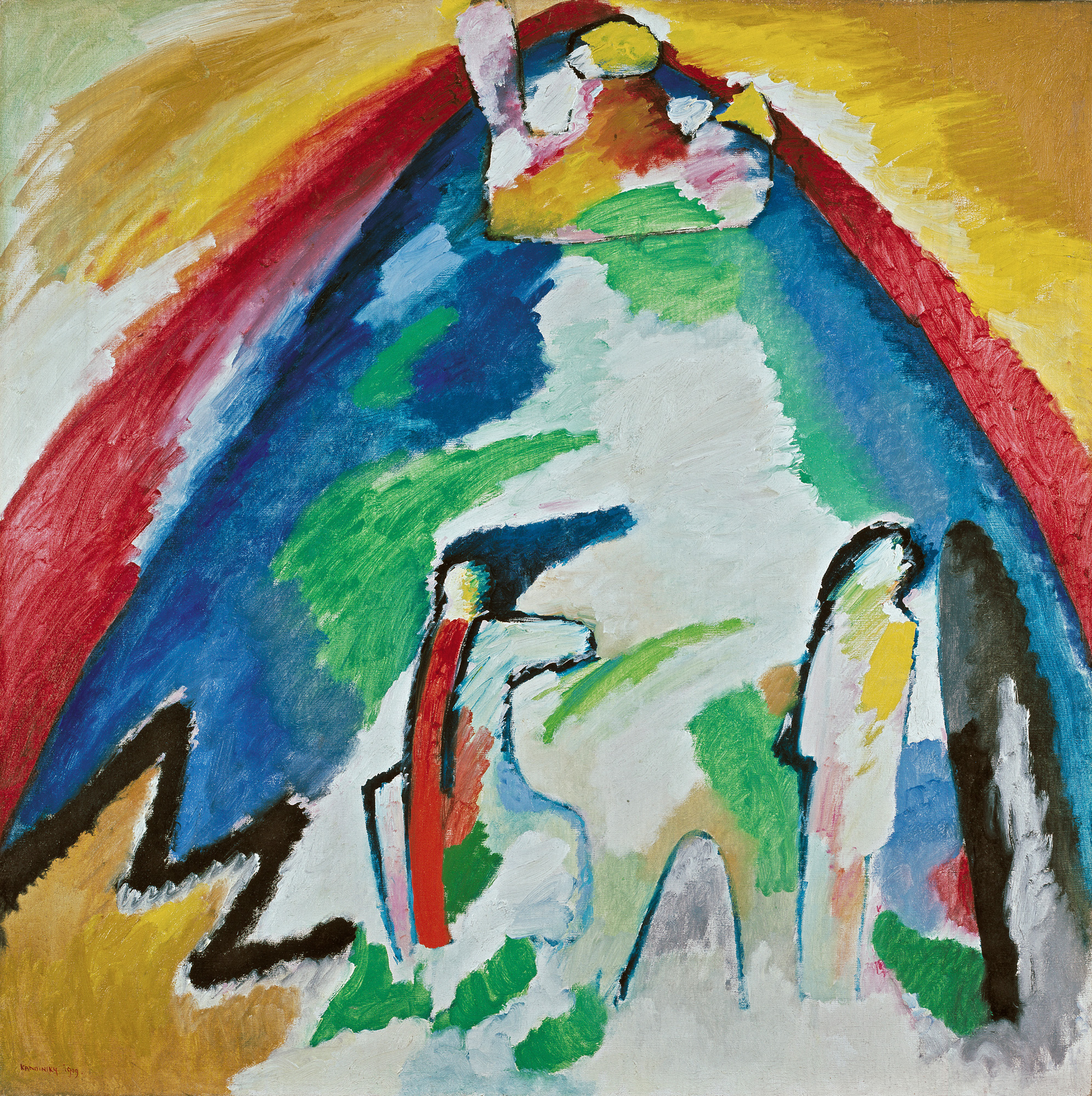
I am particularly drawn to the period of creation that led him to paint this Mountain. Intimately bound up with the emergence of the Blaue Reiter, it speaks of a vision of the world that no longer seeks to render the visible, but to reach beyond it, allowing an inner emotion, a spiritual reality, to surface where figuration alone cannot. The mountain is no longer a topographical motif. It becomes a pretext, a vibration, an impulse toward something beyond words. It is precisely this shift, between representation and sensation, that makes this work so arresting.
This is not a landscape. Or rather, it is no longer quite a landscape. Mountain (1909) belongs to Kandinsky’s pivotal Murnau period. It is held at the Lenbachhaus in Munich, home to the world’s largest collection of the Blue Rider.
Formal and Technical Analysis
The square canvas asserts an immediate physical frontality. Red encircles the composition like warmth felt against the skin. Blue descends, dense and weighted, from the summit. The green flank tears open into white. Look low: two figures barely emerge, a rider, and a form facing him. High above, fragmented shapes suggest a dome, perhaps the remembered outline of the Kremlin. The handling is broad, urgent. The oil retains the imprint of the gesture. Kandinsky works here at the confluence of two practices he had kept separate: the study from nature and figurative painting. Mountain is the first time they merge on a large-scale canvas. What the brushstroke gains in freedom, the motif loses in legibility. And it is precisely there that something begins.
Historical and Artistic Significance
In 1909, the Blaue Reiter does not yet formally exist. Yet Mountain already carries its philosophy. For Kandinsky, blue is the quintessential celestial colour. Red bears a resolute energy. White is not empty, it is a silence charged with possibility. The figurative forms persist, rider, mountain, dome, but they waver. They stand on the verge of dissolving into pure colour. The tension between figuration and abstraction does not resolve. It remains open, like a question addressed to painting itself.
Vassily Kandinsky (1866–1944), Russian-German painter and co-founder of the Blaue Reiter in 1911, stands as one of the founding figures of abstract art. Mountain predates that historic turning point by two years.
A New Vision for the Blue Rider at the Lenbachhaus
Since 10 March 2026, the Lenbachhaus has been presenting Beyond the World. The Blue Rider, an ambitious rehang of its Blue Rider collection, enriched with new acquisitions and on view until September 2027. Mountain holds a pivotal place within it: it marks the precise moment at which Kandinsky tilts toward what will become the movement.
Learn more about the exhibition
A question for you
💭 Cézanne had already reduced the Mont Sainte-Victoire to its essential planes. Kandinsky paints his mountain six years later, and yet, were they still speaking the same language?
About this work
- Mountain
- Wassily Kandinsky
- 1909
- Oil on canvas
- 109 × 109 cm
- Städtische Galerie im Lenbachhaus und Kunstbau, Munich
- https://www.lenbachhaus.de/en/digital/collection-online/detail/berg-30018932